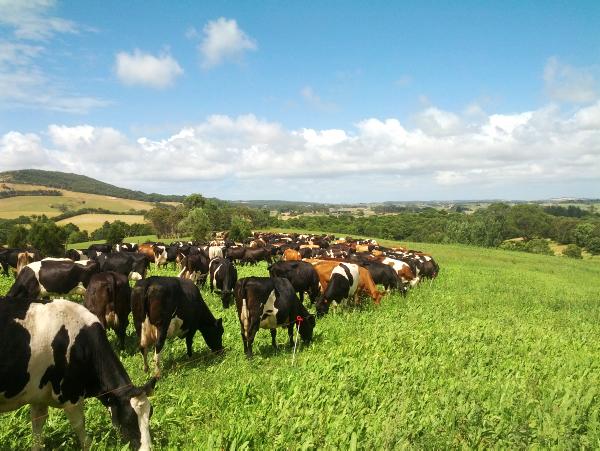
Graeme Nicoll milks 310 crossbred cows on a 95ha milking platform and farms 200ha of grassland in total in south Gippsland in Victoria, Australia. Like many Irish dairy farmers, Graeme is excited about increased global demand for dairy products but is also aware that price volatility is likely to be a huge challenge.
Unlike Irish farmers, Graeme has access to the Farm Management Deposit Scheme (FMDS), which allows him to control how volatility affects his business. The FMDS is a taxation scheme introduced by the Australian government in 1999. It allows farmers to set aside pre-tax income in good financial years and keep the money in a special savings account to be used as needed in the future. This means farmers can tax-efficiently set aside money in good years to create a fund for when farm profit is reduced due to increased costs, a drop in milk price, or both.
Graeme explained to me what the system means to Australian dairy farmers: “The main purpose of the FMDS is risk control, not reduced tax. In a good milk price year I can deposit income into an account and know that in a poor milk price year I can draw it back down. This means I am not worried or stressed about when milk price drops as I have income saved, ready for this. I am in full control of my business. If anything you then embrace volatility – you make as much money as you can when milk price is good and then you know you have this to fall back on when price drops. It was a fantastic move by the Government to make the scheme available to farmers.”
Graeme’s strategy is to always have at least a full year’s interest repayment stored in a FMDS account. He also outlined how the FMDS helps him manage his business better, especially in lower profit years. Graeme said: “In a poor milk price year because you have income saved, you farm the year as it comes and don’t try and cut corners everywhere which could well cost your business more in the long term. We have had years where profits were down but that never stopped me reseeding poor grass growing fields or spreading capital fertilizer as I had a backup income in place with the FMDS.”
Low profits
To date Graeme hasn’t had to draw money out of his FMDS funds for any specific crisis, just to compensate for low farm profit years. Income from other years was then pulled in to smooth the difference.
He said: “You draw down the money when profits aren’t as good to help support the business. There is a tax benefit to this also which again gives farmers the chance to manage their own financial futures and is an extra motivation to put money away in the high income years.”
The state of Victoria produces nearly half of Australia’s milk and Graeme explained that the climate is not drastically different to Ireland – his farm typically gets 1,000ml of rain annually and grows on average 11.5-12tDM/ha of grass per year. However, the region does get periods of extreme heat and when I spoke to Graeme last week they had just had five days of greater than 40°C temperatures and grass was really suffering.
Graeme explained that a dry spell like this is seasonally normal and the business has to be able to cope with different challenges. He said: “Cows are heading for late lactation now and are getting silage and wheat every day. Drought is something we are used to dealing with and milk price is good so we are not too worried.”
On average Graeme feeds 1.6t of meal per cow but he highlights how grain is relatively cheap in Australia with the large national production.
Periods of poor grass growth like what’s being experienced currently also means increased levels of meal feeding. Production from Graeme’s mainly crossbred herd typically averages around 510kgMS/cow.
Another risk control method Graeme uses is varying the number of cows milked depending on how the year is looking in terms of milk and feed price.
He said: “We can vary herd number by 10-15% dropping down to 270 cows if it looks like a tough year or increasing up to 330 cows if a very good year is forecast. Managing and reacting to risk is crucial for Australian dairy farmers and managing volatility properly is something I think European farmers have a lot to learn about when quotas go.”
Matt Reid also farms in the state of Victoria but his farm is located nearly 400km from Graeme Nicoll near Carlisle River. He moved to this farm with his parents in 2003 and has since expanded the farm through land purchase from 400 cows initially to over 750 cows today.
Much of this expansion was financed by borrowed capital and so, with repayments to make, Matt hasn’t had a lot of spare cash to put in the FMDS to date. He explained how the FMDS suits established farms better as it’s easier for them to put money aside.
“When businesses are expanding there is always plenty of development work to be done and it’s very difficult to put cash away. However in 2007/08 when milk price was excellent we deposited nearly €100,000 and had this as a safety net when 2009 hit. Without it we would have had to rely a lot more on expensive merchant credit and cut costs such as meal fed which you really can’t if grass growth drops off.
“The FMDS smooths out the peaks and troughs in volatility and makes your business more resilient. The amount of extra stress trying to get buy in a year like 2009 would be a huge burden if we didn’t have money put away in the FMDS.”
Since the start of the FMDS in 1999, farmer uptake has increased hugely and today, across all primary farming activities in Australia there is over $3bn worth of income saved in special savings accounts.
Matt believes uptake of the scheme has increased in recent years as the peaks and troughs of volatility are happening closer together and businesses need to be better prepared.
He said: “We are trading on a global market and it’s hard to know what milk price will do in any one year with variations in harvest yield around the world.
“Having a backup fund in place is crucial and the Australian government has helped us put this in place for ourselves.”
DAIRYING IN VICTORIA
Many farms in North Victoria irrigate their farms whereas most farms in south Victoria rely on seasonal rainfall.Grass growth in spring can hit levels of 120kgDM/day and farmers conserve as much of this as possible to have feed during droughts and over the winter.Average herd size is 250 cows.Cows calve from July to September (spring in Australia)Milk price can vary dramatically and dropped by 11% between the 2011/12 and 2012/13 season from $5.52 /kgMS (€3.64/kgMS) to $4.90/kgMS (€3.23/kgMS).
Graeme Nicoll milks 310 crossbred cows on a 95ha milking platform and farms 200ha of grassland in total in south Gippsland in Victoria, Australia. Like many Irish dairy farmers, Graeme is excited about increased global demand for dairy products but is also aware that price volatility is likely to be a huge challenge.
Unlike Irish farmers, Graeme has access to the Farm Management Deposit Scheme (FMDS), which allows him to control how volatility affects his business. The FMDS is a taxation scheme introduced by the Australian government in 1999. It allows farmers to set aside pre-tax income in good financial years and keep the money in a special savings account to be used as needed in the future. This means farmers can tax-efficiently set aside money in good years to create a fund for when farm profit is reduced due to increased costs, a drop in milk price, or both.
Graeme explained to me what the system means to Australian dairy farmers: “The main purpose of the FMDS is risk control, not reduced tax. In a good milk price year I can deposit income into an account and know that in a poor milk price year I can draw it back down. This means I am not worried or stressed about when milk price drops as I have income saved, ready for this. I am in full control of my business. If anything you then embrace volatility – you make as much money as you can when milk price is good and then you know you have this to fall back on when price drops. It was a fantastic move by the Government to make the scheme available to farmers.”
Graeme’s strategy is to always have at least a full year’s interest repayment stored in a FMDS account. He also outlined how the FMDS helps him manage his business better, especially in lower profit years. Graeme said: “In a poor milk price year because you have income saved, you farm the year as it comes and don’t try and cut corners everywhere which could well cost your business more in the long term. We have had years where profits were down but that never stopped me reseeding poor grass growing fields or spreading capital fertilizer as I had a backup income in place with the FMDS.”
Low profits
To date Graeme hasn’t had to draw money out of his FMDS funds for any specific crisis, just to compensate for low farm profit years. Income from other years was then pulled in to smooth the difference.
He said: “You draw down the money when profits aren’t as good to help support the business. There is a tax benefit to this also which again gives farmers the chance to manage their own financial futures and is an extra motivation to put money away in the high income years.”
The state of Victoria produces nearly half of Australia’s milk and Graeme explained that the climate is not drastically different to Ireland – his farm typically gets 1,000ml of rain annually and grows on average 11.5-12tDM/ha of grass per year. However, the region does get periods of extreme heat and when I spoke to Graeme last week they had just had five days of greater than 40°C temperatures and grass was really suffering.
Graeme explained that a dry spell like this is seasonally normal and the business has to be able to cope with different challenges. He said: “Cows are heading for late lactation now and are getting silage and wheat every day. Drought is something we are used to dealing with and milk price is good so we are not too worried.”
On average Graeme feeds 1.6t of meal per cow but he highlights how grain is relatively cheap in Australia with the large national production.
Periods of poor grass growth like what’s being experienced currently also means increased levels of meal feeding. Production from Graeme’s mainly crossbred herd typically averages around 510kgMS/cow.
Another risk control method Graeme uses is varying the number of cows milked depending on how the year is looking in terms of milk and feed price.
He said: “We can vary herd number by 10-15% dropping down to 270 cows if it looks like a tough year or increasing up to 330 cows if a very good year is forecast. Managing and reacting to risk is crucial for Australian dairy farmers and managing volatility properly is something I think European farmers have a lot to learn about when quotas go.”
Matt Reid also farms in the state of Victoria but his farm is located nearly 400km from Graeme Nicoll near Carlisle River. He moved to this farm with his parents in 2003 and has since expanded the farm through land purchase from 400 cows initially to over 750 cows today.
Much of this expansion was financed by borrowed capital and so, with repayments to make, Matt hasn’t had a lot of spare cash to put in the FMDS to date. He explained how the FMDS suits established farms better as it’s easier for them to put money aside.
“When businesses are expanding there is always plenty of development work to be done and it’s very difficult to put cash away. However in 2007/08 when milk price was excellent we deposited nearly €100,000 and had this as a safety net when 2009 hit. Without it we would have had to rely a lot more on expensive merchant credit and cut costs such as meal fed which you really can’t if grass growth drops off.
“The FMDS smooths out the peaks and troughs in volatility and makes your business more resilient. The amount of extra stress trying to get buy in a year like 2009 would be a huge burden if we didn’t have money put away in the FMDS.”
Since the start of the FMDS in 1999, farmer uptake has increased hugely and today, across all primary farming activities in Australia there is over $3bn worth of income saved in special savings accounts.
Matt believes uptake of the scheme has increased in recent years as the peaks and troughs of volatility are happening closer together and businesses need to be better prepared.
He said: “We are trading on a global market and it’s hard to know what milk price will do in any one year with variations in harvest yield around the world.
“Having a backup fund in place is crucial and the Australian government has helped us put this in place for ourselves.”
DAIRYING IN VICTORIA
Many farms in North Victoria irrigate their farms whereas most farms in south Victoria rely on seasonal rainfall.Grass growth in spring can hit levels of 120kgDM/day and farmers conserve as much of this as possible to have feed during droughts and over the winter.Average herd size is 250 cows.Cows calve from July to September (spring in Australia)Milk price can vary dramatically and dropped by 11% between the 2011/12 and 2012/13 season from $5.52 /kgMS (€3.64/kgMS) to $4.90/kgMS (€3.23/kgMS). 





SHARING OPTIONS