The current heatwave hitting Ireland can put significant stress on animals; ensuring animals have sufficient shade and ample water can reduce this stress.
For many farms, the current water infrastructure may be found to be lacking.
Two major factors will dictate if the current water system in place is fit for purpose or if modifications are required; trough size and flow rate of pipes.
Peak demand for water occurs at peak grazing time, which for dairy herds, is after each milking.
Teagasc suggests that up to 50% of the daily water intake of a cow occurs in the three hours after each milking.
For this reason, it may be worthwhile having a water trough situated as cows exit the parlour to reduce the pressure on the system in the paddock.
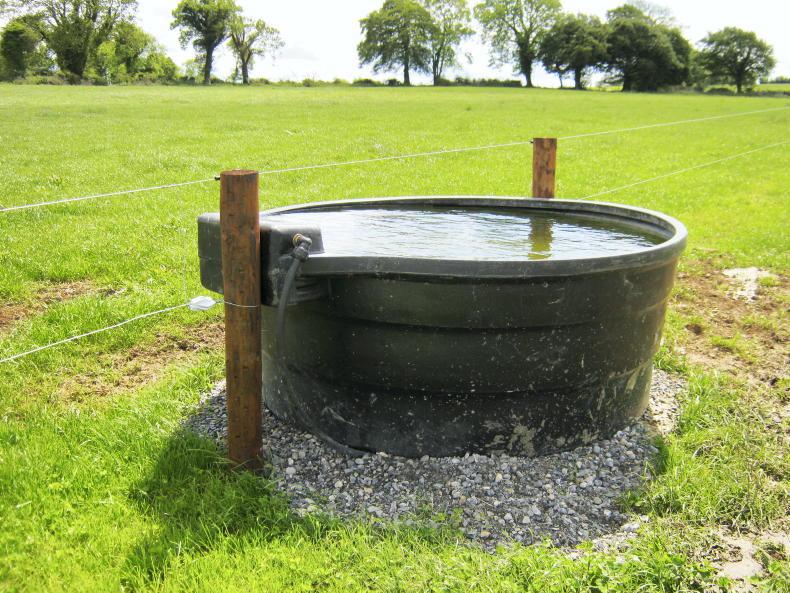
It is recommended that 10% of the herd are able to drink at the one time, with each cow requiring 450mm of trough space.
Capacity ratio
Typically, rectangular troughs have a greater perimeter: water capacity ratio compared to round or elliptical troughs.
A recommendation by Teagasc is for a trough capacity of nine litres/ two gallons per cow, equating to a 900-litre or 300-gallon trough for a 150-cow herd. Cows should never be more than 250m from a trough to encourage drinking.
For other livestock types (other than dairy cows) , a good rule of thumb is that for every 100kg of liveweight, an animal will drink approximately 15 litres water/day.
For lactating ewes with lambs, this will result in a water intake of 9-10 litres.
For drystock, a reduced rate of 7 litres/lu can be used to calculate trough requirements, eg, 25 suckler cows and calves= 25 cows @ 1.0 lu + 25 calves @ 0.4 lu x litres =245 litres/ 53.89 gallons.
Pipe diameter
A far more common issue with water supply on farms is inadequate pipe diameter, resulting in poor flow capacity.
As dairy herd sizes have increased, so to have milking platforms and the distance water must be piped.
The further the distance water has to travel through a pipe, the greater the loss of pressure due to friction between the water and the internal pipe surface.
For example, at a flow rate of 3m³ per hour (50 lit/min or 11gal/min) with a 32mm (1¼ inch) pipe, the pressure is reduced by 4.83psi for every 100 metres of pipe.
To determine flow rate in a trough, lift the ball cock, empty a fixed amount (eg, 50 litres) and time how long it takes the trough to refill.
A simple calculation will show the litres/minute flow rate. Where flow rate is inadequate, a larger diameter pipe can be installed.
For herds fewer than 150 cows, pipe diameter should be a minimum 25mm (1 inch), and for herds of 150-300 cows, this should rise to 32mm minimum (1 ¼ inches).
A 40mm (1 ½ inch) pipe should be installed for herds greater than 300 cows.
Pipes carrying water with a high iron concentration can also have a build up of iron – causing a reduced flow rate, especially where the PSI is lower than ideal. Where pipes are checked and found to have iron build ups, the likelihood is that they will have to be replaced.
Water pressure
Pressure can also be lost in pipes where the source (public scheme or private well) is lower than the destination, with each foot of a rise in the pipe leading to a drop in pressure of 0.433 PSI.
A 20ft rise will therefore lead to a drop in pressure of 8.66 PSI. Normally, pumps of private wells are set at 20/40, where the pump kicks in at 20 PSI and kicks out at 40 PSI, but where there is an issue with pressure loss due to elevation, then the pressure can be readjusted to 30/50.
Wells should not be in any danger of drying out due to the recent rainfall and short nature of this current heatwave, but narrow bore wells with a reduced reservoir of water should be monitored at peak water usage times all the same.
Where any issue has been observed above regarding insufficient pressure, trough size, pipe diameter etc, it is unlikely that this can be rectified quickly.
In this instance, setting up a second trough fed off of IBC tanks will go some way towards helping to ease the pressure on the system.