



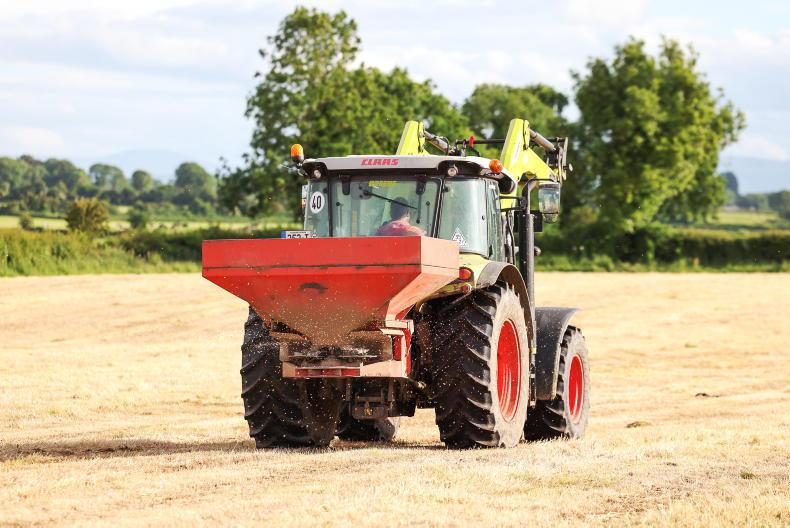
With no rain over the past ten to fifteen days and no more forecast in the coming ten days, many farmers are debating whether or not to go with fertiliser this week.
It’s important to point out in the beginning that there are two different scenarios in play. Farms in the Northwest of the country are in a very different position to those in the South and South East. Soil moisture is still plentiful in the Northwest, with soil moisture deficits still only between 15mm and 35mm.
The landscape in the other regions is very different, with SMD anywhere from 50mm up to 70mm according to Met Éireann.
Above 40mm growth is restricted, above 50mm it’s significantly restricted and over 75mm, there will be close to zero growth.
These numbers are important as they are a big factor in whether or not spreading fertiliser will be worthwhile. Other factors are growth rates, when rain is next forecast and if there was rain since the last spreading.
Dry farms
On farms with SMD over 50mm, there is little benefit in spreading nitrogen fertiliser now. The uptake is low and there is not going to be any rain to wash it in.
In recent days wind speeds are also up and many farmers have noted the lack of dew in fields. Without a dew, it makes it almost impossible for fertiliser to get down into the soil.
The only paddocks that may benefit from nitrogen are those ahead of cows where growth rates are still above 40kg/day. The heavier covers in these paddocks may hold some dew and the cow’s activity in the paddock may help to wash that fertiliser in.
Paddocks that were recently grazed are not going to respond to fertiliser as growth rates will be very low and spreading nitrogen will be a waste of product and money.
Recently reseeded paddocks will still be green on most farms and these will respond to nitrogen. Parlour washings are a good option for these paddocks to get some nutrient washed in.
Heavy farms
Farms on heavier soils won’t suffering the same moisture deficit problems. There is moisture in the ground, the issue on these farms is mainly with the lack of rain to wash the fertiliser in.
Again, it’s the paddocks ahead of cows which are best placed for spreading, as the dew and cow activity here will help with washing in.
On paddocks that were recently grazed it’s up to the individual to decide whether or not the paddock will respond to fertiliser.
If it’s a fresh sward reseeded in the past two to three years, there will be a response to nitrogen provided growth is still good.
Older swards that are struggling to grow will be better left until rain is forecast. Any paddocks that were spread with nitrogen since the last fall of rain should also not be getting any more nitrogen.
Parlour washings are an excellent option in this weather for all soil types as the nutrient has a vehicle of transport into the soil and this should be one of the first options when it comes to getting a fertiliser out.
Other nutrients
At this stage, all farms should be hopefully up to date with potassium (K) and sulphur (S) applications. These nutrients are important in helping the plant regulate water movement and tolerate stress in times of drought.
If the farm has not gotten enough of either product, spreading now will still offer a response. Total S applications for the year should be around 15 to 20 units/acre, while total K applications should be around 25 units/acre on grazing ground.
Like with nitrogen, if there has been no rain since the last compound fertiliser application, hold off on spreading until the rain comes.



SHARING OPTIONS