



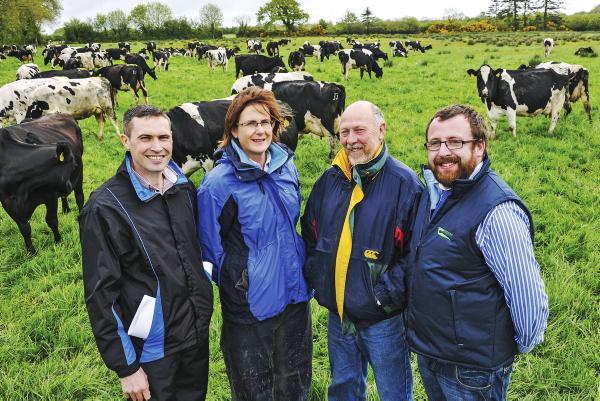
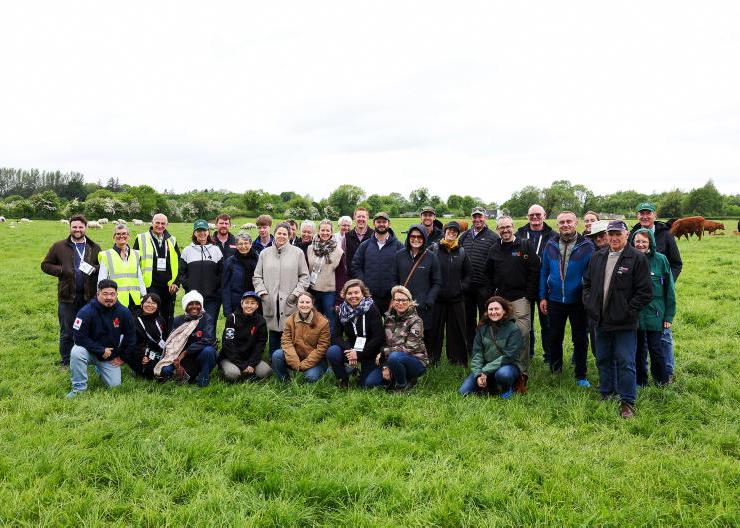
Teagasc recently held a ‘Fodder and Financial Planning’ workshop on the farm of Peter and Margaret Duggan, who are milking 157 cows on a 58.5ha grazing platform outside Kanturk in Co Cork.
The farm lies in the Duhallow region of north Cork, which has pockets of very heavy land. The fodder crisis hit hard in this area – from March to May this year purchased hay was required for feeding on many farms.
Peter is a progressive dairy farmer. He was one of the founding members of the Bottom-Line discussion group, formed nearly twenty years ago, and is determined to make the most from his grazing platform. The farm has a good network of farm roadways and 80% of the land has been drained over the last twenty years, although Peter acknowledges there is more to be done.
2012 posed some big challenges on the farm. In total, 73 inches (1.8 metres) of rain fell, which made grazing very difficult; some paddocks suffered poaching, reducing their production potential this year as a result.
The decision has been taken to reduce stock numbers dramatically this year before next winter. If all stock currently on the farm were carried over next winter, Peter’s winter feed budget indicates he would be short over 1,000 tonnes of fresh weight silage.
Destocking
Peter doesn’t see the destocking as an overly drastic option. He said: “By my nature I just don’t like selling stock but we are facing a considerable winter feed shortage and without destocking I would have to purchase huge amounts of feed. There are also other benefits. By culling poor performers I think I can increase the profit per cow generated from animals left on the farm, compensating for lower numbers.”
Last autumn as prices for dairy replacements were poor Peter held onto more heifers than he required over the winter. This spring, the Duggans calved down 173 cows and heifers.
Every year he has a reserve of silage and this year it lasted until the end of May, just as he finally managed to get cows back out to grass. Sixteen cows have since been sold and so 157 cows are now being milked.
More destocking is planned. The breeding season will be kept strictly to twelve weeks this year (88% of all cows were submitted in the first three weeks) and anything that doesn’t go in calf in this period will be culled.
Peter said: “I have 157 cows currently but only plan to carry 130 of these over the winter. By achieving a more compact calving season next year, I can produce more milk solids per cow which will help compensate for smaller numbers. With improved days in milk and a more mature herd, while numbers might drop 17% I think it could be possible that production and profit will drop less by dealing with better animals.”
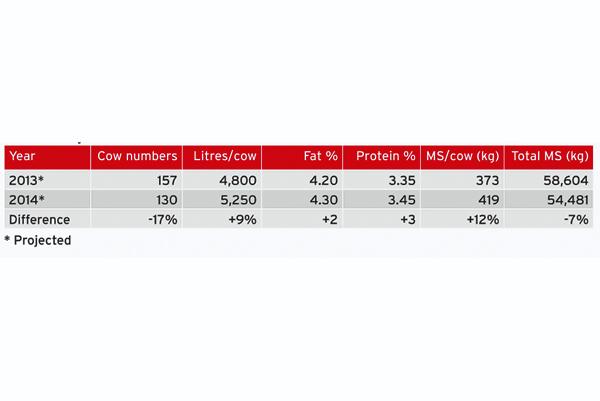
Table 1 shows Peter’s expected milk solids production for 2013 and projected milk solids production for next year when stocking rate will be lower and the herd more mature; this year 33% of the herd are first lactation. This will drop to 13% next year. He estimates he will still fill his milk quota with 130 cows.
Empty rates
Peter plans to breed from 147 cows in total this year. The other 10 have somatic cell count (SCC) issues and will be dried off, fattened and sold to the factory in the autumn. Assuming a 10% empty rate, 15 cows won’t go in calf, bringing Peter down to 132 cows. Another 10 poorer performing, older and later calving cows may also be culled, leaving room for 10 replacement heifers.
Peter has 60 heifers with the bull currently so he plans to sell the 50 he won’t need before the winter.
With good herd fertility and AI use, Peter could generate 50% of the herd in high EBI replacements (herd EBI is currently €144) in any one year. He has 60 heifer calves on the ground this year so doesn’t feel he is reducing his options by selling many of this year’s In-calf heifers.
Selling these heifers pre-winter will save him nearly 350 tonne of silage fresh weight over a five-month winter. Peter also keeps all male calves on an out-farm and finishes them as steers.
This year he plans to sell the 57 stores pre-housing which should save him 370 tonne of silage in total. These two options would leave Peter with a shortage of just over 300 tonnes of silage.
At the farm walk, Teagasc nutritionist Siobhan Kavanagh equated this to 48 tonnes of soya hulls which at current prices of €240/tonne would cost €11,520. Buying 300 tonne of silage at €35/tonne would cost €10,500 but feeding quality may not be as good as soya hulls, and silage availability next winter is also likely to be an issue.
Stocking rate
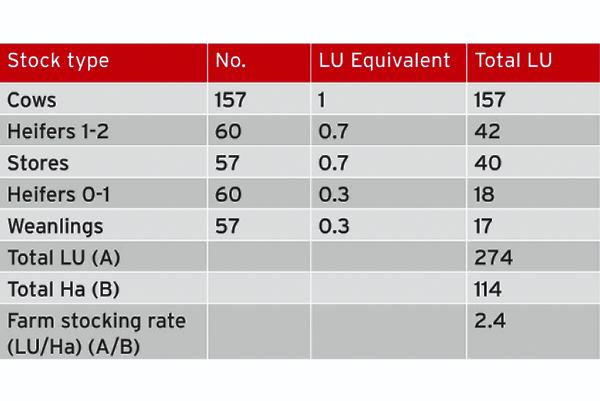
The long term question Peter must answer is what level of stock is sustainable to carry on his farm (both milking platform and out-farms). His current farm stocking rate (over all land farmed) is 2.4 Livestock Units (LU) and is broken down in Table 2.
A farm without a nitrate derogation can have a maximum whole farm stocking rate of 2 LU per hectare (170kgN/Ha). Farms in derogation can stock the farm up to 2.94 LU/ha (250kgN/ha as each LU excretes 85kg of N). A farm stocked higher than this must export slurry to someone that is under their nitrates regulation requirement. As each LU will require approximately five tonne of dry matter per year, Peter needs to ask himself how much grass he can grow per hectare and, based on this, how much stock he can carry.
This year total tonnage of dry matter grown per hectare is likely to be back at least one tonne per hectare on an average year. Some of Peter’s ground is now only just being grazed for the second time and may grow significantly less than this. He farms 114 hectares in total, so that means if he is down one tonne of dry matter per hectare, he is short 114 tonne of dry matter from grass this year over an average year.
As each livestock unit needs five tonnes, this means in 2013 the farm can support 23 less cows for the year.
Future Plans
With 58.5ha around the parlour, would Peter be tempted to push up stocking rate on the grazing platform, scrap the beef enterprise and bring in all silage from the outside block?
He thinks not: “Some of the ground around the parlour is just far too marginal to increase stocking rate further. 130 cows is realistically the maximum for this block of land.
“Currently 17ha is not possible to graze at all in the spring and is just cut for first cut in late May when ground conditions should be good and you won’t do any damage.
“It also means I get a heavier first cut which has been crucial in providing enough winter forage up to now. Some of the land is excellent but overall it just can’t be pushed as hard as drier farms.”
Peter feels a parlour on his 140-acre out-farm, which is much drier land, is the most likely expansion route. The current plan is to cut back numbers, increase efficiency and improve the current milking platform’s production potential with more drainage and reseeding.
KEY POINTS
Peter Duggan plans to cut cow numbers from 157 cows to 130 cows next year.
By culling poorer performers (high SCC, late calvers, etc.) he hopes that production won’t fall in proportion to cow numbers by working with a better quality herd.
Each cow or livestock unit equivalent on the farm requires five tonne of dry matter per year.
Reduced grass growth this spring will mean stocking rates will need to be reduced or extra supplementary feed bought in.
Tax implications of selling extra stock
If short winter feed many farmers will be considering destocking prior to winter housing. For some this will mean effectively selling two groups of stock in the one calendar year, eg calved heifers in spring 2013 and in calf heifers in autumn 2013.
Many have incurred colossal feed bills which will erode much of this extra income, but with milk price hitting new highs, exposure to a large tax bill could be an issue on larger scale farms.
IFAC accountant Martin Kennedy, who is based in Templemore, advises the following: “Tax planning depends very much on individual scenarios.
“A number of our clients would be on income averaging where the tax they pay is based on the average of the previous three years’ profits. This would reduce the tax implications of extra sales in any one year.
“Farmers planning for increased stock sales should consult with their tax advisers. A budget can be done up projecting income and expenditure for the rest of the year and the effect extra sales would have on taxation.
“Stock inventory change could also be an issue leading to extra taxation depending on the opening value used in the farmers’ accounts.”




SHARING OPTIONS