



The importance of the higher beef prices in 2025 and resultant increase in value of breeding stock is clearly evident in the financial performance of Tullamore Farm in 2025.
The farm generated a net profit of over €30,000 after all operating costs including land rent and labour were deducted, the first time in a number of years that this was achieved.
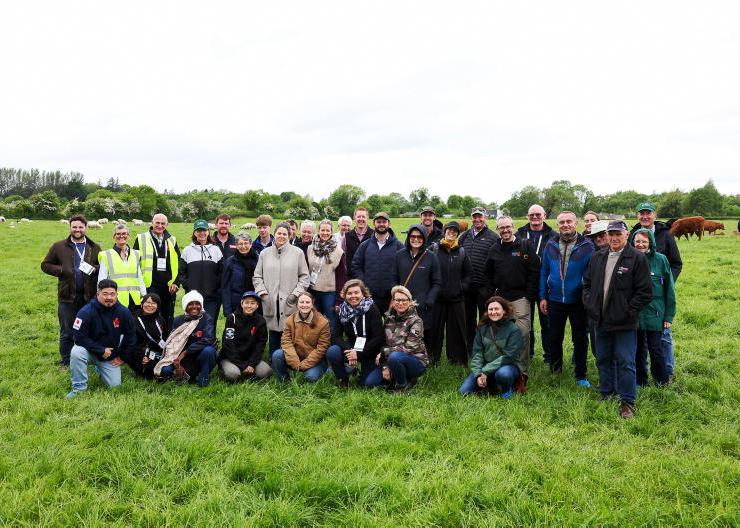
The figures were presented last week at a visit from farmers and industry stakeholders from Australia, New Zealand, the US, Canada, United Kingdom and Japan, as part of Ireland hosting the Nuffield International Triennial.
The financial performance is detailed in table 1. Cattle sales were boosted by 14 in-calf heifers and seven maiden heifers selling for an average price of €4,870 in October 2025.
The sale average was over €2,300 head higher than the previous sale held in 2023 with no sale held in 2024.
The lift in confidence from higher beef and weanling prices inserted much more life into the trade for replacement heifers of a high health status and possessing good Eurostar evaluations.
The beef price attained for cull cows was nearly €2/kg higher (€6.50/kg) while the fact that a percentage of 2024-born male progeny were sold for live export reduced the farm’s concentrate feed bill compared to the normal practice of finishing intensively under 16 months of age.
Sales income on the sheep side was up about 10% with the average lamb price recorded at €8.32/kg and the average sale price at €171.86 for lambs slaughtered.
There were also a small number of Easycare ram lambs sold at a value of €300 per head for breeding and ewe lambs sold live for breeding at about €165 to €170 per head.
The figures in Table 1 are broken down simply on a per-hectare basis, but if based on the area allocated to the cattle and sheep enterprise then the farm would have generated sales of almost €3,900/ha on the cattle side and over €2,000/ha on the sheep side.
The financial performance includes a number of scheme payments. There was a payment of €28,610 to cover the Basic Income Support for Sustainability (BISS), the Complementary Redistributive Income Support for Sustainability (CRISS) and the Eco Scheme.
While these payments are drawn down by the farm they are returned to the Grogan family (landowners) as per the terms and conditions of the 15-year lease. This is factored in to the figure of €64,749 for land rent, with 36,750 dedicated to land rent.
The Agri-Climate Rural Environment Scheme (ACRES) payment of €6,910 and payments totalling over €21,000 in the Suckler Carbon Efficiency Programme, the National Beef Welfare Scheme, the Sheep Improvement Scheme and the National Sheep Welfare Scheme are retained by the farm.
The big ticket items in terms of variable costs are contractor costs, veterinary, concentrate feed and fertiliser and lime. Contractor charges are likely higher than a typical farm of such size but this is influenced by a focus of streamlining labour input with approximately 1.3 labour units used across the year.
Veterinary costs have crept upwards in recent years in line with an increase in the cost of medicines. Veterinary costs are quiet high on the farm with an extensive vaccination programme on the cattle and sheep side accounting for the majority of the spend.
Seed and spray costs are allocated to the sowing of barley and the protein crop while silage and polythene costs is mainly polythene. The farm does produce its own source of straw which roughly halves its requirement but approximately 50 additional bales were purchased at a cost of €30/bale delivered to the yard.
The two big fixed expenses are labour costs of €80,000 and land rental cost of almost €65,000.
The labour costs includes all associated costs of hiring help including student heap at lambing/calving and casual help at busy times during the year.
As explained already, the land rental cost includes an agreement to return the BISS, CRISS and Eco Scheme payments to the landowners.
The majority of other costs are standard for such an enterprise as Tullamore Farm with the exception of professional fees. These are higher than the norm, but the farm is required to have additional auditing of finances carried out as per the requirements of the Agricultural Trust.
The profit margin is positive at €31,792. The reason why the capital expenditure is listed separately is due to the fact that spending on capital expenditure is split between Tullamore Farm and the Grogan family. The split was 60/40 Tullamore Farm/Grogan family for the first eight years of the 15 year lease and vice versa for the final seven years.
Unfortunately, financial performance projections completed for 2026 by IFAC and Tullamore Farm management team show the farm at best breaking even in 2026. These projections have factored in higher fertiliser and contractor charges while the veterinary bill will increase again on the back of a decision to vaccinate all breeding stock for the bluetongue virus. Green diesel costs will also increase.
The sales projections figures are broadly similar overall with a higher number of cattle potentially to sell offsetting a forecast reduction in the value of in-calf heifers and beef bulls. Sheep sales projections are unchanged.
If the farm manages to keep these costs in check then the financial performance would still be in a relatively positive position for a farmer who owned their lands and retained pillar I direct payments.
The projections at present are for the a reduction in net profit of about €35,000 meaning that the farm should hopefully cover the full €80,000 labour cost and land rent.
Getting back to current practices on the farm, manager Shaun Diver recently completed 40-day weighing of lambs born to mature ewes. The average daily gain of lambs was in the region of 300g daily.
This is back about 20g to 30g on last year’s performance, which is not surprising considering the challenging weather conditions in early lactation. It is hoped that seeing as sward quality is presently good, that lambs might compensate for lower performance in early lactation.
The batch of 20 bulls being finished in an under-16 bull beef system are approaching slaughter weight and will be weighed and assessed on body condition this week.
Performance appears to be good, with bulls developing a solid fat score ahead of a target slaughter date of early June.
Silage ground is bulking up well and a close eye is being kept on it to monitor grass heading out. The aim is to go for a bulky cut to feed to cows, so Shaun is balancing up good yield without compromising too much on feed quality.
Grass growth has really taken off this week with closed paddocks growing upwards of 100kg DM/day. Any surplus grass paddocks developing will be taken out of the rotation to maintain grass quality.





SHARING OPTIONS