



Last week the draft Nitrates Action Programme (NAP) was released by the Government for a public consultation. This consultation period will run until 1 December.
Subject to approval by the European Commission, these new rules are set to come into place from next year.
One of the big changes in the new draft is the measure looking to improve nutrient distribution on farms.
This would be achieved by moving a percentage of the slurry to outblocks instead of spreading that slurry on the milking platform.
The measure is being recommended to improve nutrient efficiency.
The Department of Agriculture’s reasoning is that farms with a high milking platform stocking rate, who are also applying the majority of slurry on the platform are applying too many nutrients on a small part of the farm and that these excess nutrients are high risk for losses.
According to the NAP report, this slurry would be better utilised by applying a more of it to the silage ground and out blocks.
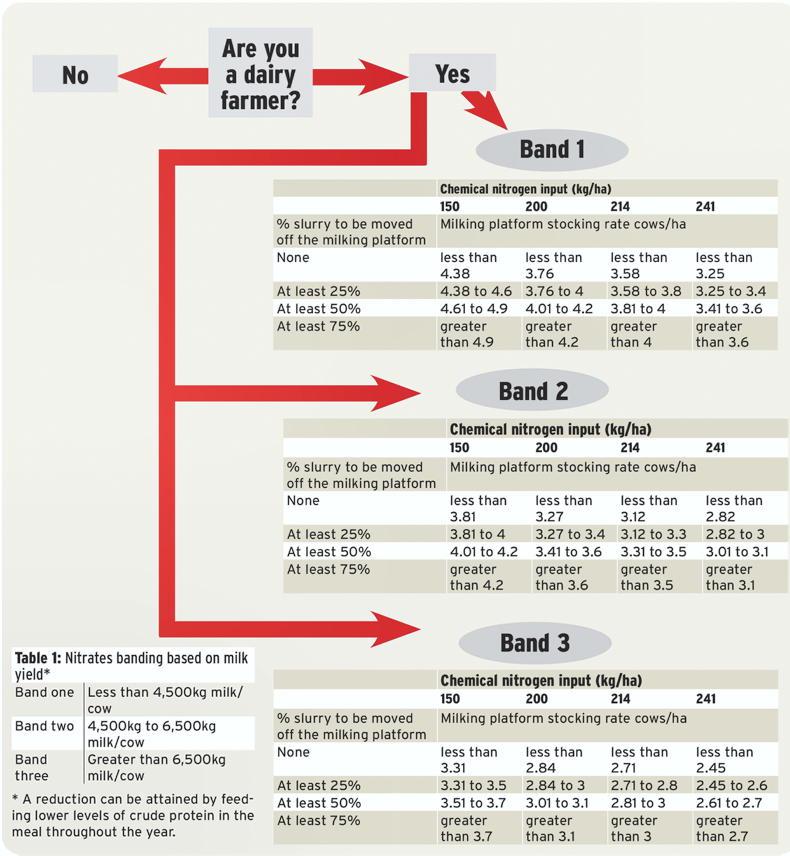
The amount of slurry that must be moved off the milking platform will depend on a number of factors.
The milking platform stocking rate, the nitrates band and the level of nitrogen fertiliser a farm chooses to spread per hectare on the platform.
The nitrates band is determined by the average of the previous three years milk yield.
The upper limits of the three bands are outlined in table one below.
The level of nitrogen fertiliser that is opted for, will vary from farm to farm. The four options to choose from are 150kg/ha, 200kg/ha, 214kg/ha or 241kg/ha.
The advantage of this measure is that a farm that is successfully implementing clover and thus reducing their chemical nitrogen requirement, is not required to move as much slurry off the milking platform as a farm with high no clover and a high demand for chemical nitrogen.
Farmer A is milking 100 cows on a 30ha milking platform with a further 20ha in outblocks. Therefore the milking platform stocking rate is 3.33 cows/ha. The herd is producing 6,000kg of milk on average so they are in band two, with a nitrogen excretion rate of 92kg/cow/year. The farm is not growing any clover so the farmer has opted for 241kg/ha of chemical nitrogen input per year.
With these figures farmer A falls into the last category and they will have to move at least 75% of the slurry off the platform to the outblocks.
Farmer B is also milking 100 cows on a 30ha platform. Farmer B also has outblocks and the herd of cows are in band two. The only difference between the two farms is the chemical nitrogen demand.
Farmer B has been reseeding with clover for the last 10 years and has been able to reduce the chemical nitrogen demand below 150kg/ha on the milking platform.
As a result Farmer B is not required to move any slurry off the milking platform. There are ways of reducing the nitrogen excretion rates that the individual bands dictate such as opting to use low crude protein feeds. As such, the actual stocking rates may differ. ?




SHARING OPTIONS