



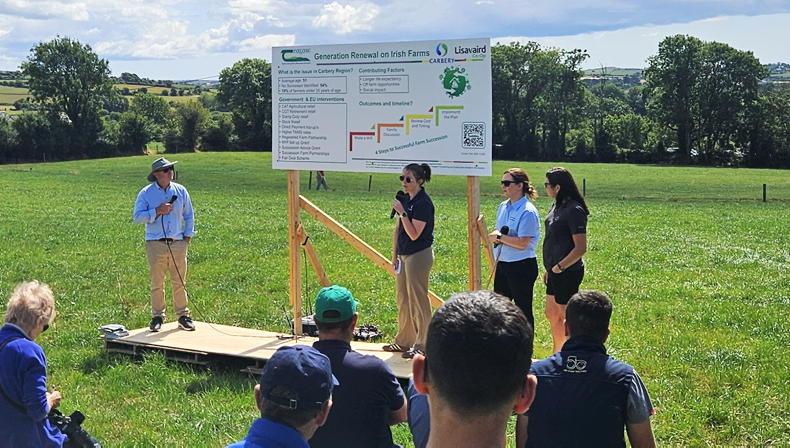
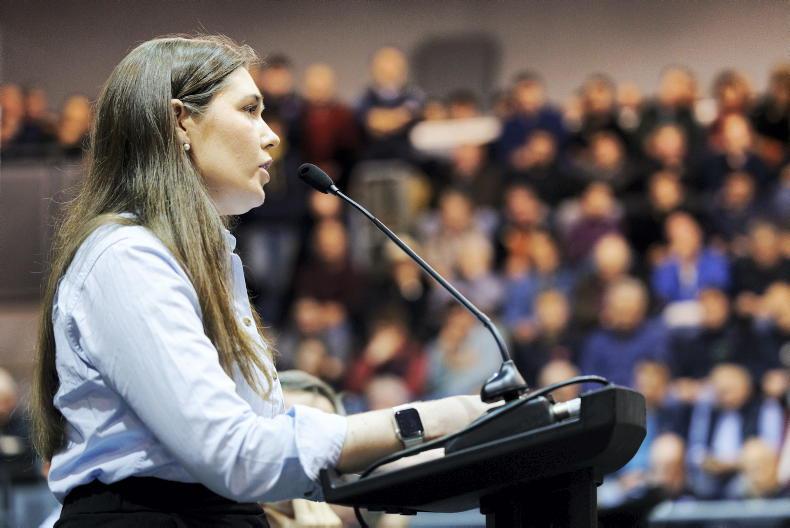
Assumption is the killer of succession, according to Klara McGriskin, Teagasc farm management specialist.
Addressing attendees at the Carbery Milk Quality farm walk on the Buttimer farm near Clonakilty, Co Cork, last Thursday, McGriskin said that longer life expectancy, better education and greater emphasis on work-life balance were the main issues leading to a slowdown in generational renewal on dairy farms in particular.
Handing on a farm from one generation to the next involves legal and taxation issues, but she said these are far from the main stumbling blocks.
“When people hear ‘succession’ they say, ‘Oh we’ll deal with it another time,’ and they kick the can down the road. About 80% of succession is a people issue,” McGriskin said.
“We need to sit down and have a conversation with our families about it.”
She encouraged farmers to find a hobby or interest away from the farm to give themselves something else to do. It shows the next generation that it’s not all about working all the time and being tied to the farm. The fear of having little else to do was something she felt was a barrier to generational renewal.
“That’s the biggest barrier I see,” she said. “It’s that people have worked their whole lives on the farm and done nothing else.
“They missed games, kids’ events and family occasions because of the farm but really if they had taken that time and gained an interest somewhere else, handing it over would be an awful lot easier because they’d have something else to do.”
Life outside the farm
Encouraging the next generation to be involved from a young age and show them that it is not all hard graft was something echoed by host farmer Caroline Buttimer.
She and her husband Darren have four children aged from 13 to 17.
“There is life outside the farm as well and we’d be trying to instil that in the kids as well,” Buttimer said.
“They’re huge into sport, the four of them, so we’d be encouraging them to go to college, experience sport, the social life, the living away from home because I’d hate any of them to think that they had to be tied to come home straight away after school.
“We wouldn’t force any one of them to take it on but luckily enough they are interested in farming in their own way.
“They all share in the workload and we see it as being involved in the family business and seeing how it all happens and why it happens,” she added, “and not just saying ‘I’m from a farm’ and not understanding what’s going on.”
She added that, while not assuming any one of them has to take over the farm, once children are included in decisions about the farm, they develop a stronger sense of ownership. This, she said, leads to much easier conversations around succession later on or could show if they’re not interested.



SHARING OPTIONS