



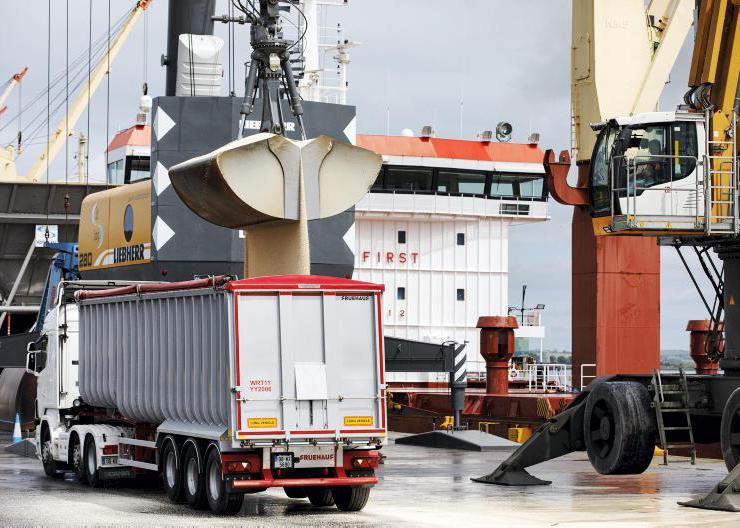
Protected urea may not be available in Ireland in 2026, according to the Irish Fertiliser Manufacturers and Blenders Association (IFMBA).
The organisation has written to politicians, state agencies and farm organisations to highlight the risks posed by the introduction of the Carbon Border Adjustment Mechanism (CBAM), a new carbon tax on fertiliser imports from outside of the EU.
It says that 80% of the urea used in Ireland is imported from outside of the EU and that CBAM will add €78/t to the cost of urea in 2026 as the actual emissions factor for fertiliser manufactured outside of the EU cannot be verified, meaning importers will have to rely on default values.
The organisation says that the CBAM rules are “unworkable”, citing the fact that importers won’t know the actual cost of CBAM certificates until months after the fertiliser is imported.
“Importers are already being asked to quote for fertiliser deliveries in the first half of 2026 without knowing the applicable CBAM certificate costs, creating impossible conditions for pricing and contracting,” the letter states.
Imported
IFMBA says that 43% or 580,000t of fertiliser imported into Ireland in 2024 originated from outside of the EU. It says that under-reporting emissions on fertiliser carries a penalty of €100/t CO2e.
“For 2024 volumes alone, this could amount to more than €61m in fines based on a carbon price of €75/t, not counting the reputational and legal risks.”
The crux of the issue appears to be that fertiliser produced in the EU has verified actual emissions, whereas emissions on fertiliser produced outside of the European Economic Area (EEA) will be set to default emission factors, in the absence of verified data.
The default emissions factors are up to twice as high as the verified emissions factors, making imported fertiliser less competitive than fertiliser produced in the EU.
As most of the CAN used in Ireland is manufactured within Europe and as over 80% of the urea used in Ireland is manufactured outside of the EEA, IFMBA says the relative price advantage of protected urea versus CAN will be eroded if CBAM is introduced in its current form.
Ceases
The organisation says that if it halts or ceases the importation of non-EU urea, then Ireland faces a shortfall of 164,000t of urea/protected urea.
It says that if this nitrogen was replaced with CAN which has higher emissions than urea, then the greenhouse gas emissions from agriculture would increase by 0.75 to 0.89 Mt CO2e per annum, undermining Ireland’s climate targets.
It also says that ceasing the importation of non-EU fertiliser risks a fertiliser shortage leading to a potential hike for fertiliser prices and a fodder shortage if fertiliser is not available.
Speaking to the Irish Farmers Journal this week, IFA president Francie Gorman said: “The proposed CBAM charges on fertiliser due to come in next January is of huge concern to IFA. Ireland is particularly vulnerable given our reliance on imported fertiliser from outside the EU.
Raised
“We have raised the issue both with the Minister, the Tánaiste and the Commission and will continue to do so until a sensible solution is found. Here, yet again, is an example of poorly thought out regulation potentially driving up the cost of doing business for farmers.”
According to the European Commission, the Carbon Border Adjustment Mechanism (CBAM) is the EU’s tool to put a fair price on carbon emitted during the production of carbon-intensive goods that are entering the EU, and to encourage cleaner industrial production in non-EU countries.
CBAM applies to almost all heavy goods such as steel, fertiliser, electricity, cement, etc. The stated aim is to prevent carbon leakage, whereby manufacturers of carbon heavy goods move manufacturing to outside of the EU, or importers buy from non-EU countries where less stringent climate policies are in place. Food and animal feed is exempt from CBAM.
The introduction of CBAM, which is set to commence in January 2026, is viewed by many as a support mechanism for EU manufacturers of fertiliser and steel. In the case of Ireland, which does not have a domestic fertiliser manufacturing industry, all fertiliser is imported from both within and outside of the EU.
Sourced
With 80% of the urea fertiliser used in Ireland sourced from outside of the EU, the Irish fertiliser sector is particularly exposed to CBAM. Over 70% of the urea used in the EU comes from outside of the EU, so CBAM is going to have a disproportionate impact on urea prices relative to CAN.
This is happening at the same time as unprotected granular urea is being banned and the government and semi-state bodies such as Teagasc and Bord Bia are encouraging farmers to switch away from CAN based fertiliser towards protected urea, which has a lower carbon footprint than CAN.





SHARING OPTIONS