If you landed into the Irish Grassland Association Summer Tour and didn’t know anything about cows, you would have soaked up lots of positives about Irish farming and what it can do for farm families, people in the industry and the environment. The Twomey home farm is an absolute gem of a farm, with grass and clover green fields nestled in between hundreds of mature oak, beech and ash, with the Blackwater river running through it.
The Bermingham farm is north-facing and higher, but the Berminghams showed how they can and do make their farm work to deliver what they want. The clarity of mission from both farm families was clear. They are both technically at the top of their game. You’d like to work with either family – all members that spoke on the day were enthusiastic, passionate, clued in and able to mix humour with the deadly serious to get a message across.
We heard from plenty of young people that were on a journey using the Twomey ladder to get to where they want to go. Listening to the young people on Twomey’s farm, you get the sense they knew they were working hard, but they were gaining knowledge, experience, a vision, capacity and the ability to control their destiny and were delighted with the opportunity. Not all Irish dairy farmers would be able to or would want to attract the calibre of young people on the Twomey farms. Kevin and Margaret invest huge time and resources in their people and that’s what makes them unique as a farming operation.
At least 12 of their past employees are now operating their own dairy farm businesses, mostly on leased land. The spring calving, high fertility and high milk solids model is clear and locked in as non-negotiable. However, you get the sense that Kevin and Margaret are not ‘so rigid’ to the extent they want absolute identical delivery per farm. They leave the door open for farm and operator variation to adapt to what works for them.
In much the same way, the Berminghams recognise the land asset they have and know only top-class performance focusing on key deliverables is what makes their business tick.

Mike Bermingham speaking during the Irish Grassland Association Dairy Summer tour visit to his farm in Fermoy, Co Cork. \ Donal O' Leary
In quotes from Kevin and Margaret Twomey
Kevin on college or farming – “I did the Leaving Cert, turned down university and went to ag college, and I loved it. I did a farm management course and worked with some great people. I know my parents were probably disappointed initially with my decision to go farming, but once my mind was made up they backed me 100%.”
Kevin on stocking rate – “We calve 530 on this farm to keep 470 milking. We are at 2.8 cows/ha, but have lost at least a tonne of grass with less nitrogen and the plan is to go to 2.6 cows/ha next year, with a 5 February calving start date in 2026. Stocked at 206kg of organic nitrogen, we stayed at 2.8 this year because milk price was good and margin is better.”
Kevin on costs – “What makes the mare go? Selling good quality milk off grass and then understanding the costs. Clarity on costs is driving the system. There is about 2c/litre of a difference in costs between the seven farms and this varies with lactation, stocking rate, soil type and farm effects, etc. The rotary parlour costs a lot more to run – that’s just a fact. We don’t pull investment in soil fertility out in a low margin year, but prefer to keep it stable across all years.” Margaret on background – “I come from a tillage background, so I knew nothing about dairy farming. In 2007, I completed a wealth creation course and it was the best thing I could have done.
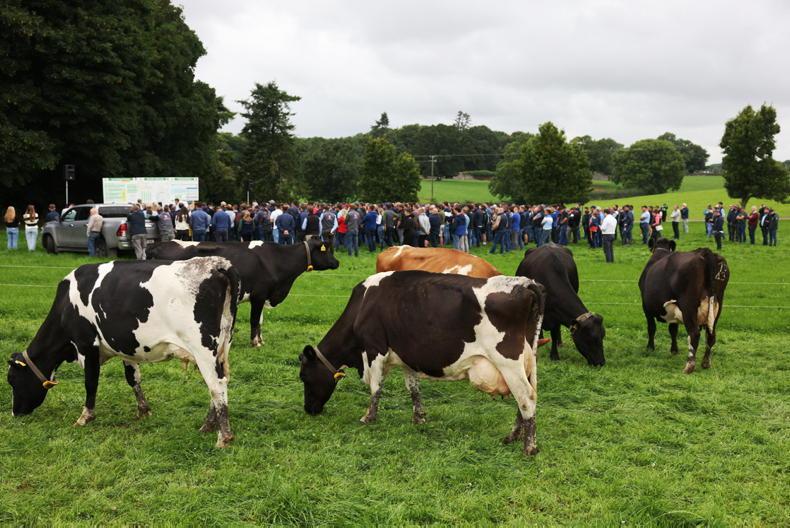
Sean O’Dwyer, farm manager for Twomey’s home farm – “Three weeks ago we only had 127kg grass/cow and cows were getting two- thirds of their diet in the yard (12kg). The rain arrived and now they are on 5kg with grazed grass. The herd is in top 2% on EBI delivering 440kg milk solids, but also feeding about 300 heifer calves (whole milk) so producing about 470kg MS/cow and supplement in 2024 was about 954kg/cow.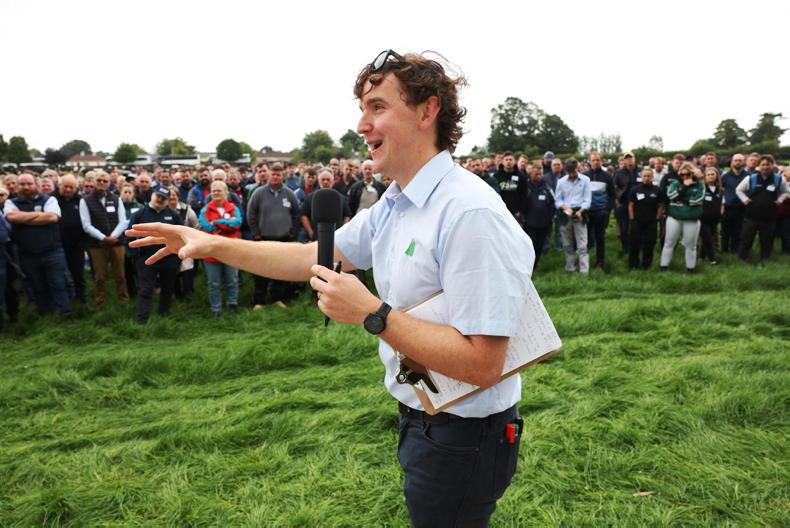
John McCabe, IGA speaking to the crowd of over 600 farmers that attended the Irish Grassland Association Dairy Summer tour on the farms of Kevin Twoomey and Mike Bermingham in Cork. / Donal O'Leary
Comment
Berminghams’ farm is elevated 400 to 500 feet above Twomeys and it is north-facing, milking 90 cows this year (84 next year) and producing 540kg of milk solids per cow. The plan is that the farm will be stocked at 2.1 cows/ha going forward, in an attempt to be self-sufficient in feed – within a grass/clover sward spreading circa 170kg of bag nitrogen, with a Jersey-cross cow. Based on information shared, if every cow is throwing off €1,300 profit, it means the farm can generate a €110,000 to €120,000 margin in a year for the farm family.
Twomeys’ Ballyhooley farm will be stocked higher, at 2.6 cows/hectare, with slightly lower performance per cow than Berminghams’ at 470kg/cow. However, with economies of scale (lower costs) and slightly higher stocking rate, each cow is also making close to €1,300 per cow margin. Twomeys’ farm has great soils, is gently sloping, with calving starting 5 February, with excellent soil and herd fertility.
Stocking rate is at the heart of the Nitrate Derogation debacle and the summer tour highlighted clearly that one size can’t fit all. Indeed the clear message from both farmers is that stocking rate needs to match the farm (what feed the farm can grow). Long gone are the days of stocking the farm at three cows/hectare – the focus of many a Grassland Summer Tour. Now nutrients, varieties, management and farm infrastructure are the stock number drivers.
The EU and Irish policy is forcing farmers to take their foot off the nitrogen pedal and it is forcing change. European policy is attempting to set maximum stocking rates on farms across the European Union of 1.8 cows/ha and yet we see 0.5 cows/hectare of a difference between two farms within 30 minutes of each other. The derogation debacle is making it more difficult and risky for young operators leasing land. We need certainty as soon as possible, but more importantly, the grazing system needs the 220kg stocking rate and more.
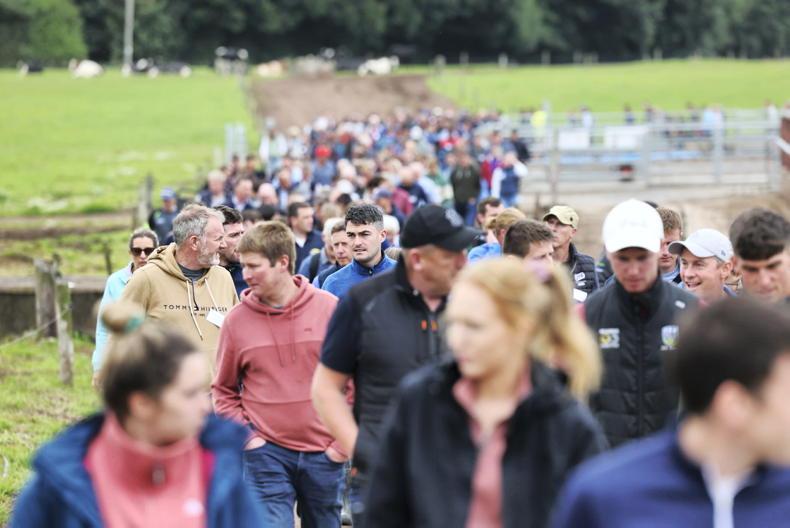
A general view of the crowd of over 600 farmers that attended the Irish Grassland Association Dairy Summer tour on the farms of Kevin Twoomey and Mike Bermingham in Cork. / Donal O'Leary
We asked a number of visitors on the day for key messages and an opinion on what they saw
“What the Twomeys have done, keeping the balls in the air on seven farms, is exceptionally rare and in a different league altogether. It really is quite an accomplishment. On Berminghams’ farm the emphasis on grazing quality grass was clear, with the focus now turning to grazing covers of 1,200 to 1,250kg to allow clover survive and optimise grass quality. This, in turn, will drive protein percentage and litres. I would love to see the bull selection and traits for both farms. Mike emphasised protein percentage, but we didn’t see the selection. There is no doubt we need to be categorising grass better, depending on quality. We can get 12%, 14%, 16% nuts, etc, and yes we can weigh grass, but it tells us nothing on quality. The same way we need milking cow silage, dry cow silage, emergency silage and long-term reserve silage.” – Anthony Betts, Co Waterford.
“The attention to detail on Berminghams’ farm was clear, with a knowledge of the farm inside out. Had a budget done with pen and paper and it works, and he obviously loves what he does and is doing it very well. Twomeys are beacons for the next generation and show you don’t have to own land to milk cows, but you must know your figures.” – Mella Briscoe, east Galway.
“Both farmers were clear, grass is king and compact spring calving is driver. Excellent genetics, but interestingly, both were crossbred herds in spite of anecdotal evidence that there is a move away from crossbreds. Excellent cost control evident on both farms. Top class grassland management. Mike said “grow as much grass as legally possible”. Mike Bermingham is aiming to make the farm self-sufficient in feed for the cows, ie by reducing bought-in silage and meal. He is progressing that through investment in reseeding and controlling stocking rate, clover incorporation and nutrient management. He has sown approximately 800t of lime in the last 10 years.” – Anthony Green, Four Valleys Discussion Group, Fermanagh.
“The positivity and openness and ability to show the fun factor shone out at Twomeys. The correct stocking rate for a farm can be more profitable than a high stocking rate as Berminghams’ showed. Both farms should be highly commended.” – Jack Gorman, Patrickswell, Co Limerick.
“We run a similar operation to Mike and Tina, and this year we sold our youngstock, a decision that wasn’t taken lightly, but suits our current situation with work-life balance. We have a young family and Mike’s comments around “no point building if you don’t have time to enjoy the rewards from the hard work” resonated with me. Both farms reassured me that a lot of decisions we’ve made on our farm recently have been the right ones. Both farms on the tour complemented each other nicely from two very different situations, but a similar end outcome.” – Samantha McCarroll, Omagh, Co Tyrone.
“My three take home messages from a great day out were: one, genetics and grass are central to success; two, graze lower covers (going into 1,200kg) if clover is part of the mix; and three, success breeds success – you need to be surrounding yourself with reality and positivity if you want to succeed in a growing dairy business. My questions after the day are: is leasing less of an attractive option in a post-derogation world and should other partnership/share options be more of the future? And what way is the price of leased land going to go if the dairy farmer will potentially make less profits, but the demand for land is only going one direction? This is important, because Mike and Tina Bermingham emphasised sticking to the budget when developing, and if output is restricted then it’s even more important.” – Brendan Phelan, Tipperary






SHARING OPTIONS