



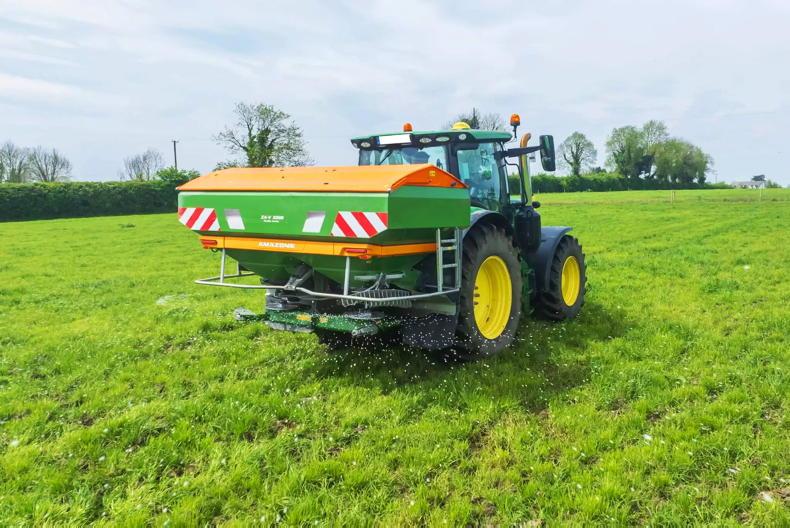
GPS fertiliser spreaders have grown in popularity over the last number of years.
With higher fertiliser prices and the potential of the GPS spreaders to improve the efficiency of spreading, farmers are excited by the technology.
TAMS grants were made available on the purchase price of the equipment three years ago, which is another reason for the growing popularity.
The spreaders covered under the TAMS scheme are automatically controlled by a GPS unit.
Once the farmer has set the application rate and the type of fertiliser, the GPS will dictates the rate of spread depending on the forward speed and the working width of the tractor and spreader.
Calibration
In essence, the GPS is constantly recalibrating the rate of spread. In a standard spreader, most farmers do not correctly calibrate the machine, as it’s a time-consuming exercise and can be difficult to get right.
As a result, there is an increase in the wastage of fertiliser, as well as problems with uneven spreads and insufficient product spread, which in turn leads to lost grass production.
Another advantage of the GPS spreader is the headland feature. At the headlands of a field the spreader operates an on/off control. The spreading stops as the tractor turns.
This takes away the problem of operators starting their spreader too early after turning on the headland and wasting fertiliser.
This is a massive bonus for dairy farmers or any farmers that are working in paddocks and small fields that require more regular turns.
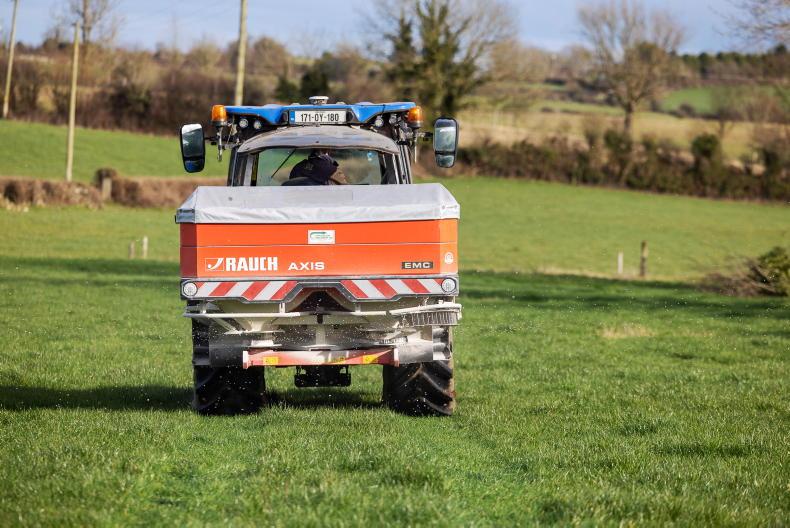
The GPS automates a lot of the process, but the operator will still be required to carry out some mechanical adjustments.
For example, the operator will need to check the settings required for working width and the type of fertiliser being used to set the drop point adjustment.
Prices
There’s a wide range of GPS spreaders available, with varying levels of technology on each. The more basic entry-level GPS spreaders will carry out all the functions mentioned above.
The more expensive high-tech machines have some added benefits - for example, adjusting flow rate for wind-speeds. These are all added extras and, realistically, the benefits of those are minimal.
The main priority should be to reduce wastage and increase nutrient usage to maximise the bang for buck when it comes to spreading fertiliser.
The spreader can be bought separately to the GPS unit, provided the spreader is fully GPS-ready.
The advice is to shop around, as there might be value to be found by purchasing both items separately. Ensure the GPS technology is compatible to the spreader technology, though, if you do purchase separately.
TAMS has an option for purchasing both separately, as two separate invoices can be submitted.
In terms of the TAMS reference cost, the reference figure for the GPS-ready spreader is based on a formula dictated by the hopper size.
The formula is y=1.469x + 19,543. X is the hopper capacity. Therefore, a 2,000l (two-tonne) spreader will be TAMS aided to the value of €22,481. At the 40% grant, that’s a €8,992 reduction off the cost of the two-tonne spreader.
There is also a grant for the GPS unit. The reference cost of this is €3,937.50. At the 40% grant, it’s a reduction of €1,575 on the GPS price.
In total, there’s a reduction of €10,567 off the total price of a new spreader plus GPS unit at 40% TAMS and a reduction of €15,850.50 at 60% TAMS.
The actual prices of the machines vary depending on the spec, but an entry level two-tonne TAMS eligible spreader plus the GPS unit is available for an approximate cost of €27,000 including VAT.
With the 40% grant reducing the purchase price by €10,567, the total cost of the two-tonne machine including the grant is €16,433 including VAT.
At the 60% young farmer TAMS grant, the total cost of the machine including the grant would be €11,150 including VAT.
Return on investment
According to Teagasc, farmers are reporting a saving of roughly 10% in fertiliser usage. That’s a fairly significant amount for farms spreading high levels of fertiliser every year.
As an example, take a 100-cow farmer with a fertiliser bill of €20,000.
A saving of 10% equates to a €2,000/year saving on the fertiliser bill. The return on investment (ROI) figure on the €16,433 cost price including the 40% grant is 12.5%. In other words, the machine would pay for itself in eight years.
At the 60% grant, the ROI is 18% and the machine would pay for itself in five and a half years.
My rating
A GPS fertiliser spreader is a nice thing to have, but it’s far from essential. The return on investment is quite good though.
On a well set-up farm business that has invested well over the years and is looking for something relatively affordable to make life a bit easier, it could be an option.
However, in my opinion, most farms have higher-priority investments to make before they start looking at nice gadgets such as this one.
This investment is not going to improve production significantly and it’s not going to cut down on much labour. Therefore, I’m going to give this investment a 3/5 rating.


SHARING OPTIONS