



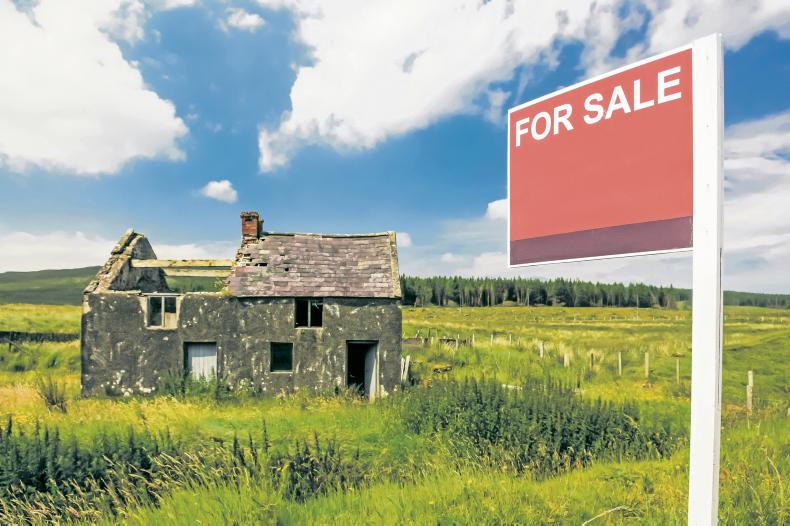
Land price has inflated significantly over the last 10 years.
This has left many farmers questioning whether purchasing land is a good decision for their business. Is there going to be a strong enough return to justify the capital spend?
In this week’s edition of the Twenty Ways to Spend €20,000 series, we’re looking to answer this question and see whether or not the return on investment from land purchase actually stacks up.
Land price
To start with, land prices obviously vary significantly depending on what part of the country the farm is located.
In the midlands or southern half of the country, land prices regularly clear €20,000, while, in the northwest, it would take a very good parcel of ground to break the €10,000 mark.
Another major factor on the price of purchase and the potential return is the level of facilities and infrastructure on the farm. A turnkey dairy unit is worth a lot more money than walking on to a greenfield site.
Finally, the attractiveness of the investment will largely depend on accessibility to the land.
There are very different returns on land that’s within walking distance or bordering the milking platform versus a parcel of land that’s half an hour away from the yard.
These are all factors that must be taken into account before evaluating any potential returns. For the purpose of this piece, we will be looking at a case study of a block of land that is adjacent to the milking platform.
Case study
Let’s say farmer A is milking 120 cows on a 40ha milking platform, stocked at three cows/ha.
The farmer also has several smaller outblocks totalling 30ha that provide silage and rears the replacement heifers. The overall stocking rate on the farm is 2.25 livestock units per hectare (LU/ha).
The option to purchase an adjoining 20ha (50 acres) has come up and it’s something the farmer is strongly considering.
The land is of excellent quality in a strong dairy area, so it’s expected to receive in the region of €17,000/acre.
The land is not in paddocks and there is a poor water system in place, which would need to be redone.
The investment required for the land purchase alone is €850,000. This is without the stamp duty fee of 7.5%, which would see the spend rise to €913,750.
The capital expenditure required on water, roadways and paddocks are likely to cost another €700/acre, giving a total investment required of €948,750 to have the land set up and ready to go for milking cows.
With 20ha extra now on the platform, the farmer can look to expand the herd of cows. At a stocking rate of three cows/ha on the platform, it would bring the total herd size to 180 cows.
However, to carry this stocking rate would require the farmer to take on extra outblocks to remain compliant with nitrates and to have enough silage ground.
To keep the overall stocking rate at 2.25 LU/ha, which is optimum, would require the farmer to lease an extra 15ha of ground. The alternative is to have the replacement heifers contract reared.
Contract rearing the heifers would allow the farmer to increase cow numbers to 180 in the most cost-effective way, without leasing any extra land.
To purchase the extra cows is another cost that must also be factored in. At current stock prices of €2,500/cow, the investment will be €150,000.
With a combined investment in both the land and the cows now adding up to €1,098,750, we can assume the farmer will also need to take a land loan for the purchase.
Let’s say the farmer loaned €1m in total and planned to do the rest of the investment from cashflow. The loan was secured on a 20-year term at 4% interest. That leaves the total interest to be paid at €471,680.
The total cumulative cost of the investment over the 20-year period is now at €1,570,430 (€1.57m).
Extra cubicles and slurry storage haven’t been accounted for in this calculation.
The farmer in this case study has ample facilities with the heifers contract-reared off farm. If you were to factor this extra expenditure into the calculation, the farmer is looking at an extra €3,000/cow or €180,000 across the 60 cows.
Return on investment
While it’s difficult to offer an accurate return without knowing how good the farmer is at managing the farm and turning profit, we’re assuming this farm is making in the region of €1,000 profit/cow/year.
At 60 extra cows, that’s a net return of €60,000 per year from the extra land.
With a total investment in both the land and the cows, including the cost of the loan at €1.57m, the return on investment (ROI) is 3.8%. This would mean it would take approximately 26 years for the investment to pay for itself.
This is a huge investment with a small ROI. However, we have not accounted for the appreciation in land value that occurs through inflation.
Over the last 50 years, the average inflation rate on land has been 3% per year. Going off this figure, the value of this 20ha in 26 years could have gone from €850,000 to €1.78m.
My rating
Investment in land is a huge commitment and it’s a decision that needs a lot of planning and discussion. Extra land will inevitably mean extra cows, which has its pros and cons.
On one hand, the economies of scale from growing the business will lead to increased income, but, on the flip side, with more cows there’s a requirement for extra labour, as well as greater expenditure.
The decision to purchase land ultimately lies with the farmer and their family. This is a long-term investment, but it’s typically a safe one.
The value of land is going to increase year on year - that’s almost a guarantee based on historical data.
With all things considered, I’m giving land purchase a 4/5 rating. This investment is situation dependent and requires a huge capital outlay, but, overall, I think it’s a solid investment, even with the small ROI.


SHARING OPTIONS