


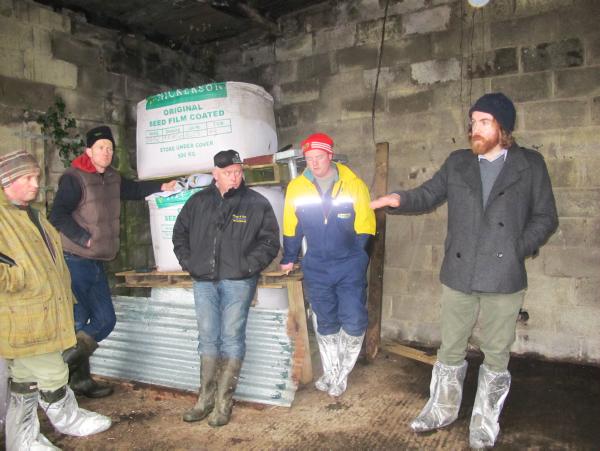
A series of calf care meetings took place at various venues last week. The meetings were hosted on farms and organised by Teagasc and AHI, with the support of Volac. More than 600 farmers attended over the four days and the walks centred mainly on health and nutrition.
Colostrum management
Bernadette Early, Teagasc Grange, advised farmers on the importance of colostrum and enforced the 1-2-3 rule: 1) feed the first milk of the cow; 2) feed the calf within two hours; and 3) Feed three litres. She also focused on colostrum quality and emphasised the importance of feeding colostrum quickly after birth to ensure that the calf gets enough antibodies as the calf’s ability to absorb these declines quickly after birth. By 24 hours old, the calf is unable to absorb antibodies from colostrum.
She said that the reason for feeding such a high volume of colostrum to dairy calves is to ensure that the calf gets enough antibodies. She said that the concentration of antibodies in a dairy cow’s milk is lower than in a suckler cow’s milk due to a dilution effect.
On colostrum storage, she urged farmers to only use colostrum from cows on their own farm because they have specific antibodies to the pathogens that are present on the farm. When choosing what colostrum to store, she advised farmers to only store colostrum from cows which are known not to have Johne’s disease.
For suckler farmers that need to have a store of colostrum on the farm, she advised to take the first milk from cows that do not have Johne’s disease after the calf is fed and then freeze it. When thawing colostrum, she said to do so slowly in warm water and not to microwave it as this breaks down the proteins contained in it.
Calf scour
Ingrid Lorenz spoke about feeding calves through scour. She said that the scouring calf can lose up to 10% of its body weight as scour in a day. The average healthy calf needs four to five litres of fluids per day, while a sick or scouring calf could need up to eight or nine litres of fluids. She said that the best way to feed a scouring calf is by giving them electrolyte solutions between milk feeds. Two litres of an electrolyte solution should be fed midway between each feed to ensure the calf does not become dehydrated.
She told the farmers that it is now known that milk should continue to be fed to calves even when they are scouring. She added that the presence of milk in the affected intestine area helps in the healing process. She warned against the use of antibiotics for treating most scouring calves as most calf scours are caused by either a viral infection or by parasites and very few by bacteria. She said that in extreme cases of scour where the calf needs veterinary attention, vets may opt to use an antibiotic if there is a high temperature and or bloody diarrhoea.
Johne’s disease
Ciaran Mellett, a local vet practising in Kells, Co Meath, sits on the Johne’s disease implementation group. He said that until 25 years ago there was little or no Johne’s disease in Ireland. Imported stock from mainland Europe was the main entry point for the disease, and it is now estimated that one in five herds has some level of infection of the disease. Ciaran explained that animals suffering from the disease often suffer from scour which in some cases can lead to death. However, in most cases these infected animals will be culled for poor fertility or other issues before this occurs. He informed farmers of the voluntary programme available to dairy farmers.
Ciaran advised the farmers that preventing the spread of the disease to calves should be the aim. He said that milk should not be fed to calves from cows that are known to have or are suspected of having Johne’s. At calving, the cow should be moved to a clean, well-bedded and dry calving pen. Once the cow calves, the calf should be removed as quickly as possible in order to avoid any contact with faeces.
Nutrition
Joe Patton, a nutritionist based at Teagasc Ballyhaise, told farmers that studies have shown the clear advantages of calving down heifers at 24 months of age as opposed to 30 months. He said that studies in Britain of heifers calving at 24 months versus 30 months have shown that heifers calving down at 30 months had a calving interval of 450 days on average versus 390 days for heifers that were calved down at 24 months of age – a difference of two months. In addition, he pointed out that farmer mindset is that older heifers will produce more milk, yet studies have dispelled this myth showing virtually no difference between milk yield of a 24-month versus a 30-month calved heifer.
Milk feeding methods
Pat Cahill of Volac outlined the various milk feeding methods for calves. He said that the most important thing in calf-rearing is consistency. Milk powder needs to be mixed at a consistent concentration and temperature and it needs to be fed at the same time every day. He advised farmers considering a once-a-day feeding regime not to do so until the calves are at least three weeks of age. The minimum feed needs to be three litres and the calf requires 13-15% solids per day.
On the milk powder types, he said that there is a vast difference in price between the cheaper and more expensive powers, but stressed: “You get what you pay for.”
He said that farmers should target powders with a crude protein content of 25-26%. He added that the cheaper milk powders contain vegetable proteins, while the more expensive ones contain whey or skim proteins. He said that the best quality milk powders contain whey and skim proteins.
Weight targets
Pat stressed that farmers need to target a liveweight at weaning of 90-100kg, while Joe reinforced the need for adequate concentrate supplementation during the rearing phase, emphasising the fact that concentrates are the driver of rumen development for the growing calf, along with water and a roughage source such as straw.
He said that in most cases dairy farmers are now only selecting early spring-born heifer calves as replacements, as calves born after mid-March will find it difficult to hit weight targets.
At bulling, a Friesian heifer needs to weigh 340-350kg and will need to maintain an average growth rate of 0.75kg/day to be on target to calve down at 90% of mature cow weight. He advised farmers to weigh heifer calves in September/October each year. This will allow them to have adequate time between then and calving to ensure that they calve down at the correct weight.
Housing
Local adviser Vincent Tracy highlighted the issues around both calving facilities and calf housing during dairy expansion. He recommended that in a tight spring-calving herd, there should be calving accommodation for 20% of the herd at one time. Calving pens need to measure approximately 4.8m by 4.8m to allow for adequate space to safely use a calving jack.
In terms of calf housing, he said that individual pens need to measure 1.5m by 1m and calves need to be able to see and touch each other. As calves get older, they need to be moved to group housing and each calf requires at least 2.3m2. He emphasised the need for dry bedding, good ventilation and no draughts.





SHARING OPTIONS