



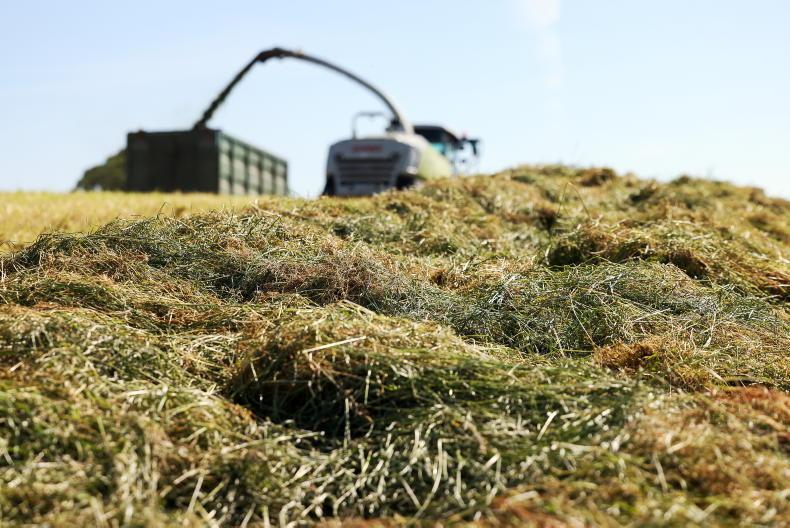
Farmers should prepare to feed higher quality silage to milking cows in the summer months, as a result of the impact of climate change on grass growth.
An Agricultural Science Association (ASA) event heard on Thursday that an increase in grass growth is expected to be a consequence of global warming.
However, this increase will not be seen during the summer months, according to Elodie Ruelle, senior researcher at Teagasc Moorepark.
Higher temperatures and earth warming will not change annual yield, but there may be a longer growing season, more grass growth and earlier phenology.
Ruelle’s presentation to the ASA event on Thursday also warned that this could result in more pests, diseases and a drop in yield quality.
Annual grass growth
Additionally, the increase in grass growth will only be seen in the winter and spring months, with June, July, August and September seeing reduced growth.
Annual grass growth from 1976 to 2025 was 12.4 t DM/ha and with 1.5°C warning, this is projected to increase to 12.9 t DM/ha.
In a 3°C warming, a further increase to 13.5 t DM/ha is expected.
Flexibility
“Up to now, farmers could do the same thing every year, such as increasing concentrates if there is a grass deficit... but we are going to experience more extreme weather, so farmers need to bring flexibility into their systems.
“We are good at reacting, but long-term planning, not so much.
“Year-on-year variability in grass growth is increasing, making it very challenging to predict.”
Warmer summers will result in a water deficit and, therefore, reduced growth and yield, while wetter winters will result in more waterlogging of soils, meaning grazing may start later and sowing and harvesting could become more challenging, it is predicted.
Utilising additional grass
In terms of stocking rate and managing grass, Ruelle said that it wasn't about "the grass you can grow; it’s about the grass you can utilise. Having the right stocking rate to maximise utilisation is very important”.
Ruelle suggested practising on/off grazing, improving farm infrastructure, more slurry storage, regular and consistent grass measuring to prepare for such changes in weather patterns.
When choosing species for crops, Ruelle advised farmers to: “think about pests, [and] species which are tolerant to all types of weather, not just drought”.




SHARING OPTIONS