Imagine a farm where a swarm of robots – powered by artificial intelligence (AI), carrying out field tasks such as cultivating, sowing and precision treatments – works tirelessly day and night. Now picture rows of solar panels in the fields, not spaced two metres apart but 10 metres apart, leaving enough room to grow crops between them.
The solar farm generates power for the robots, provides an income from exported excess electricity, and offers shelter for the crops. Meanwhile, the robots produce food with only a fraction of the cost and carbon footprint of conventional farming.
This is the vision of Gerry Lacey, Professor of Electronic Engineering and department head at Maynooth University, who is leading a team of researchers who have set out to demonstrate this concept. Later this month, the public will be invited to see it in action.
The Irish Farmers Journal spoke to Gerry to learn more about the pioneering work being carried out in Maynooth. While robotics is developing rapidly worldwide, field robots are still in the early stages for Irish agriculture.
Across Europe, a new generation of smaller robots is emerging to suit diverse crops and landscapes. These contrast with the large autonomous tractors designed for large-scale farms in parts of America for example. In France and the Netherlands, smaller robots are already operating in vineyards, orchards and vegetable farms. These are lighter, more flexible and better suited to Irish conditions.
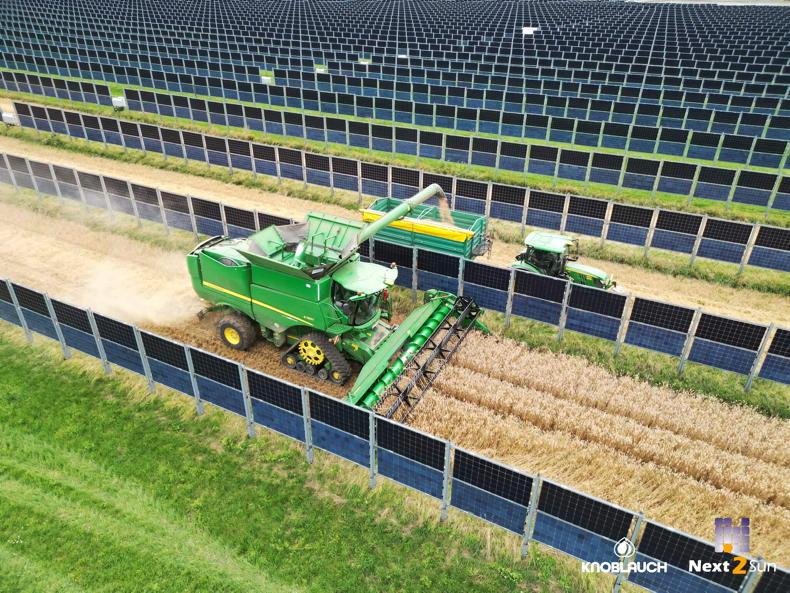
Agrivoltaics is an example of outside of the box thinking that could combine both food and energy production.
Irish farmers
Gerry’s work in Maynooth is wide-ranging, but at its core it relies on co-design with farmers. His robotic research is largely focused mainly in tillage, and he believes that robotics and renewables can make farms economically independent units that generate their own power, produce food and manage their own sustainability.
Two of the key projects currently underway at Maynooth are the AURA project (Automating Regenerative Agriculture) and the SCARCE (Sustainable Cereals through Agrivoltaics, Robotics and Circular Economy) project.
AURA, co-funded by Enterprise Ireland and Comex McKinnon, is applying robotics and AI to optimise regenerative agriculture.
SCARCE, funded by Irish Distillers, combines robotics and agrivoltaics to study how vertical solar panels influence grain production and overall field performance. As part of their work, Gerry’s team interviewed a cross-section of Irish farmers about technology adoption. Irish farmers, however, are clear about their priorities he said. Farmers told Gerry they want simple, affordable machines which are easy to maintain, not something that needs a PhD to run.
They want systems that use existing implements, can be repaired locally and do not lock them into expensive service contracts, he explained.
Maynooth robots
Feedback from farmers shaped the design of Maynooth’s two-metre electric robot, called “Callan” which was built on site and can carry standard small implements. They built the robot with a light footprint, allowing it to enter fields more frequently for precision operations such as spot-spraying or inter-row cultivation, with little compaction or fuel consumption.
The idea is that this robot would work in swarms with other robots, to complete farm jobs. Each robot would be capable of talking to and working with each other using AI. They would carry out selective operations like spot spraying, targeted fertilising and precision crop and soil monitoring, reducing costs on farms.
Gerry believes that electric robots are the way forward as they require fewer moving parts and less maintenance than diesel engines. If the robot is powered by electricity produced on the farm, then that significantly reduce costs further than running on diesel.
The robot is being put to the test at Maynooth’s one-hectare test farm where there are also greenhouse robots for watering, seeding, weeding and measuring plant growth.
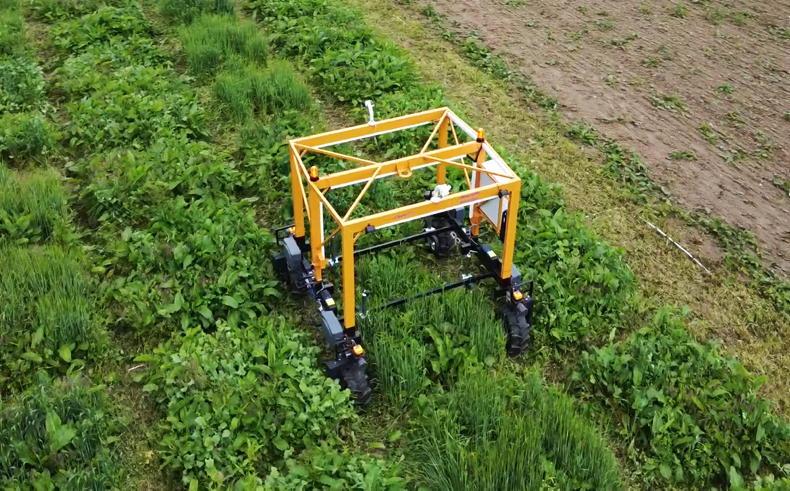
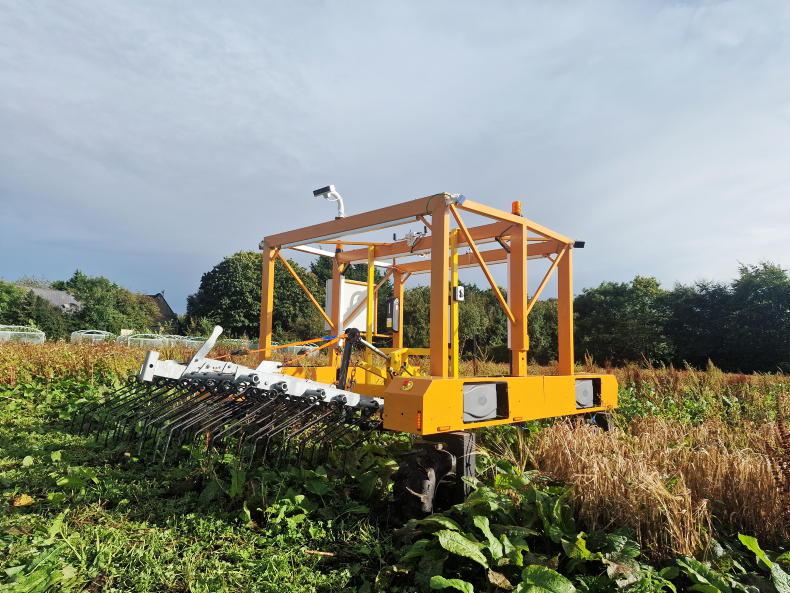
Maynooth’s two-metre electric robot, called “Callan” which was built on site and can carry standard small implements.

Maynooth’s two-metre electric robot, called “Callan” which was built on site and can carry standard small implements.
Agrivoltaics
As reported extensively in the Irish Farmers Journal, the solar farm industry is in growth mode, with over 22 gigawatts (approximately 80,000ac) of solar projects in the pipeline. Questions over the merits of using farmland for solar farms continue. However, Gerry’s team is working on a new type of solar farming.
At the time of speaking to Gerry, he was taking delivery of solar panels for their agrivoltaics project.
Agrivoltaics integrates solar panels into productive farming. Conventional ground-mounted solar farms often remove land from crop production and limits the land to light grazing by sheep. The Maynooth agrivoltaics system will instead use vertical solar fences that stand about two metres high and spaced 10 metres apart.
“They generate electricity in the morning and in the evening, but during the middle of the day the sun hits the crops,” Gerry explains. The idea is that the area between the solar panels would be used to produce food by robots, powered by the electricity produced from the panels. Solar fences are easy to maintain and when combined with battery storage, they could form the foundation of energy-independent farming communities, he said.
As part of their work, sensors installed on the test farm will monitor soil moisture, temperature, wind and plant growth between the panels. The data will help the team understand how agrivoltaics layouts influence crop performance and soil health.
The researchers are also exploring how the shaded areas beneath the panels can support biodiversity. These strips can act as habitats for beneficial insects, which may reduce pest pressure in crops, Gerry explained. Ultimately, agrivoltaics is about balance between food and energy production he said.
Data, AI and farmer control
Automation produces large volumes of data, which raises questions about ownership and privacy. Gerry’s team is addressing this challenge through what is known as edge AI. In this approach, data is processed locally on the robot rather than being transmitted over the network. This means the information stays in the field if the farmer wants it to, he explains.
He said that the data could be valuable. Food processors and retailers must increasingly account for their supply chain emissions, known as Scope 3 carbon emissions. Verified sustainability data from robotic systems could help them meet that requirement.
However, AI is not just about data collection, it is about intelligent interaction. The Maynooth team is developing algorithms that allow multiple robots to coordinate tasks outdoors, a complex challenge. The concept of smaller swarms of robots working collaboratively on farms is not new.
Around a decade ago, companies such as Fendt were reportedly exploring such systems. Those early attempts didn’t take off because AI technology at the time was neither advanced nor powerful enough to coordinate multiple machines effectively. That situation has changed in recent years.
AI you can talk to
So how will this work practicality on the farm? Gerry said he expects that the next step in farm automation will involve voice interaction. In future you will simply tell your phone to go and disc a stubble field he said. The AI system will plan the task, check what equipment is available and send the robot to work.
Farmers might eventually use these machines through a robotics-as-a-service model, hiring them from local contractors instead of buying their own he said.

Stephen Robb talks to Gerry Lacey, Professor of Electronic Engineering and department head at Maynooth University about his work in agricultural robotics, combining solar farms with food production and where the farms of the future are going.
The future?
Irish farmers are adaptable, and if something makes financial sense, they are willing to explore it. When it comes to tillage farming in particular, the Irish system is broken.
Tillage farmers are hampered with high-input costs, internationally low commodity prices, and relentless competition from other sectors. With all three pressures likely to persist, the current model cannot continue unchanged.
To survive, Irish tillage farming must reduce costs while maintaining yields. The rapid integration of farm robotics and precision technologies could form part of that solution, especially in cutting operational costs.
It may sound out there, but remember when we thought autosteer and guidance would only ever make sense on the vast plains of America, Canada or Australia and cost an arm and a leg? Today, many Irish tillage farmers use it, regardless of field size.
Policy, support and available technology all need to align before robotics becomes mainstream, but as Gerry pointed out, that shift may be happening faster than we think.
AI is a game-changer in this space, and the pace of progress is accelerating.
As for agrivoltaics, current policy makes it difficult. Commercial solar farm developers are driven to maximise the number of panels per acre to make projects financially viable.
But what if incentives encouraged real farming between wider solar rows? Imagine if, alongside conventional solar farms, developers were required to include 20% agrivoltaic systems and were guaranteed a slightly higher electricity price to compensate for lower panel density.
To be clear, policy is not heading in that direction in Ireland. But what ever happened to blue-sky thinking at policy level?
Since the new Government term began, the climate and land-use agenda appears to have slipped down the priority list, but agrivoltaics is an area that should be examined closely.
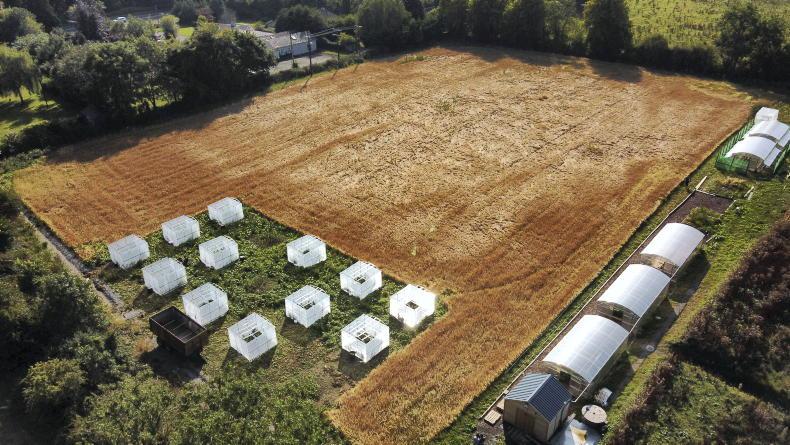
The robot prototype robot is put to the test at Maynooth’s one-hectare test farm.
Open day
An open day, showcasing the work ongoing in Maynooth is set to take place on the campus on Thursday 23 October from 1pm to 5pm. The event will see a range of speakers from Maynooth University, Irish Distillers, Comex McKinnon on soil health, renewable energy, robotics, AI and innovation. Places are limited so registration is a must. You can register for free for the Future of Farming: Robotics, AI & Sustainability open day at Eventbrite.
Imagine a farm where a swarm of robots – powered by artificial intelligence (AI), carrying out field tasks such as cultivating, sowing and precision treatments – works tirelessly day and night. Now picture rows of solar panels in the fields, not spaced two metres apart but 10 metres apart, leaving enough room to grow crops between them.
The solar farm generates power for the robots, provides an income from exported excess electricity, and offers shelter for the crops. Meanwhile, the robots produce food with only a fraction of the cost and carbon footprint of conventional farming.
This is the vision of Gerry Lacey, Professor of Electronic Engineering and department head at Maynooth University, who is leading a team of researchers who have set out to demonstrate this concept. Later this month, the public will be invited to see it in action.
The Irish Farmers Journal spoke to Gerry to learn more about the pioneering work being carried out in Maynooth. While robotics is developing rapidly worldwide, field robots are still in the early stages for Irish agriculture.
Across Europe, a new generation of smaller robots is emerging to suit diverse crops and landscapes. These contrast with the large autonomous tractors designed for large-scale farms in parts of America for example. In France and the Netherlands, smaller robots are already operating in vineyards, orchards and vegetable farms. These are lighter, more flexible and better suited to Irish conditions.

Agrivoltaics is an example of outside of the box thinking that could combine both food and energy production.
Irish farmers
Gerry’s work in Maynooth is wide-ranging, but at its core it relies on co-design with farmers. His robotic research is largely focused mainly in tillage, and he believes that robotics and renewables can make farms economically independent units that generate their own power, produce food and manage their own sustainability.
Two of the key projects currently underway at Maynooth are the AURA project (Automating Regenerative Agriculture) and the SCARCE (Sustainable Cereals through Agrivoltaics, Robotics and Circular Economy) project.
AURA, co-funded by Enterprise Ireland and Comex McKinnon, is applying robotics and AI to optimise regenerative agriculture.
SCARCE, funded by Irish Distillers, combines robotics and agrivoltaics to study how vertical solar panels influence grain production and overall field performance. As part of their work, Gerry’s team interviewed a cross-section of Irish farmers about technology adoption. Irish farmers, however, are clear about their priorities he said. Farmers told Gerry they want simple, affordable machines which are easy to maintain, not something that needs a PhD to run.
They want systems that use existing implements, can be repaired locally and do not lock them into expensive service contracts, he explained.
Maynooth robots
Feedback from farmers shaped the design of Maynooth’s two-metre electric robot, called “Callan” which was built on site and can carry standard small implements. They built the robot with a light footprint, allowing it to enter fields more frequently for precision operations such as spot-spraying or inter-row cultivation, with little compaction or fuel consumption.
The idea is that this robot would work in swarms with other robots, to complete farm jobs. Each robot would be capable of talking to and working with each other using AI. They would carry out selective operations like spot spraying, targeted fertilising and precision crop and soil monitoring, reducing costs on farms.
Gerry believes that electric robots are the way forward as they require fewer moving parts and less maintenance than diesel engines. If the robot is powered by electricity produced on the farm, then that significantly reduce costs further than running on diesel.
The robot is being put to the test at Maynooth’s one-hectare test farm where there are also greenhouse robots for watering, seeding, weeding and measuring plant growth.

Maynooth’s two-metre electric robot, called “Callan” which was built on site and can carry standard small implements.

Maynooth’s two-metre electric robot, called “Callan” which was built on site and can carry standard small implements.
Agrivoltaics
As reported extensively in the Irish Farmers Journal, the solar farm industry is in growth mode, with over 22 gigawatts (approximately 80,000ac) of solar projects in the pipeline. Questions over the merits of using farmland for solar farms continue. However, Gerry’s team is working on a new type of solar farming.
At the time of speaking to Gerry, he was taking delivery of solar panels for their agrivoltaics project.
Agrivoltaics integrates solar panels into productive farming. Conventional ground-mounted solar farms often remove land from crop production and limits the land to light grazing by sheep. The Maynooth agrivoltaics system will instead use vertical solar fences that stand about two metres high and spaced 10 metres apart.
“They generate electricity in the morning and in the evening, but during the middle of the day the sun hits the crops,” Gerry explains. The idea is that the area between the solar panels would be used to produce food by robots, powered by the electricity produced from the panels. Solar fences are easy to maintain and when combined with battery storage, they could form the foundation of energy-independent farming communities, he said.
As part of their work, sensors installed on the test farm will monitor soil moisture, temperature, wind and plant growth between the panels. The data will help the team understand how agrivoltaics layouts influence crop performance and soil health.
The researchers are also exploring how the shaded areas beneath the panels can support biodiversity. These strips can act as habitats for beneficial insects, which may reduce pest pressure in crops, Gerry explained. Ultimately, agrivoltaics is about balance between food and energy production he said.
Data, AI and farmer control
Automation produces large volumes of data, which raises questions about ownership and privacy. Gerry’s team is addressing this challenge through what is known as edge AI. In this approach, data is processed locally on the robot rather than being transmitted over the network. This means the information stays in the field if the farmer wants it to, he explains.
He said that the data could be valuable. Food processors and retailers must increasingly account for their supply chain emissions, known as Scope 3 carbon emissions. Verified sustainability data from robotic systems could help them meet that requirement.
However, AI is not just about data collection, it is about intelligent interaction. The Maynooth team is developing algorithms that allow multiple robots to coordinate tasks outdoors, a complex challenge. The concept of smaller swarms of robots working collaboratively on farms is not new.
Around a decade ago, companies such as Fendt were reportedly exploring such systems. Those early attempts didn’t take off because AI technology at the time was neither advanced nor powerful enough to coordinate multiple machines effectively. That situation has changed in recent years.
AI you can talk to
So how will this work practicality on the farm? Gerry said he expects that the next step in farm automation will involve voice interaction. In future you will simply tell your phone to go and disc a stubble field he said. The AI system will plan the task, check what equipment is available and send the robot to work.
Farmers might eventually use these machines through a robotics-as-a-service model, hiring them from local contractors instead of buying their own he said.

Stephen Robb talks to Gerry Lacey, Professor of Electronic Engineering and department head at Maynooth University about his work in agricultural robotics, combining solar farms with food production and where the farms of the future are going.
The future?
Irish farmers are adaptable, and if something makes financial sense, they are willing to explore it. When it comes to tillage farming in particular, the Irish system is broken.
Tillage farmers are hampered with high-input costs, internationally low commodity prices, and relentless competition from other sectors. With all three pressures likely to persist, the current model cannot continue unchanged.
To survive, Irish tillage farming must reduce costs while maintaining yields. The rapid integration of farm robotics and precision technologies could form part of that solution, especially in cutting operational costs.
It may sound out there, but remember when we thought autosteer and guidance would only ever make sense on the vast plains of America, Canada or Australia and cost an arm and a leg? Today, many Irish tillage farmers use it, regardless of field size.
Policy, support and available technology all need to align before robotics becomes mainstream, but as Gerry pointed out, that shift may be happening faster than we think.
AI is a game-changer in this space, and the pace of progress is accelerating.
As for agrivoltaics, current policy makes it difficult. Commercial solar farm developers are driven to maximise the number of panels per acre to make projects financially viable.
But what if incentives encouraged real farming between wider solar rows? Imagine if, alongside conventional solar farms, developers were required to include 20% agrivoltaic systems and were guaranteed a slightly higher electricity price to compensate for lower panel density.
To be clear, policy is not heading in that direction in Ireland. But what ever happened to blue-sky thinking at policy level?
Since the new Government term began, the climate and land-use agenda appears to have slipped down the priority list, but agrivoltaics is an area that should be examined closely.

The robot prototype robot is put to the test at Maynooth’s one-hectare test farm.
Open day
An open day, showcasing the work ongoing in Maynooth is set to take place on the campus on Thursday 23 October from 1pm to 5pm. The event will see a range of speakers from Maynooth University, Irish Distillers, Comex McKinnon on soil health, renewable energy, robotics, AI and innovation. Places are limited so registration is a must. You can register for free for the Future of Farming: Robotics, AI & Sustainability open day at Eventbrite.
SHARING OPTIONS