


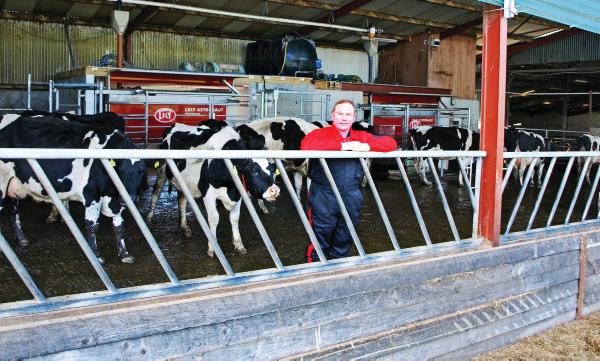
For weeks since then, Aidan and Anne have been entertaining visitors to look at the recently installed Lely milking robots.
I first visited Aidan and Anne in spring 2012 when the first robot had been installed. Since then, a second robot has been installed alongside the first robot. The Powers are milking all year round supplying Tipperary Co-op and they plan to milk 110 to 120 cows all year round post 2015.
This week, they are milking 85 cows as some of the autumn calving cows have been dried off.
When I met Aidan and Anne at the Tullamore Show this week, I asked them what does a farmer need to be considering if thinking about investing in a milking robot.
He said: “Consider if a robot would be suitable for your farm and farming system. Ideally, you need the farmyard near the centre of the farm and you need the grazing area in one block so that the cows can come and go from the robot at ease but a new farm road can make it possible also. One robot will comfortably milk 70 to 75 cows so you need to consider where your herd and farm business will be in five to 10 years time. This is probably the most important decision but it is also the most difficult for a lot of farms.”
capacity
The Power situation is such that Aidan has the capacity to graze the milking herd and make about 70% of the winter feed. This stocks the farm at 2.8 cows per hectare and means he can graze the herd and make about 70% of the winter feed.
While Aidan is limited in that he does not have the quota to allow him to milk 120 cows yet, he plans to milk this number post 2015.
Aidan and Anne have five girls who all help out on the farm when they are not in college and school.
The available grazing area, family situation and minor back pain were key considerations when Aidan and Anne were looking at their new milking investment. Aidan has postponed a back operation until farm development is completed.
I asked Aidan two of the most important lessons he has learned since starting with the robots. He said: “Firstly, grassland management is more important than ever because you are using grass to entice the cows back to the paddocks. Secondly, farm roadways need to be positioned so that cows can take a direct route over and back to the robot.
‘‘If cows have to walk at right angles they will not move between the parlour and the paddocks as often. Expecting cows to walk out a gate at the top of a paddock and then expecting them to walk back down a farm roadway alongside a paddock won’t work.
‘‘Instead, you need a gate at the bottom of the paddock so that cows can flow directly to the robot without any obstacles,” he said.
At all times, Aidan has two distinct and separate grazing areas so that when cows move from grazing one paddock they move back through the robot and out to the other grazing area. They soon get into the routine of knowing that when they go back through the robot, they will get fresh grass once they leave the robot at certain times of the day.
At the open day, Aidan said he very rarely has to sweep the paddock for cows except when cows are in one paddock in a corner of the farm, which is not in direct line of sight of the robot.
Lifestyle is another reason that the Powers decided to go with the milking robots. As Aidan said in Tullamore: “In our old parlour, if we were away for a Sunday, we would have to leave our visit early to get back for milking or else get somebody in to do the milking for us. With the robot, we don’t have to worry about heading home early for milking.”
There was a suggestion when milking robots first arrived in Ireland that cows would become more difficult to handle as the person to cow contact would be less but Aidan finds that the opposite is the reality.
He said: “Cows are actually more placid and nothing seems to upset them. Most of our cows will hardly get out of your way if you were walking behind them.”
herd health
Computer records obviously have a large role to play in managing herd health and milk quality.
Individual animal records mean that cell count per cow and cell count per quarter can be monitored on a regular basis.
If a cow needs to be treated or inseminated, Aidan will punch the cow’s number into the computer and when she is in the robot the next time she will be drafted into a holding pen beside the robot where she will wait until someone attends to her.
The Power herd is milking 23 litres per day on 2kg of meal per cow per day. Most cows are milked 2.2 to 2.3 times per day. Indoor systems can achieve a higher frequency of milking sometimes, heading for close to three times per day; hence cows are fed and managed for higher yields.
The retail price of installing one robot is approximately €120,000, with the same or slightly less money if installing a second robot.
Lely also offers the option of leasing a robot in the same way as you might lease a tractor.
A leased robot is not eligible for grant aid so some farmers who are installing two robots will usually buy one and maybe lease the other.
Key Points
Consider where your farm will be in five or 10 years time when making an investment in a milking robot.
Consider your farm infrastructure and where new roadways might or might not be necessary, so that cows have a direct route to the robot.
Lease option available for robots if capital is limiting.



SHARING OPTIONS