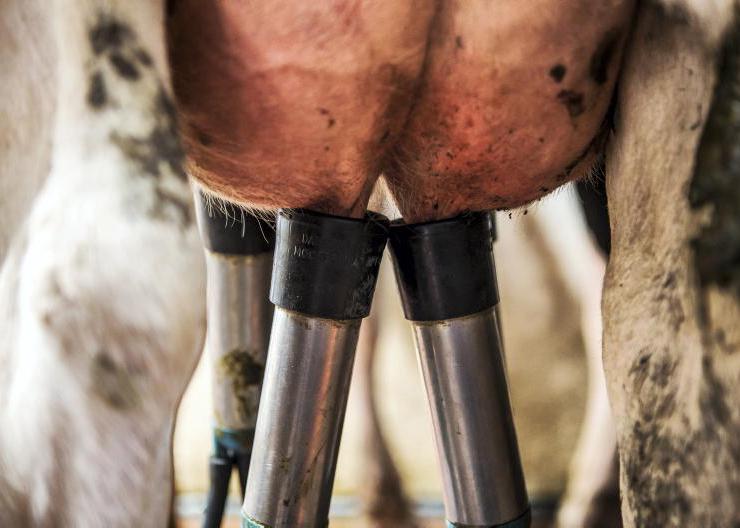
A more productive cow, producing more milk solids and eating more to do so, is the reason why slurry storage requirements per dairy cow are increasing, according to Teagasc director Frank O’Mara, who was speaking at the Listowel Food Fair last week.
O’Meara was answering a question in relation to the increase of slurry storage requirements of 21% for dairy farmers proposed in the draft Nitrates Action Plan released last month, with the proposed increase of storage set to come in to place by October 2028.
The 21% figure stems from recent research by Teagasc, which was commissioned by the Department of Agriculture to assess the production of slurry and soiled water on Irish dairy farms between winter 2023/2024 and winter 2024/2025, which showed that the current minimum requirements of 0.33m³/cow/week were inadequate with regard to slurry storage, and a figure of 0.4m³/cow/week was more appropriate.
Cost-effective slurry storage
Slurry storage was one of the main focal points at dairy day, with speakers on the topic being Bertie Troy of Grasstec, who complete planning applications and drafting of building designs for Irish and UK dairy and drystock farmers, and John Mulcahy of Mulcahy Steel Ltd, Co Cork, who himself is also a dairy farmer.
Slatted tank costs
Table 1 shows the costings associated with conventional slatted tanks, which are still the most common option for many farmers. The above costs include excavation of tank, supply of all reinforcing steel, concrete, mesh in floors, water bar, 225mm floor, 300mm wall, supply and fitting of tractor slats, two agitation points and backfilling of tank on completion.
John pointed out that 9ft (2.7m) deep tanks are now “nearly always the standard. Shuttering pans are nearly all 9ft x 8ft, and there is a lot of extra work in going to a 10ft tank. There are issues when you go deeper; agitating, sucking slurry and digging out deeper tanks, with water and rock being the main ones. When you meet rock, you are talking of €100 to €120/hour for breaking”.
As can be seen from the table, the larger the capacity, the reduced cost per cow, though this could be negated where rock is hit should a farmer wish to go to a 10ft (3m) tank.
“It’s one part of farm buildings where the bigger you go, the cheaper it gets. With sheds, your shed price is your shed price [per bay], but on tanks, you can see it’s nearly half the cost [per gallon/ cubic metre] when you compare the larger tank in the table with the smaller one,” highlighted John.
“There’s no point building what you need, because it’s changing so fast [the requirements], and this probably isn’t the end of it. There aren’t a whole lot of greenfield sites going on at the minute. If I had the option to do it myself again in the morning, I would put a tank under all the cubicle shed and slat the whole lot of it, but people haven’t that option with existing sheds, so I think they need to look at external options with flow channels or pumps.”

John Mulcahy, Mulcahy Steel and Bertie Troy, Grasstec speaking during the Irish Farmers Journal Dairy Day in the UL Sports Arena, Limerick. \ Donal O' Leary
Slurry towers/outdoor concrete tanks
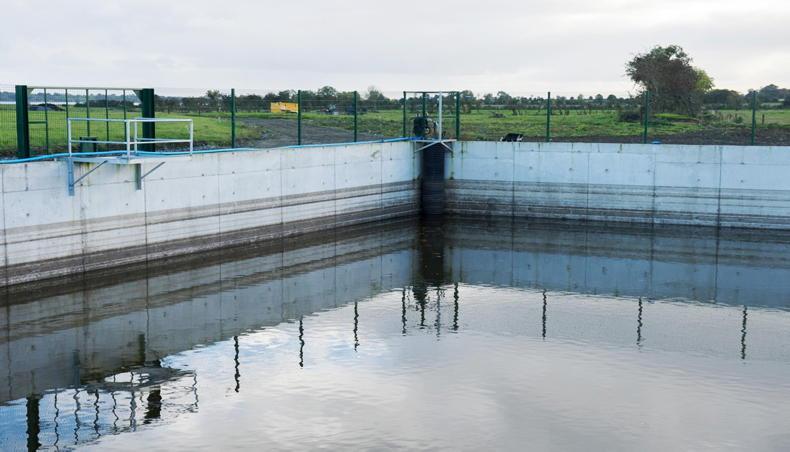
Costings around slurry storage in over-ground towers and outdoor concrete tanks are listed in Tables 2 and 3. John pointed out that less labour was associated with outdoor concrete tanks when it came to spreading of slurry for farmers or contractors, there was a reduced labour demand with these systems, as farmers or contractors are “not going around to five or six different tanks in the yard mixing them”.
The costings for the slurry tower include stripping site, supply and placing of stone, supply and placing of mesh, supply and placing of concrete, supply and erection of tank (three rings high), with the tanks including a ladder, platform and jetter.
Reception tanks are not included and neither are roofs, agitators or suck off point. The cost of suck off point is €2,500 + VAT, while the cost of agitator €3,700+VAT
Cheapest option
The cheapest option presented on the day was the outdoor concrete tanks, with the cost comparison between all three shown in table 4.
“For anyone who needs slurry storage but doesn’t need additional housing, build an outdoor [concrete] tank. They’re so easy to work with. If you go up to 600,000 or 700,000 gallons, they’re going to get cheaper still.
“Everything is included in the construction of that tank; excavation, mesh, concrete, fencing around it, agitation points,” stated John.
When queried on why wouldn’t a farmer just slat the tank on day one, cost was the main driver.
“Where do you stop? If someone want cheap storage and a lot of storage, they want an outdoor tank. We always design them so they can be slatted down the line.”
How is construction faring?
John highlighted that there was a large volume of work now going to both slurry storage and cattle underpasses, with TAMS aid being a driver in both of these.
“Agricultural building works has been very, very steady since Covid, and even before that.”
Bertie Troy pointed out that while 2023 and 2024 had been quite, there had been an increase in the last year.
“From late last year, we saw a resurgence in people looking to do work in their yards; I would say 70% of that is in relation to slurry storage related, followed by calf housing and milking parlours. Clarity around derogation would help.”
A more productive cow, producing more milk solids and eating more to do so, is the reason why slurry storage requirements per dairy cow are increasing, according to Teagasc director Frank O’Mara, who was speaking at the Listowel Food Fair last week.
O’Meara was answering a question in relation to the increase of slurry storage requirements of 21% for dairy farmers proposed in the draft Nitrates Action Plan released last month, with the proposed increase of storage set to come in to place by October 2028.
The 21% figure stems from recent research by Teagasc, which was commissioned by the Department of Agriculture to assess the production of slurry and soiled water on Irish dairy farms between winter 2023/2024 and winter 2024/2025, which showed that the current minimum requirements of 0.33m³/cow/week were inadequate with regard to slurry storage, and a figure of 0.4m³/cow/week was more appropriate.
Cost-effective slurry storage
Slurry storage was one of the main focal points at dairy day, with speakers on the topic being Bertie Troy of Grasstec, who complete planning applications and drafting of building designs for Irish and UK dairy and drystock farmers, and John Mulcahy of Mulcahy Steel Ltd, Co Cork, who himself is also a dairy farmer.
Slatted tank costs
Table 1 shows the costings associated with conventional slatted tanks, which are still the most common option for many farmers. The above costs include excavation of tank, supply of all reinforcing steel, concrete, mesh in floors, water bar, 225mm floor, 300mm wall, supply and fitting of tractor slats, two agitation points and backfilling of tank on completion.
John pointed out that 9ft (2.7m) deep tanks are now “nearly always the standard. Shuttering pans are nearly all 9ft x 8ft, and there is a lot of extra work in going to a 10ft tank. There are issues when you go deeper; agitating, sucking slurry and digging out deeper tanks, with water and rock being the main ones. When you meet rock, you are talking of €100 to €120/hour for breaking”.
As can be seen from the table, the larger the capacity, the reduced cost per cow, though this could be negated where rock is hit should a farmer wish to go to a 10ft (3m) tank.
“It’s one part of farm buildings where the bigger you go, the cheaper it gets. With sheds, your shed price is your shed price [per bay], but on tanks, you can see it’s nearly half the cost [per gallon/ cubic metre] when you compare the larger tank in the table with the smaller one,” highlighted John.
“There’s no point building what you need, because it’s changing so fast [the requirements], and this probably isn’t the end of it. There aren’t a whole lot of greenfield sites going on at the minute. If I had the option to do it myself again in the morning, I would put a tank under all the cubicle shed and slat the whole lot of it, but people haven’t that option with existing sheds, so I think they need to look at external options with flow channels or pumps.”

John Mulcahy, Mulcahy Steel and Bertie Troy, Grasstec speaking during the Irish Farmers Journal Dairy Day in the UL Sports Arena, Limerick. \ Donal O' Leary
Slurry towers/outdoor concrete tanks
Costings around slurry storage in over-ground towers and outdoor concrete tanks are listed in Tables 2 and 3. John pointed out that less labour was associated with outdoor concrete tanks when it came to spreading of slurry for farmers or contractors, there was a reduced labour demand with these systems, as farmers or contractors are “not going around to five or six different tanks in the yard mixing them”.
The costings for the slurry tower include stripping site, supply and placing of stone, supply and placing of mesh, supply and placing of concrete, supply and erection of tank (three rings high), with the tanks including a ladder, platform and jetter.
Reception tanks are not included and neither are roofs, agitators or suck off point. The cost of suck off point is €2,500 + VAT, while the cost of agitator €3,700+VAT
Cheapest option
The cheapest option presented on the day was the outdoor concrete tanks, with the cost comparison between all three shown in table 4.
“For anyone who needs slurry storage but doesn’t need additional housing, build an outdoor [concrete] tank. They’re so easy to work with. If you go up to 600,000 or 700,000 gallons, they’re going to get cheaper still.
“Everything is included in the construction of that tank; excavation, mesh, concrete, fencing around it, agitation points,” stated John.
When queried on why wouldn’t a farmer just slat the tank on day one, cost was the main driver.
“Where do you stop? If someone want cheap storage and a lot of storage, they want an outdoor tank. We always design them so they can be slatted down the line.”
How is construction faring?
John highlighted that there was a large volume of work now going to both slurry storage and cattle underpasses, with TAMS aid being a driver in both of these.
“Agricultural building works has been very, very steady since Covid, and even before that.”
Bertie Troy pointed out that while 2023 and 2024 had been quite, there had been an increase in the last year.
“From late last year, we saw a resurgence in people looking to do work in their yards; I would say 70% of that is in relation to slurry storage related, followed by calf housing and milking parlours. Clarity around derogation would help.”
SHARING OPTIONS