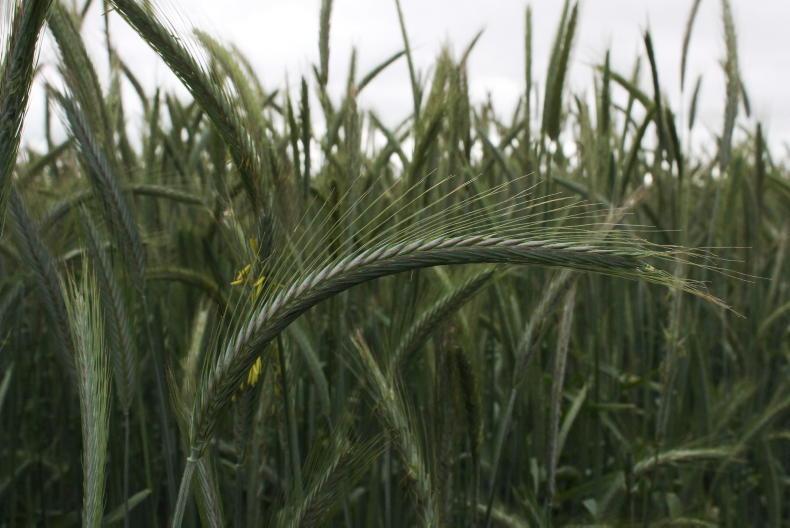
Rye is a minor crop in Ireland but there has been increasing interest in it in recent years. But markets are limited and growers should only contemplate growing rye where they have secured a market.
Recent work at Oak Park indicates that modern hybrid rye varieties have high yield potential, comparable to winter wheat (see Figure 1).

Figure 1. Previous research has shown that rye yields have been very much on par with winter wheat.
It is less affected by take-all than either wheat or barley and has good foliar disease resistance, although it can be susceptible to mildew and brown rust.
Ergot susceptibility was an issue in the past but it is much less of an issue in modern hybrids.
Rye has good nutrient use efficiency and has been shown to be more drought tolerant than other cereals.
All of this indicates that rye could be a very suitable crop for Irish conditions while helping to alleviate issues associated with the reduced sensitivity of some diseases to fungicides and the need to reduce fertiliser inputs.
There is little research on rye under Irish conditions and the current work aims to correct this
A major challenge is the fact that rye is tall, which increases the risk of lodging. But this is usually root roll rather than stem buckling and it requires careful use of fertiliser N and plant growth regulator. There is little research on rye under Irish conditions and the current work aims to correct this.
Seed rates, sowing dates, fertiliser
This agronomy research on rye aims to provide science-based advice to growers. Sowing dates (mid-September, early October, late October) and seed rate (70 seeds/m2 to 400 seeds/m2) combinations are being examined.
This research is also looking at appropriate rates and timings for fertiliser N to optimise yield while minimising the lodging risk. Varieties are also being examined.
The effect of PGR programmes on plant height, lodging and grain yield are also being evaluated.
One of these trials will be on show at the trials event comparing none, one and two PGR applications at two N rates on two contrasting varieties.
Robust against weather
This research will provide agronomy guidance for winter hybrid rye production in Ireland.
Observations from previous trials indicate that rye is less likely than wheat to suffer yield loss or grain quality deterioration as a result of storm events or delayed harvests.
In the trial itself, height effects of PGR on rye have been modest to date, with PGR-treated plots being only marginally shorter than untreated plots. This may be a result of the cool temperatures during stem extension period last spring.
Rye is a minor crop in Ireland but there has been increasing interest in it in recent years. But markets are limited and growers should only contemplate growing rye where they have secured a market.
Recent work at Oak Park indicates that modern hybrid rye varieties have high yield potential, comparable to winter wheat (see Figure 1).
Figure 1. Previous research has shown that rye yields have been very much on par with winter wheat.
It is less affected by take-all than either wheat or barley and has good foliar disease resistance, although it can be susceptible to mildew and brown rust.
Ergot susceptibility was an issue in the past but it is much less of an issue in modern hybrids.
Rye has good nutrient use efficiency and has been shown to be more drought tolerant than other cereals.
All of this indicates that rye could be a very suitable crop for Irish conditions while helping to alleviate issues associated with the reduced sensitivity of some diseases to fungicides and the need to reduce fertiliser inputs.
There is little research on rye under Irish conditions and the current work aims to correct this
A major challenge is the fact that rye is tall, which increases the risk of lodging. But this is usually root roll rather than stem buckling and it requires careful use of fertiliser N and plant growth regulator. There is little research on rye under Irish conditions and the current work aims to correct this.
Seed rates, sowing dates, fertiliser
This agronomy research on rye aims to provide science-based advice to growers. Sowing dates (mid-September, early October, late October) and seed rate (70 seeds/m2 to 400 seeds/m2) combinations are being examined.
This research is also looking at appropriate rates and timings for fertiliser N to optimise yield while minimising the lodging risk. Varieties are also being examined.
The effect of PGR programmes on plant height, lodging and grain yield are also being evaluated.
One of these trials will be on show at the trials event comparing none, one and two PGR applications at two N rates on two contrasting varieties.
Robust against weather
This research will provide agronomy guidance for winter hybrid rye production in Ireland.
Observations from previous trials indicate that rye is less likely than wheat to suffer yield loss or grain quality deterioration as a result of storm events or delayed harvests.
In the trial itself, height effects of PGR on rye have been modest to date, with PGR-treated plots being only marginally shorter than untreated plots. This may be a result of the cool temperatures during stem extension period last spring.







SHARING OPTIONS