


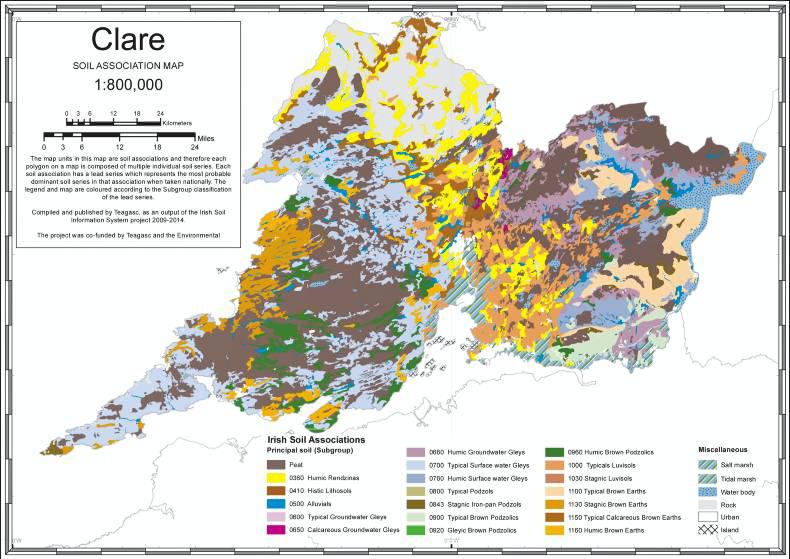
The Burren, situated in the northwest of Co Clare, is one of the largest karst landscapes in Europe and is home to an extensive assemblage of flora and fauna. This landscape is comprised of limestone pavement and the soils found here include rendzinas (shallow calcareous soils found over limestone bedrock), calcareous brown earths (well-draining) and luvisols (movement of clay down the soil profile).
The mild climate coupled with a high soil pH, associated with the calcareous nature of the soils, mean that the Burren has one of the longest grass-growing seasons in Ireland, producing grass that is sweeter for grazing. Further south, stretching from Ennistymon to Loop Head, the majority of the landscape can be described as undulating wet shale bedrock with glacial drift materials including sandstones and shale.
Glacial drift
In the east, the tract between Scarriff and Tulla has the same bedrock. However, the landscape here features more upland hills, with glacial drift accumulating only in the lowland areas.
In Co Clare, surface-water gleys dominate the landscape and represent the majority of all soils found here. These soils form due to the presence of a slowly permeable subsurface layer found on heavy glacial till which gives rise to heavy textured sub-soils.
As a result, these soils are poorly drained, making them difficult to work with. The most prevalent of these is the Kilrush series (found in association 0700b led by subgroup 0700), originally classified in the 1971 in-depth survey of Co Clare as part of the National Soil Survey. This indicates the first location at which this soil series was classified, but today the Kilrush series is found in 16 counties outside of Clare.
The next most prevalent soil found is the ‘Burren’ series (found in association 0360a led by subgroup 0360), which reaches from the high Burren in the northwest to the low Burren that runs through the centre of the county southwards towards Shannon town.
Shallow soils
These are typically humic rendzinas (calcareous) and similar soils which have been decalcified (no longer calcareous above the bedrock). These are shallow soils overlying hard rock with a humose top layer indicating high organic matter content.
Luvisols are also common, found in the low Burren and towards Tulla. The movement of clay from the topsoil down the profile and deposited further down the subsoil means that these are very good agricultural soils due to their higher clay content as they retain nutrients well.
However, the increased clay in the subsoil can slow down the movement of water through the profile, meaning that these soils can be moderately to poorly draining, depending on the soil texture.


SHARING OPTIONS