



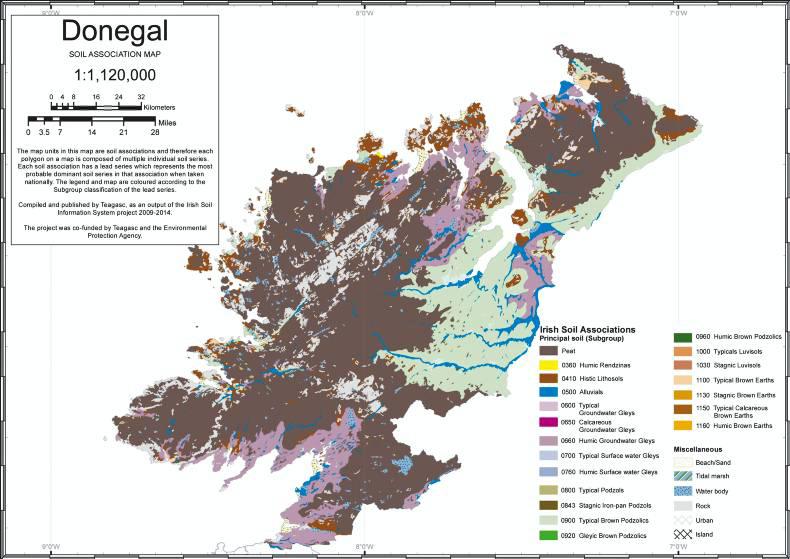
Donegal is home to the sixth-highest sea cliffs in Europe, one of Ireland’s six national parks, a mountainous landscape and a deeply indented coastline, all of which results in a countryside that is beautifully shaped.
The majority of this landscape, particularly the east coast, comprises valleys and depressions in drift (glacial deposits) from acid igneous rock, which are rocks that have formed through the cooling and solidification of magma or lava.
Further west, around Glenveagh National Park, the landscape is better represented by thin peat over steep rocks such as those on the Derryveagh Mountains. There is also evidence of both eroding and cut-over peat in the county. Cut-over refers to peat soils that have had the surface peat removed by hand-cutting methods but the remaining peat depth is still sufficient for these to be classified as peat soils. Overall, peat is the central feature on the Donegal landscape, with both shallow peat soils and some well-developed blanket bogs.
Although the county is dominated by peat landscapes, brown podzolic soils are also prevalent, occupying the valleys and depressions of the east coast of the county from the area around Ballybofey up to the northeast around Moville.
The soils of east Donegal are the most productive soils of the county. Brown podzolic soils have lost much of their nutrients, especially iron and aluminium, as a result of acidic conditions and high rainfall over time. Consequently, these soils can be considered nutrient poor and may benefit from liming periodically. They are naturally free-draining and should not require any additional drainage. Almost all of the brown podzolic soils in Donegal are of the Cupidstownhill series (found in association 0900g led by subgroup 0900).These are predominantly brown podzolic soils found on undulating shale or slate bedrock.
Groundwater gleys
Humic groundwater gleys can also be found in Donegal. Groundwater gley soils have a high groundwater table. This results in waterlogging to within 40cm of the surface for prolonged periods, which results in a grey colour throughout the profile, referred to as gleying.
In Donegal, the groundwater gleys are humic, indicative of topsoil that is high in organic matter. Most of these are found closest to coastal areas around Donegal, including around Ballyshannon in the south of the county and Milford towards the north.
Histic lithosol soils are also found, particularly in coastal locations around the northwest such as those near Dunfanaghy. These are acidic shallow soils with a pH of less than 6.5, and are commonly associated with mountain landscapes and occur on acidic parent rocks, such as sandstone.


SHARING OPTIONS