



First let’s look at the why. Producing high yielding wheat crops is not an easy task -- it takes skill and knowledge. Overseas growers look at Ireland’s high yields and think “what an easy life”! Plant the crop and let Mother Nature do the rest.
Unfortunately this is as far from reality as is possible. Take this season so far. Crop establishment, while not bad, was not perfect given the wet October weather.
The early spring was nice and dry but, when it came to the critical timings to apply the T1 and T2 fungicides, broken weather and wind again made life difficult. Coupled with this, the continued reduction in sensitivity to the fungicides we need to protect our crops has meant that getting timings right has become even more important.
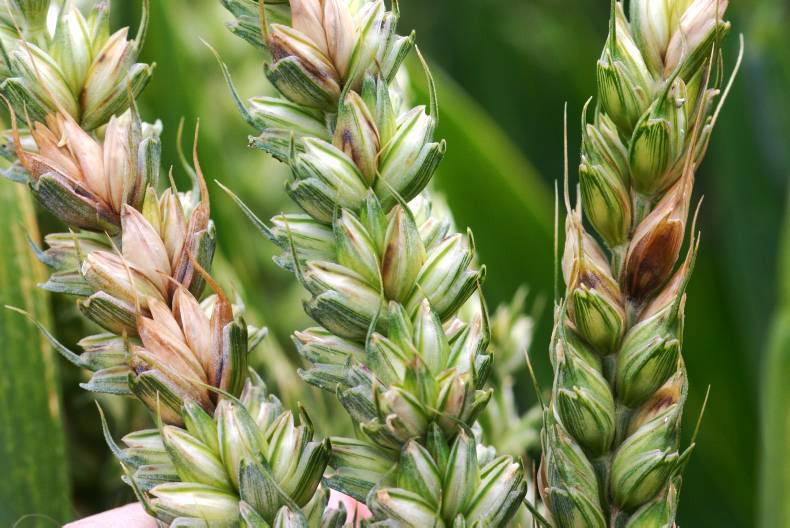
Even if you bring gleaming crops through all of these adversities there are still more threats. The wrong climatic conditions during flowering can trigger the development of diseases such as fusarium head blight (FHB) and all of your previous good work can be undone. You only have to look back as far as 2012 to recall the effects that these diseases can have.
Fusarium is often viewed as a once-in-five-year occurrence and 2012 was definitely one of those years. However, in the absence of an extremely accurate forecasting system, fusarium has the potential to singularly wipe out any potential profits if protection against infection is not undertaken.
Furthermore, unlike septoria, it is not a single specific pathogen but a complex of different pathogens, some of which even belong to different species. And, depending on the ones that infect the plant, the complex can not only cause significant yield reductions, but also quality hits in terms of grain fill and grain contamination by mycotoxins.
In addition to providing fusarium control, the final fungicide application also serves to top-up the protection of the final leaves (particularly the flag leaf at this stage) which are contributing most to yield and need to be kept free from significant disease for as long as possible. In Irish crops, this means septoria prevention.
Protecting against the unknown
The common factor shared between the major diseases which threaten Irish crops (other than their impact on yield) is their affinity to wet weather. As the first country to feel the brunt of the Gulf Stream after it makes its way across the Atlantic, Ireland is both blessed and cursed by a weather pattern that can throw almost all four seasons in the space of an hour. It is these conditions that allow Irish wheat yields to be world leaders.
However, the same conditions also enable specific fungi to do serious damage. As described above, without an extremely accurate weather forecasting system, there is always the risk that leaving wheat crops untreated during flowering could be risking potential yields.
Fusarium head blight (FHB) is one of those wet weather diseases. In wet conditions, spores of the pathogen will be splashing about at many times throughout the season, particularly as the temperatures increase. If wet humid conditions occur during flowering, these spores will infect and grow in the developing grains.
When this happens, the disease not only restricts the filling of the infected sites, but it can also restrict filling in surrounding grain sites. While one or two infected heads in a field is not an issue, a whole field of infected heads is. And in 2012 it was estimated from trials that FHB caused as much as 1.5t/ha yield reductions when left unchecked.
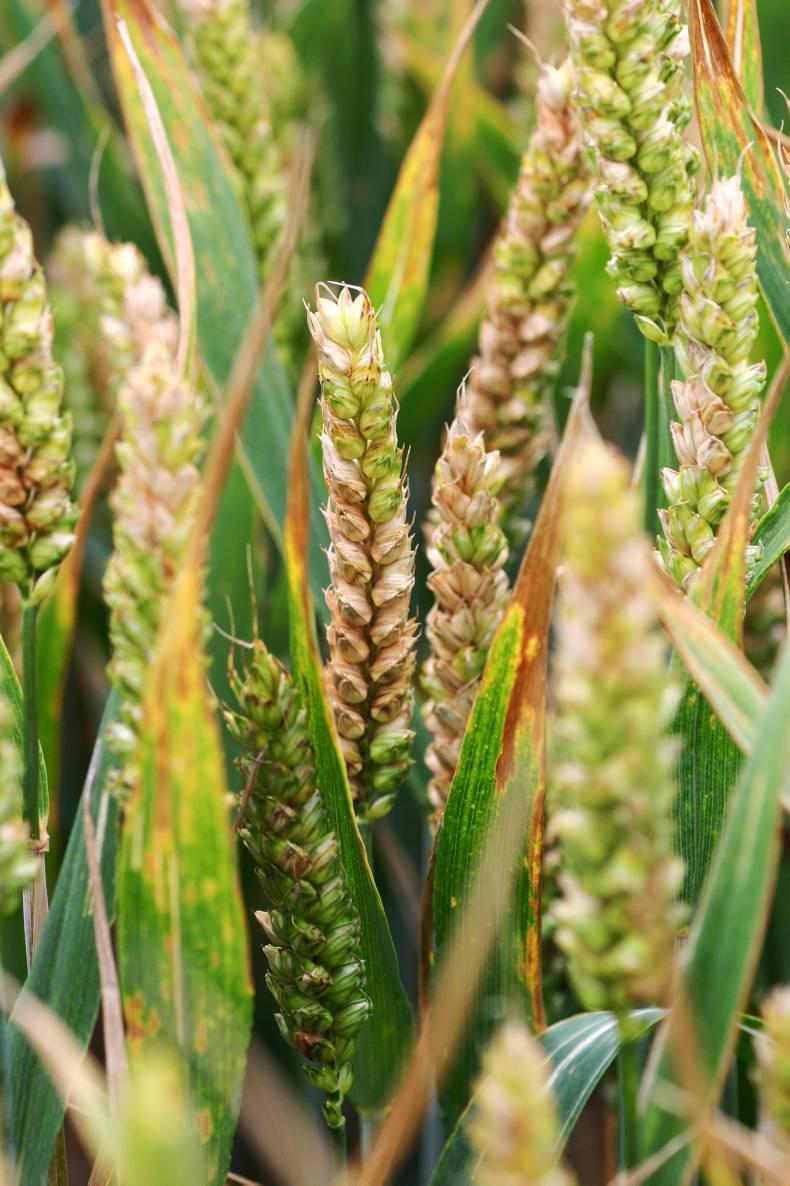
Septoria is also a wet weather disease. Fungicide programmes are designed to protect the upper leaves from disease so that they can fill the grains that are created following fertilisation during flowering. Where good T1s and T2s have been applied, a big chunk of its control is complete.
From a septoria control perspective, the final spray is applied to help ensure that the crop gets maximum protection to enable it to fill all these grains to the maximum. This does not necessarily mean that one needs four clean leaves up until the end of senescence. The objective is more one of protecting the upper leaves in a typical crop from infection until around mid-July when it is at peak grain filling.
How to achieve these goals?
Applying a fungicide targeting FHB midway through flowering is one’s best means of protecting wheat ears against the unpredictability of Irish weather and its associated diseases. This season may well turn out to be similar to 2014, when all the rain fell prior to flowering. As soon as anthers started to appear on the ears, a ridge of a blocking high pressure appeared which provided the dry weather which stopped fusarium development in its tracks.
However, it may not be a similar weather pattern to 2014 and protection may prove essential. The best option to control the range of pathogens that cause FHB is the azole fungicides – prothioconazole, tebuconazole and metconazole. Among these the most effective products from trials tend to be the mix of prothioconazole and tebuconazole in the form of Prosaro.
Alternatives include metconazole in Caramba, or in mixture with epoxiconazole as Gleam; tebuconazole as a straight in various forms or in mixture with difenconazole in Magnello. These latter options can, however, be weaker than prothioconazole on Microdochium species which can, depending on the season, be the dominant pathogen.
What must be remembered is that the fungicide needs to be present when infection occurs to provide satisfactory protection as there is only so much the active(s) can do once infection has already occurred.
When the efficacy of individual actives against FHB is logged, they often come up short compared to their efficacy against other diseases. One of the reasons for this is that it is unlikely that complete protection can be achieved, even with the most active product. The crop flower over a number of days and this makes the achievement of perfect protection virtually impossible.
If weather conditions which suit FHB infection occur, some level of disease can always be expected. The challenge is to protect as many flowers and hence grain sites as possible. Too early and you miss the bulk of them, too late and infection may already be in.
Finally, when topping up septoria control, the increased efficacy afforded by the azole mixtures becomes important.
Straight azoles no longer have the required efficacy for septoria control when applied alone.
From a disease control point of view, the benefit of the addition of a multisite will depend largely on the season and how successful disease control has been up to that point.
The multisite may benefit in protecting the azoles from further resistance selection.




SHARING OPTIONS