‘Tis the season for food-filled celebrations, but ‘tis also the season where we see more wild Irish game, like pheasant and venison, on restaurant menus. Irish wild venison is particularly delicious with a rich flavour, tender texture and slight sweetness.
While thoughts of deer hunting might bring up traumatic Bambi-induced childhood flashbacks, the fact is that with a notable absence of natural predators, like wolves, most Irish deer populations are thriving. And their eating habits are having an adverse impact on native woodland.
Most deer found in Ireland are not native to the country but one population of red deer, found in Co Kerry, is a native species. These deer are protected and cannot be hunted. For other deer found in Ireland (which include non-native red deer, Sika deer, fallow deer and Muntjac deer), population management via hunting is considered a sustainability measure. All hunters must be licensed by the National Parks and Wildlife Service (NPWS) and adhere to strict regulations.
Irish consumers enjoy venison, but not regularly. The majority of Irish venison is exported to the UK and continental Europe. Many believe we should be eating more venison, though, and not just in restaurant settings. It is a healthy, lean protein, rich in amino acids, vitamins and minerals.
Future Oak Farm
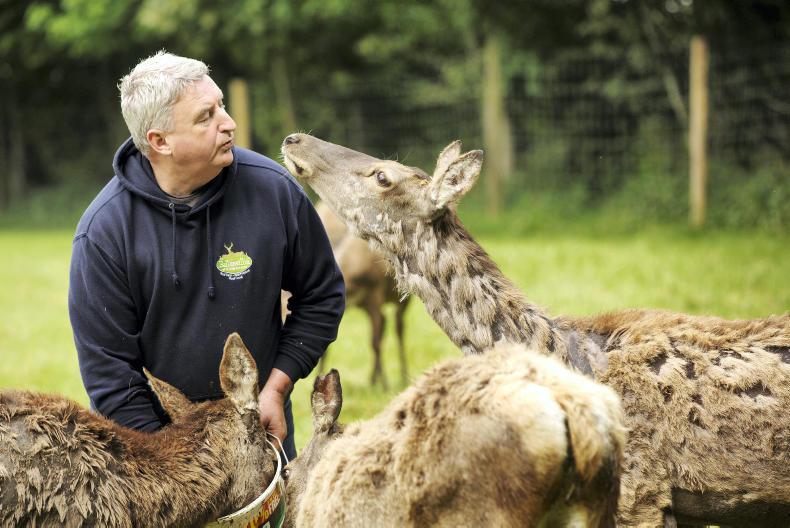
For several years, John Duffy has been managing the non-native red deer population on his family’s seven-generation farm near the Glenveagh National Park in Co Donegal. His farm, called Future Oak Farm (@futureoakfarm on Instagram), is fully regenerative, using a holistic planned grazing method for his beef herd over 130ac of uplands.
“I grew up on this farm,” he tells Irish Country Living. “I left at 17, studied an engineering degree and worked all over the world in gas and oil exploration. Thirteen years in, I had an epiphany. I couldn’t do [that kind of work] anymore. [At Future Oak Farm], we design agricultural enterprises which support development and complexity in our local ecosystem. We market our beef directly to consumers.”
The driving force behind the Future Oak Farm project has been John’s desire to bring the land back to its former native woodland glory – and this has also led to the need to manage the deer, which he is fully licensed to hunt.
“In Irish, the Derryveagh Mountain chain is known as Cnoic Dhoire Bheatha, or ‘The Hills of Oak and Birch,’” he explains. “But when you look at the hills today, there are no oak or birch to be seen. This is down to three separate events: first, in the mid-1700s, there was the eradication of the wolf. Second, in the early-1800s, we saw the reintroduction of a non-indigenous red deer herd. Third was the clearance of people with the Derryveagh evictions in 1861. Off the back of that, you have a shift from pastoral grazing management to [more] intensive sheep farming. When you turn up the grazing pressure, the first things to disappear are saplings and generational renewal.
“It’s not about eradicating the deer; it’s about behaviour change. When they realise they are being predated, they begin to avoid certain areas. That’s when we see native woodland systems begin to regenerate.”
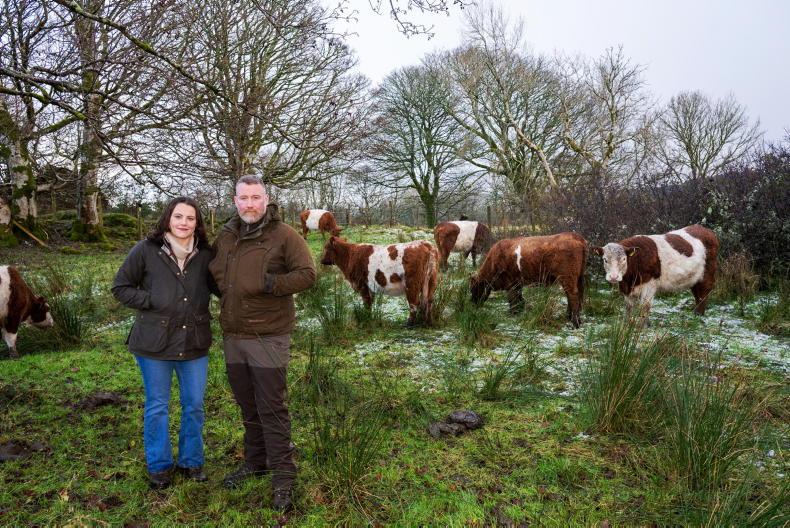
John Duffy and Laura McGowan, Wild and Co Venison, Co Donegal. \ Clive Wasson
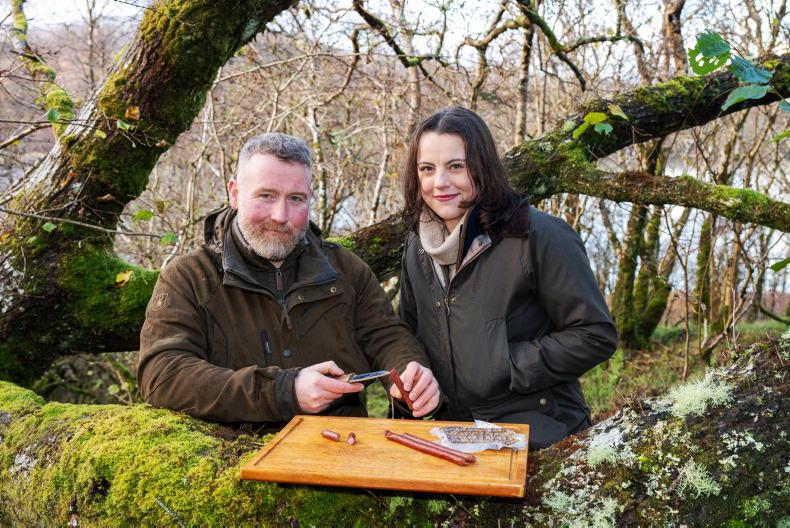
With so much venison at his doorstep, John wanted to explore ways to make its consumption more accessible to every-day Irish consumers. Last year, he and his partner, Laura McGoran, developed a start-up called Wild & Co, which creates high protein venison snacks. The idea took form when they signed up to an Alpha Innovation boot camp to stress-test venison product ideas.
“We were thinking: what market is seeking a solution?” Laura explains. “I have a background in competing in strength sports, for power lifting. From that background, I have a real ‘thing’ about reading the back of labels and understanding protein content. I was thinking, ‘This venison is an amazing protein source – is there a way to make it not just convenient and accessible, but also delicious, for the on-the-go protein market?’”
Fast-forward a year, and Wild & Co are now nearly ready to launch their Wild Venison Protein Snacks onto the Irish market. These snacks have a 12-month shelf life and are well-suited to grab-and-go sections in shops and supermarkets. Unlike jerky or biltong, they have no sugars or artificial preservatives. Each snack contains 23g of protein and is naturally low in calories. They currently come in two flavours: garlic & black pepper, and chilli & garlic.
The venison is sourced through an approved game handling facility and a wholesaler who is tied into the wild Irish venison network.
After the Alpha Innovation boot camp, John and Laura continued their product development through Enterprise Ireland’s New Frontiers programme (which helps first-time business owners access financing and develop ideas) and with the support of the Foodovation Centre in Derry.
“Core to our ethics was to create a product which didn’t have artificial preservatives,” Laura says. “Whenever we worked with our food technologist [at the Foodovation Centre] it was amazing to learn you can make anything last for 12 months if you just throw a load of preservatives in. When we said we wanted an ambient, shelf stable product with 12-month shelf life and no artificial preservatives, that was the challenge.
“The supports we’ve received from Enterprise Ireland have been incredible,” John adds. “We were able to access an innovation voucher which funded our relationship with the food technologists. We recently got our shelf-life testing and nutritional information back, and we got the results we wanted.”
Next steps
Now, Laura and John are ready to move into a production facility to get the venison ball rolling. They launched a Kickstarter campaign, which ran until 5 December, with a goal of raising €5,000 toward their business launch – they reached that goal within the first five days of the campaign and ended up with nearly double that amount. This is a hopeful indication of market demand when it becomes available in shops.
They plan to be in their new facility, located in north Donegal, by early February 2026 and have their first product out in shops by March. Over the Christmas season, they will launch their online shop for pre-orders, with Kickstarter supporters and pre-sales customers being the
first to receive product once it is launched.
“In an age of supply chain issues and the climate crisis, we are seeking out measures to support regeneration of our own native flora and fauna which is dwindling and well-documented,” John says. “Sourcing a protein from an indigenous source is an incredible opportunity to vote with your spending power.”
wildandco.ie
‘Tis the season for food-filled celebrations, but ‘tis also the season where we see more wild Irish game, like pheasant and venison, on restaurant menus. Irish wild venison is particularly delicious with a rich flavour, tender texture and slight sweetness.
While thoughts of deer hunting might bring up traumatic Bambi-induced childhood flashbacks, the fact is that with a notable absence of natural predators, like wolves, most Irish deer populations are thriving. And their eating habits are having an adverse impact on native woodland.
Most deer found in Ireland are not native to the country but one population of red deer, found in Co Kerry, is a native species. These deer are protected and cannot be hunted. For other deer found in Ireland (which include non-native red deer, Sika deer, fallow deer and Muntjac deer), population management via hunting is considered a sustainability measure. All hunters must be licensed by the National Parks and Wildlife Service (NPWS) and adhere to strict regulations.
Irish consumers enjoy venison, but not regularly. The majority of Irish venison is exported to the UK and continental Europe. Many believe we should be eating more venison, though, and not just in restaurant settings. It is a healthy, lean protein, rich in amino acids, vitamins and minerals.
Future Oak Farm
For several years, John Duffy has been managing the non-native red deer population on his family’s seven-generation farm near the Glenveagh National Park in Co Donegal. His farm, called Future Oak Farm (@futureoakfarm on Instagram), is fully regenerative, using a holistic planned grazing method for his beef herd over 130ac of uplands.
“I grew up on this farm,” he tells Irish Country Living. “I left at 17, studied an engineering degree and worked all over the world in gas and oil exploration. Thirteen years in, I had an epiphany. I couldn’t do [that kind of work] anymore. [At Future Oak Farm], we design agricultural enterprises which support development and complexity in our local ecosystem. We market our beef directly to consumers.”
The driving force behind the Future Oak Farm project has been John’s desire to bring the land back to its former native woodland glory – and this has also led to the need to manage the deer, which he is fully licensed to hunt.
“In Irish, the Derryveagh Mountain chain is known as Cnoic Dhoire Bheatha, or ‘The Hills of Oak and Birch,’” he explains. “But when you look at the hills today, there are no oak or birch to be seen. This is down to three separate events: first, in the mid-1700s, there was the eradication of the wolf. Second, in the early-1800s, we saw the reintroduction of a non-indigenous red deer herd. Third was the clearance of people with the Derryveagh evictions in 1861. Off the back of that, you have a shift from pastoral grazing management to [more] intensive sheep farming. When you turn up the grazing pressure, the first things to disappear are saplings and generational renewal.
“It’s not about eradicating the deer; it’s about behaviour change. When they realise they are being predated, they begin to avoid certain areas. That’s when we see native woodland systems begin to regenerate.”

John Duffy and Laura McGowan, Wild and Co Venison, Co Donegal. \ Clive Wasson
With so much venison at his doorstep, John wanted to explore ways to make its consumption more accessible to every-day Irish consumers. Last year, he and his partner, Laura McGoran, developed a start-up called Wild & Co, which creates high protein venison snacks. The idea took form when they signed up to an Alpha Innovation boot camp to stress-test venison product ideas.
“We were thinking: what market is seeking a solution?” Laura explains. “I have a background in competing in strength sports, for power lifting. From that background, I have a real ‘thing’ about reading the back of labels and understanding protein content. I was thinking, ‘This venison is an amazing protein source – is there a way to make it not just convenient and accessible, but also delicious, for the on-the-go protein market?’”
Fast-forward a year, and Wild & Co are now nearly ready to launch their Wild Venison Protein Snacks onto the Irish market. These snacks have a 12-month shelf life and are well-suited to grab-and-go sections in shops and supermarkets. Unlike jerky or biltong, they have no sugars or artificial preservatives. Each snack contains 23g of protein and is naturally low in calories. They currently come in two flavours: garlic & black pepper, and chilli & garlic.
The venison is sourced through an approved game handling facility and a wholesaler who is tied into the wild Irish venison network.
After the Alpha Innovation boot camp, John and Laura continued their product development through Enterprise Ireland’s New Frontiers programme (which helps first-time business owners access financing and develop ideas) and with the support of the Foodovation Centre in Derry.
“Core to our ethics was to create a product which didn’t have artificial preservatives,” Laura says. “Whenever we worked with our food technologist [at the Foodovation Centre] it was amazing to learn you can make anything last for 12 months if you just throw a load of preservatives in. When we said we wanted an ambient, shelf stable product with 12-month shelf life and no artificial preservatives, that was the challenge.
“The supports we’ve received from Enterprise Ireland have been incredible,” John adds. “We were able to access an innovation voucher which funded our relationship with the food technologists. We recently got our shelf-life testing and nutritional information back, and we got the results we wanted.”
Next steps
Now, Laura and John are ready to move into a production facility to get the venison ball rolling. They launched a Kickstarter campaign, which ran until 5 December, with a goal of raising €5,000 toward their business launch – they reached that goal within the first five days of the campaign and ended up with nearly double that amount. This is a hopeful indication of market demand when it becomes available in shops.
They plan to be in their new facility, located in north Donegal, by early February 2026 and have their first product out in shops by March. Over the Christmas season, they will launch their online shop for pre-orders, with Kickstarter supporters and pre-sales customers being the
first to receive product once it is launched.
“In an age of supply chain issues and the climate crisis, we are seeking out measures to support regeneration of our own native flora and fauna which is dwindling and well-documented,” John says. “Sourcing a protein from an indigenous source is an incredible opportunity to vote with your spending power.”
wildandco.ie
SHARING OPTIONS