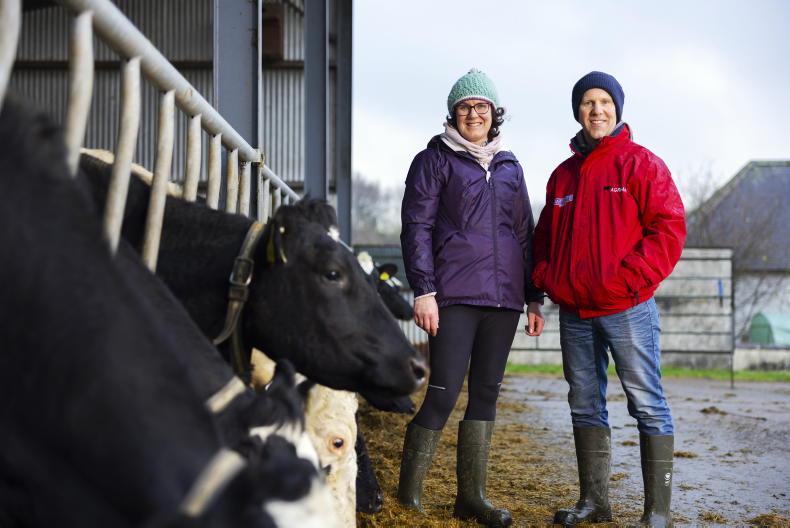
Robert and Tom Craig farm in partnership on the shores of Lough Foyle near Limavady. The brothers farm a total of 500 acres across four land blocks.
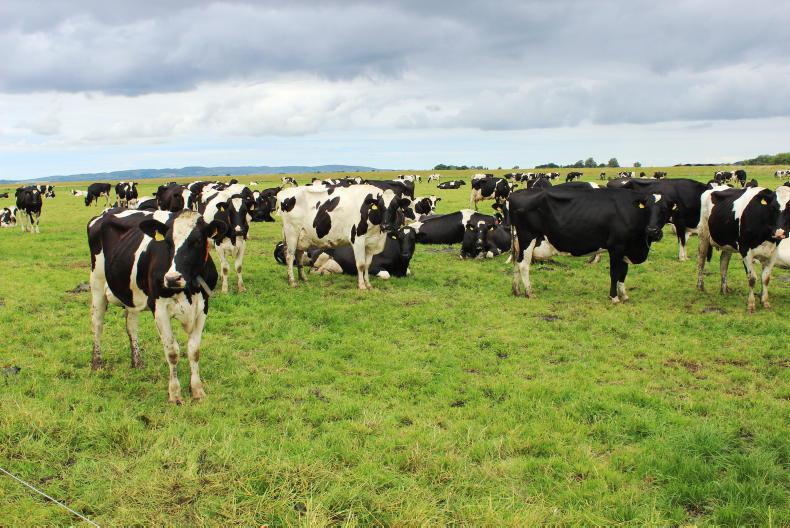
The business consists of 250 acres of cereals and 250 acres of grassland, which supports a 220-cow herd of high-yielding pedigree Holsteins. The dairy herd is pedigree-registered, operating under the Carse Hall prefix.
Also involved in the business is Robert’s son, Alistair, along with one full-time and three part-time workers.
The farm is almost self-sufficient in terms of feed, growing forages such as grass silage, lucerne, whole crop barley, grain and straw for use within the dairy herd. Some straights are purchased as well as minerals.
Herd background
The dairy herd was established at Carse Hall back in 1995 when the farm was purchased. Previously, the family had been farming in the Faughan Valley near Drumahoe.
Herd expansion has seen cow numbers grow from 120 to 160 and then to 220 within the past few years. All cows are milked through a dual line 24/24-point parlour.
The genetic background of the herd is a mix of homebred bloodlines which go back to traditional British Friesian cows, to more recent purchases of high-yielding Dutch and UK Holstein genetics, sourced through embryo transfer and conventional semen.
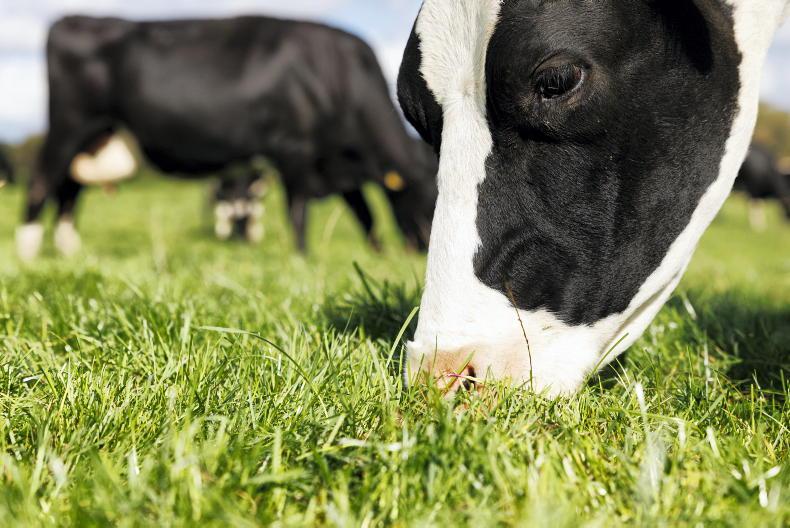
Despite the high yields of the herd, cows are not managed in a contained system. Both Robert and Tom are firm believers in getting fresh grazed grass into the cow.
Grassland management is top class and the farm has been previously awarded the UK grassland farm of the year title back in 2006.
Calving
Calving profile is kept to two distinct spring and autumn periods. Approximately 100 to 120 cows calve from late September until mid-December.
Breeding is deliberately managed to give a two-week break in calving over the Christmas period. The remaining cows resume calving from January through to April, with the peak spring-calving period in February.
Having the two compact calving blocks is intentional as it simplifies cow management on the farm, especially in terms of feeding. It also frees up time for Robert to look after the cereal enterprise from spring until autumn.
Replacements
Last year, 60 heifers calved into the herd, with replacement rates typically running at 30% to 35% annually. The relatively high replacement rate is partly due to the farm participating in a Johne’s eradication scheme.
For the calving period due to start this autumn, there are between 70 and 80 heifers served, and ready to bring new and improved genetics into the herd.
Selective breeding and hard culling has seen cow fertility improving year-on-year, with calving interval reduced from 420 days in 2015 to the current 393 days. Attention to detail around other factors such as cow nutrition have also had a positive effect on fertility.
Cows are predominantly bred using artificial insemination (AI) with stock bulls used to sweep up repeats. As the herd is pedigree-registered, all cows and heifers are bred to Holstein bulls.
Tom selects sires, and is responsible for inseminating cows, with breeding carried out to natural heats. Cows have heat time collars to aid heat detection, and he typically follows the am-pm rule for AI.
Conception rate to first service usually runs between 60% and 70% with cows given a second insemination if they repeat. Only high-yielding cows will get a third insemination, with a stock bull used to catch late-breeding animals.
Herd performance
Milk is sold to LacPatrick, Artigarvan, with cows yielding more than 10,000 litres over a 305-day lactation. Recent emphasis has been placed on selecting herd genetics with high milk solids, and that decision is bearing fruit.
Despite the high yields, average butterfat last year was 4.26%, with protein levels at 3.28%, meaning that cows are, on average, producing 776kg of milk solids per lactation.
Concentrate feeding is high at four tonnes per cow, meaning that approximately 1,700 litres of milk is produced from forage. Feed is mostly homegrown grain which is balanced with purchased soya, soya hulls and maize meal.
Groups
There are three cow management groups for most of the year consisting of fresh/high yielders (45 litres +), mid-lactation (35 to 45 litres) and stale/low-yielding cows (20 to 35 litres).
Groups are fed through a diet feeder with high-yielding animals getting up to 14kg of concentrate split 50:50 between homegrown barley and a blend of soya, maize and hulls.
Mid-lactation cows are fed 11kg of the mix, with low-yielding cows on 7kg per day.
All cows are topped up with feed to yield through the parlour. Feed rates are based on milk produced and cow liveweight with a weigh cell used to monitor changes in liveweight during lactation.
Cows that are losing condition, or below herd average, will have feed levels increased to sustain milk production and provide additional dry matter energy.
Concentrate levels are set to a maximum of 6kg/day through the parlour from a maintenance yield of 25 litres, which works out at 0.2kg of concentrate per litre of milk above 25 litres.
Forage
Cows are offered fresh grass as soon as weather and ground conditions allow in spring. Paddocks are six acres in size and usually give four grazings.
Cows are offered a buffer feed after milking which currently consists of first-cut silage, 2kg of barley and 2kg of blend. Whole crop is also included, with cows eating 28kg per day at present.
Silage is cut every six weeks from early May with four cuts made annually. Grazing follows silage cutting, with cows currently grazing aftermaths from first cut.
High protein
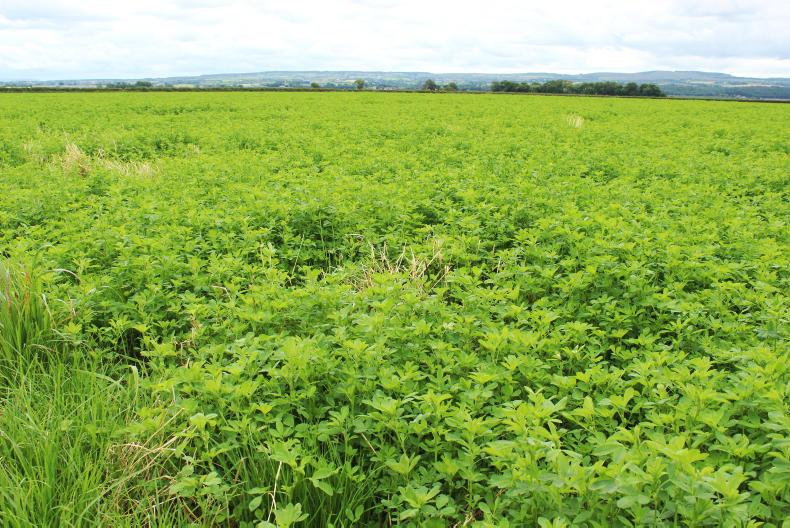
Lucerne is grown to produce a high protein forage. Analysis has shown ensiled lucerne to have a protein level of 22%. Since using the crop, purchased soya has dropped by over 20t.
Three cuts of lucerne are harvested annually on the farm, with a sward lasting three years before ploughing and going back into cereals. Like clover, lucerne is a legume and fixes high levels of nitrogen, which also boosts yields of the following crop.
Grazing swards are also high in white clover, even with nitrogen application rates of 40 units per acre every three weeks. Paddocks are topped after each grazing to provide ideal sward covers for the subsequent rotation.
Looking to the future, the challenge for the herd is to sustain yields from reduced level of concentrate feed and increase milk from forage. Further improvements in milk solids, mainly protein, is something that is also being addressed to add value to milk.
500 acres farmed with 250 acres grassland and 250 acres in cereals.220 pedigree Holstein cows.Rolling average yield of 10,500 litres.Four tonnes of concentrate fed per cow.1,700 litres of milk from forage per cow.4.26% butterfat, 3.28% protein.393-day calving index.
Robert and Tom Craig farm in partnership on the shores of Lough Foyle near Limavady. The brothers farm a total of 500 acres across four land blocks.
The business consists of 250 acres of cereals and 250 acres of grassland, which supports a 220-cow herd of high-yielding pedigree Holsteins. The dairy herd is pedigree-registered, operating under the Carse Hall prefix.
Also involved in the business is Robert’s son, Alistair, along with one full-time and three part-time workers.
The farm is almost self-sufficient in terms of feed, growing forages such as grass silage, lucerne, whole crop barley, grain and straw for use within the dairy herd. Some straights are purchased as well as minerals.
Herd background
The dairy herd was established at Carse Hall back in 1995 when the farm was purchased. Previously, the family had been farming in the Faughan Valley near Drumahoe.
Herd expansion has seen cow numbers grow from 120 to 160 and then to 220 within the past few years. All cows are milked through a dual line 24/24-point parlour.
The genetic background of the herd is a mix of homebred bloodlines which go back to traditional British Friesian cows, to more recent purchases of high-yielding Dutch and UK Holstein genetics, sourced through embryo transfer and conventional semen.
Despite the high yields of the herd, cows are not managed in a contained system. Both Robert and Tom are firm believers in getting fresh grazed grass into the cow.
Grassland management is top class and the farm has been previously awarded the UK grassland farm of the year title back in 2006.
Calving
Calving profile is kept to two distinct spring and autumn periods. Approximately 100 to 120 cows calve from late September until mid-December.
Breeding is deliberately managed to give a two-week break in calving over the Christmas period. The remaining cows resume calving from January through to April, with the peak spring-calving period in February.
Having the two compact calving blocks is intentional as it simplifies cow management on the farm, especially in terms of feeding. It also frees up time for Robert to look after the cereal enterprise from spring until autumn.
Replacements
Last year, 60 heifers calved into the herd, with replacement rates typically running at 30% to 35% annually. The relatively high replacement rate is partly due to the farm participating in a Johne’s eradication scheme.
For the calving period due to start this autumn, there are between 70 and 80 heifers served, and ready to bring new and improved genetics into the herd.
Selective breeding and hard culling has seen cow fertility improving year-on-year, with calving interval reduced from 420 days in 2015 to the current 393 days. Attention to detail around other factors such as cow nutrition have also had a positive effect on fertility.
Cows are predominantly bred using artificial insemination (AI) with stock bulls used to sweep up repeats. As the herd is pedigree-registered, all cows and heifers are bred to Holstein bulls.
Tom selects sires, and is responsible for inseminating cows, with breeding carried out to natural heats. Cows have heat time collars to aid heat detection, and he typically follows the am-pm rule for AI.
Conception rate to first service usually runs between 60% and 70% with cows given a second insemination if they repeat. Only high-yielding cows will get a third insemination, with a stock bull used to catch late-breeding animals.
Herd performance
Milk is sold to LacPatrick, Artigarvan, with cows yielding more than 10,000 litres over a 305-day lactation. Recent emphasis has been placed on selecting herd genetics with high milk solids, and that decision is bearing fruit.
Despite the high yields, average butterfat last year was 4.26%, with protein levels at 3.28%, meaning that cows are, on average, producing 776kg of milk solids per lactation.
Concentrate feeding is high at four tonnes per cow, meaning that approximately 1,700 litres of milk is produced from forage. Feed is mostly homegrown grain which is balanced with purchased soya, soya hulls and maize meal.
Groups
There are three cow management groups for most of the year consisting of fresh/high yielders (45 litres +), mid-lactation (35 to 45 litres) and stale/low-yielding cows (20 to 35 litres).
Groups are fed through a diet feeder with high-yielding animals getting up to 14kg of concentrate split 50:50 between homegrown barley and a blend of soya, maize and hulls.
Mid-lactation cows are fed 11kg of the mix, with low-yielding cows on 7kg per day.
All cows are topped up with feed to yield through the parlour. Feed rates are based on milk produced and cow liveweight with a weigh cell used to monitor changes in liveweight during lactation.
Cows that are losing condition, or below herd average, will have feed levels increased to sustain milk production and provide additional dry matter energy.
Concentrate levels are set to a maximum of 6kg/day through the parlour from a maintenance yield of 25 litres, which works out at 0.2kg of concentrate per litre of milk above 25 litres.
Forage
Cows are offered fresh grass as soon as weather and ground conditions allow in spring. Paddocks are six acres in size and usually give four grazings.
Cows are offered a buffer feed after milking which currently consists of first-cut silage, 2kg of barley and 2kg of blend. Whole crop is also included, with cows eating 28kg per day at present.
Silage is cut every six weeks from early May with four cuts made annually. Grazing follows silage cutting, with cows currently grazing aftermaths from first cut.
High protein
Lucerne is grown to produce a high protein forage. Analysis has shown ensiled lucerne to have a protein level of 22%. Since using the crop, purchased soya has dropped by over 20t.
Three cuts of lucerne are harvested annually on the farm, with a sward lasting three years before ploughing and going back into cereals. Like clover, lucerne is a legume and fixes high levels of nitrogen, which also boosts yields of the following crop.
Grazing swards are also high in white clover, even with nitrogen application rates of 40 units per acre every three weeks. Paddocks are topped after each grazing to provide ideal sward covers for the subsequent rotation.
Looking to the future, the challenge for the herd is to sustain yields from reduced level of concentrate feed and increase milk from forage. Further improvements in milk solids, mainly protein, is something that is also being addressed to add value to milk.
500 acres farmed with 250 acres grassland and 250 acres in cereals.220 pedigree Holstein cows.Rolling average yield of 10,500 litres.Four tonnes of concentrate fed per cow.1,700 litres of milk from forage per cow.4.26% butterfat, 3.28% protein.393-day calving index. 





SHARING OPTIONS