Collaborative farming options are attractive arrangements for young farmers to enter a farming business when landowners are ready to step back or retire. Share farming, partnerships, contract rearing and leasing are more commonly used where there is no family member willing to take on the farm and this will be the focus of this article. They offer an avenue of entry to farming for new entrants.
Share farming
Share farming is where two parties (the landowner and share farmer) carry on separate farming businesses on the same area of land. The landowner and share farmer share inputs/costs of the farm and outputs/income from the farm. They do not share profits as sharing of profits is basic evidence that a partnership exists. The share farmer generally takes over the day-to-day running of the farm and is responsible for staffing. The landowner will continue to be responsible for the larger infrastructure costs while the share farmer is responsible for the day-to-day running costs on the farm.
It allows the landowner to continue to be regarded as a farmer from a tax and DAFM schemes perspective. That means that they can continue to qualify for tax reliefs as an active farmer and continue to claim their entitlements.
On the other hand, it gives access to land and facilities for the share farmer who will generally use it as an opportunity to build up stock ownership and to get to a position where they will own the herd or a majority of it. The share farmer can be incentivised to improve key KPI’s such as profitability and herd health, etc.
Partnerships
Partnerships can be registered with the DAFM as Registered Farm Partnerships (RFPs). This qualifies the RFP for certain tax and subsidy benefits such as enhanced stock relief and a double TAMS grant i.e. 60% on the first €80,000 spend for Young Trained Farmer and 40% on the next €80,000 spend.
There is also an additional step an RFP can take which is a Succession Farm Partnership (SFP). This requires the owner to transfer up to 80% of the assets between years three and ten of forming the SFP. This qualifies the partners for a tax credit of up to €5,000 per year over a five year period.
There are also joint herd numbers / tax partnerships. These often have no formal legal agreement and just require a young farmer’s name to be added to the herd number. This qualifies the young farmer for a top up of up of approximately €170 per hectare on entitlements, capped at 50 hectares for a five-year period.
Partnerships involving family members are very popular given the incentives under TAMS and the young farmer top up. Partnerships involving non family members are less popular but still relevant. Partnerships do not require assets to be transferred, the landowner normally licences the land and entitlements to the partnership i.e. makes them available for use by the partnership. If the partnership ends, the owner gets their land and entitlements back.
Stock and machinery on the other hand, are normally transferred into the partnership and become a partnership asset. If the stock and machinery increase over the course of the partnership, any surplus is divided according to the profit sharing ratio. There is joint and several liability in a partnership which means that each partner can be held responsible for partnership debts. Therefore, it is important that both partners are actively involved in the business.
Contract rearing
Contract rearing is a popular arrangement for dairy farmers who wish to take a step back from dairying, but still be hands-on in the farm. Essentially, the landowner takes in young stock from another farmer and rears them as their own. The stock transfers over in the Agriculture Information Management Scheme or AIMS, thus from a DAFM viewpoint, the contract rearer is solely responsible for those stock. Disease is probably one of the biggest risks especially if the herd owner or contract rearer gets locked up with TB and prevents the animals from moving.
However, DAFM can restrict both herds where animals need to move back for animal welfare reasons. With the challenge of managing nitrates, many dairy farmers are looking to contract out stock rearing and pay handsomely. It is important to have a legal agreement supporting the arrangement otherwise the contract rearer could sell the stock without the stock owner’s knowledge or consent.
Leasing
Leasing is a very popular choice for landowners given the attractive income tax relief on rent. Leases can qualify for income tax relief of between €18,000 to €40,000 per annum depending on the length of the lease, which limit can be doubled if the land is in joint names. For farmers looking at stepping back, they often lease outblocks and continue to farm on the home block, thus reducing workload. Leasing allows those coming from non farming backgrounds to start farming.
However, it can be difficult to compete with established farmers on rent. The availability of schemes such as the National Reserve to allow new entrants to acquire entitlements, the Young Farmer Top Up and the 60% TAMS grant (detailed in the first column) gives new entrants additional income streams to become established. The IFA master lease is a popular template used for long term leasing arrangements. It is important for landowners to do background checks where possible on the proposed tenant to ensure they have a good track record with previous land leased.
Specimen template agreements are available on the Collaborative Farming section of teagasc.ie.
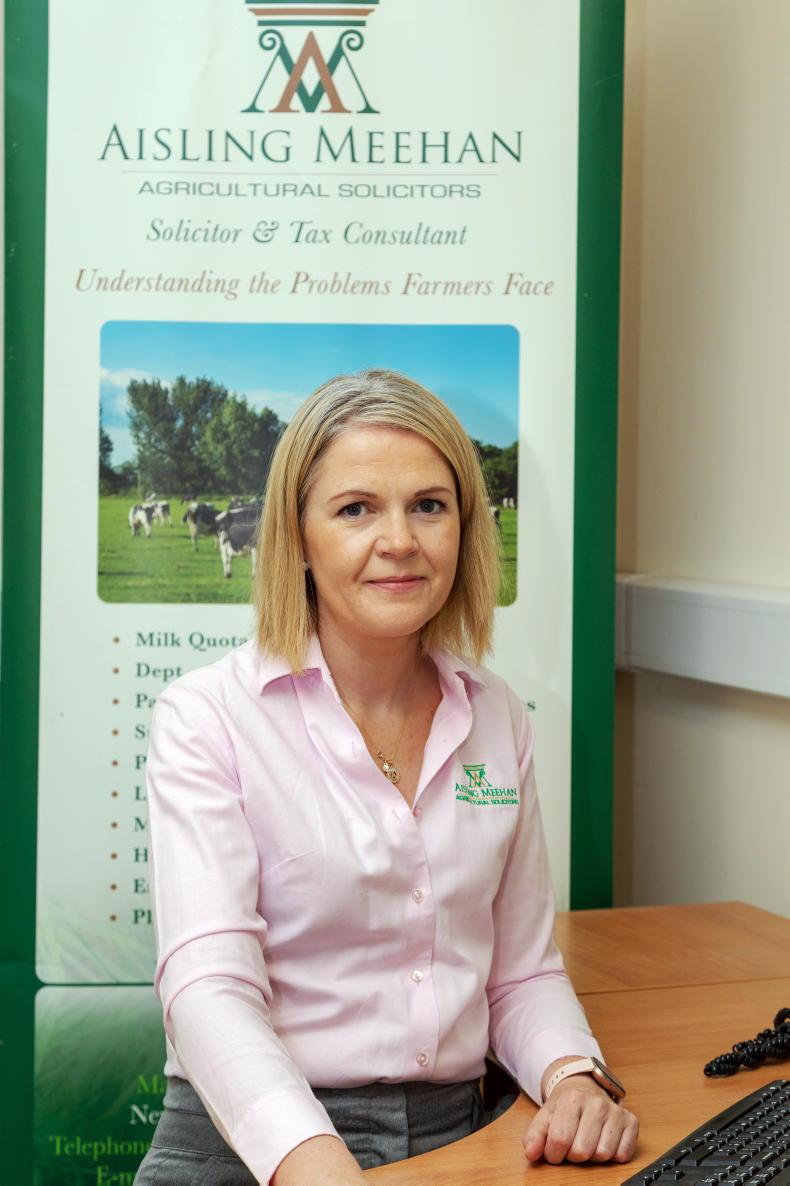
Aisling Meehan.
Disclaimer: The information in this article is intended as a general guide only. While every care is taken to ensure accuracy of information contained in this article, Aisling Meehan, Agricultural Solicitors does not accept responsibility for errors or omissions howsoever arising. E-mail aisling@agrisolicitors.ie
Collaborative farming options are attractive arrangements for young farmers to enter a farming business when landowners are ready to step back or retire. Share farming, partnerships, contract rearing and leasing are more commonly used where there is no family member willing to take on the farm and this will be the focus of this article. They offer an avenue of entry to farming for new entrants.
Share farming
Share farming is where two parties (the landowner and share farmer) carry on separate farming businesses on the same area of land. The landowner and share farmer share inputs/costs of the farm and outputs/income from the farm. They do not share profits as sharing of profits is basic evidence that a partnership exists. The share farmer generally takes over the day-to-day running of the farm and is responsible for staffing. The landowner will continue to be responsible for the larger infrastructure costs while the share farmer is responsible for the day-to-day running costs on the farm.
It allows the landowner to continue to be regarded as a farmer from a tax and DAFM schemes perspective. That means that they can continue to qualify for tax reliefs as an active farmer and continue to claim their entitlements.
On the other hand, it gives access to land and facilities for the share farmer who will generally use it as an opportunity to build up stock ownership and to get to a position where they will own the herd or a majority of it. The share farmer can be incentivised to improve key KPI’s such as profitability and herd health, etc.
Partnerships
Partnerships can be registered with the DAFM as Registered Farm Partnerships (RFPs). This qualifies the RFP for certain tax and subsidy benefits such as enhanced stock relief and a double TAMS grant i.e. 60% on the first €80,000 spend for Young Trained Farmer and 40% on the next €80,000 spend.
There is also an additional step an RFP can take which is a Succession Farm Partnership (SFP). This requires the owner to transfer up to 80% of the assets between years three and ten of forming the SFP. This qualifies the partners for a tax credit of up to €5,000 per year over a five year period.
There are also joint herd numbers / tax partnerships. These often have no formal legal agreement and just require a young farmer’s name to be added to the herd number. This qualifies the young farmer for a top up of up of approximately €170 per hectare on entitlements, capped at 50 hectares for a five-year period.
Partnerships involving family members are very popular given the incentives under TAMS and the young farmer top up. Partnerships involving non family members are less popular but still relevant. Partnerships do not require assets to be transferred, the landowner normally licences the land and entitlements to the partnership i.e. makes them available for use by the partnership. If the partnership ends, the owner gets their land and entitlements back.
Stock and machinery on the other hand, are normally transferred into the partnership and become a partnership asset. If the stock and machinery increase over the course of the partnership, any surplus is divided according to the profit sharing ratio. There is joint and several liability in a partnership which means that each partner can be held responsible for partnership debts. Therefore, it is important that both partners are actively involved in the business.
Contract rearing
Contract rearing is a popular arrangement for dairy farmers who wish to take a step back from dairying, but still be hands-on in the farm. Essentially, the landowner takes in young stock from another farmer and rears them as their own. The stock transfers over in the Agriculture Information Management Scheme or AIMS, thus from a DAFM viewpoint, the contract rearer is solely responsible for those stock. Disease is probably one of the biggest risks especially if the herd owner or contract rearer gets locked up with TB and prevents the animals from moving.
However, DAFM can restrict both herds where animals need to move back for animal welfare reasons. With the challenge of managing nitrates, many dairy farmers are looking to contract out stock rearing and pay handsomely. It is important to have a legal agreement supporting the arrangement otherwise the contract rearer could sell the stock without the stock owner’s knowledge or consent.
Leasing
Leasing is a very popular choice for landowners given the attractive income tax relief on rent. Leases can qualify for income tax relief of between €18,000 to €40,000 per annum depending on the length of the lease, which limit can be doubled if the land is in joint names. For farmers looking at stepping back, they often lease outblocks and continue to farm on the home block, thus reducing workload. Leasing allows those coming from non farming backgrounds to start farming.
However, it can be difficult to compete with established farmers on rent. The availability of schemes such as the National Reserve to allow new entrants to acquire entitlements, the Young Farmer Top Up and the 60% TAMS grant (detailed in the first column) gives new entrants additional income streams to become established. The IFA master lease is a popular template used for long term leasing arrangements. It is important for landowners to do background checks where possible on the proposed tenant to ensure they have a good track record with previous land leased.
Specimen template agreements are available on the Collaborative Farming section of teagasc.ie.
Aisling Meehan.
Disclaimer: The information in this article is intended as a general guide only. While every care is taken to ensure accuracy of information contained in this article, Aisling Meehan, Agricultural Solicitors does not accept responsibility for errors or omissions howsoever arising. E-mail aisling@agrisolicitors.ie





SHARING OPTIONS