It is a few days after Rory’s McIlroy’s second Masters win, and heavy rain is driving down the fairway at Temple Golf Club. On a good day, the nine-hole golf course in Lisburn offers some of the finest views in Co Down, of the rolling drumlin hills, Slieve Croob and Mourne mountains.
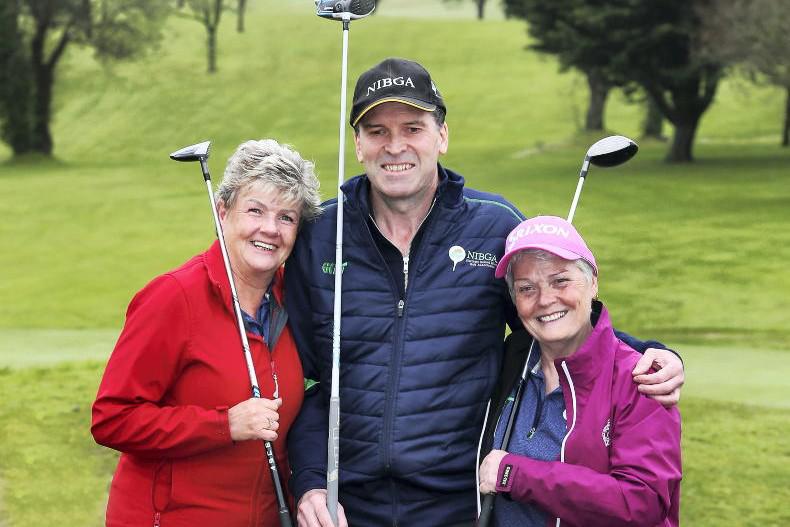
It may not be Augusta, but the wet and misty conditions have not dampened the spirit and enthusiasm of the Northern Ireland Blind Golf Association (NIBGA), whose members, Tony McEvoy, Heather Gracey, and Kate Daly, greet us in the warmth of the clubhouse.
“Oh my God,” they inhale sharply, when reflecting on the Rory-coaster in Augusta. McIlroy’s path to securing his second consecutive Masters title was not a smooth one, and the Irish golfer took fans on a fraught journey of emotions. “He just does it to us each time,” Kate smiles. “That’s what makes him box office.”
Northern Ireland Blind Golf Association was established in 1990 to support blind and visually impaired people through the game of golf. The charity hosts eight events per year for members, who join for a fee of £50 a year.
“For that, you get to play some of the best golf courses in Northern Ireland and the opportunity to play in international events,” says Kate.
All the players have varying degrees of visual impairment, starting from B1 which is the most severe. “If you had no light going into your eyes at all, you would be categorised as a B1,” Kate explains. “Tony is a B2 because he has some light going in and some vision, but it’s pretty poor. I’m a B3 as I have no vision in my right eye and pure peripheral vision in my left eye.”
Tony’s eyesight slowly deteriorated from the age of seven; and it wasn’t until he was in his late 20s when he met one of the founding members of NIBGA that he was encouraged to play. “Golf was one of those sports I thought I’d love to play, but that’s how I got involved.”
One of the members of the association is a former golf professional who lost sight in his eyes through diabetes, Tony says, but most players have gradually lost their sight over time.
“Golfers who are maybe in their 60s, and they’ve been playing golf all their life in a four ball every Saturday. Their sight starts to very, very slowly go, until such a time where they think they’re holding back their friends.
“Then they just don’t go one Saturday, and then don’t go the next Saturday, and then drift away from golf. We’re here for them. Unfortunately, not enough know that we exist, despite our efforts to publicise ourselves.”
There is no difference to the rules, except that the visually impaired and blind golfers can ground their club in the sand bunkers. “I like to emphasise that because some people think, how can they play golf?” says Tony. “It means we can stand on the same tee box as anybody else and play golf.
“There is no such thing as blind golf. It’s just golf played by blind people. We always talk about blind golf. It sounds like it’s a different game but it’s not.”
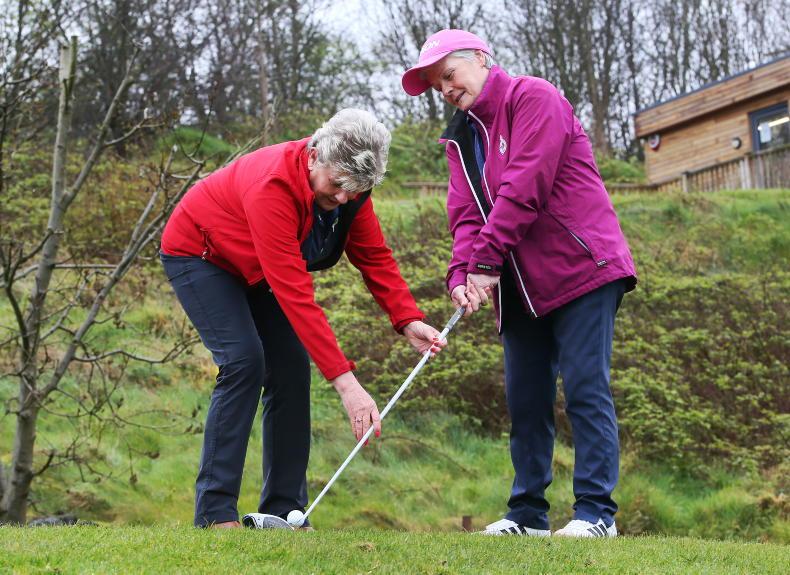
Guide Heather Gracey helps Kate Daly to set up for her first shot at the tee.
How it works
When a player joins NIBGA, they are paired with a guide who advises them on how to set their body up to hit the ball. The guides are all volunteers. Heather has been a guide for about three years, and although she has played golf for around 10 years, she adds that not all guides play golf. Some are friends or family of players. NIBGA tries to match players and guides depending on where they live.
“A guide keeps you right for everything,” says Kate. “The B1s won’t be able to get to the tee without the guide. I like to put the ball in the ground myself and then I’ll stop back from it, and my guide will straighten me. I’ll stand where I think I’m supposed to hit it.
“Then they’ll say ‘to me’, which means you’ll turn slightly towards them. Or ‘to you’, which means you’ll turn towards yourself. That’s how I work out whether I’m going in the right direction or not.
“They can put the club right behind the ball but once you go to hit the shot, they have to step away. They’re not allowed to interfere with the club in any way. At that stage, it’s up to you. They’ll set you up, and it’s up to you to do what you need to do with it.
“The commitment from guides is exceptional,” Kate continues. “If I’m playing golf in Ballymena, the guide will have to come to my house, pick me up with all my golf gear, clubs and trolley, take me to Ballymena, go and play a round of golf, and then bring me all the way back again. That’s not something somebody really wants to do with their day.
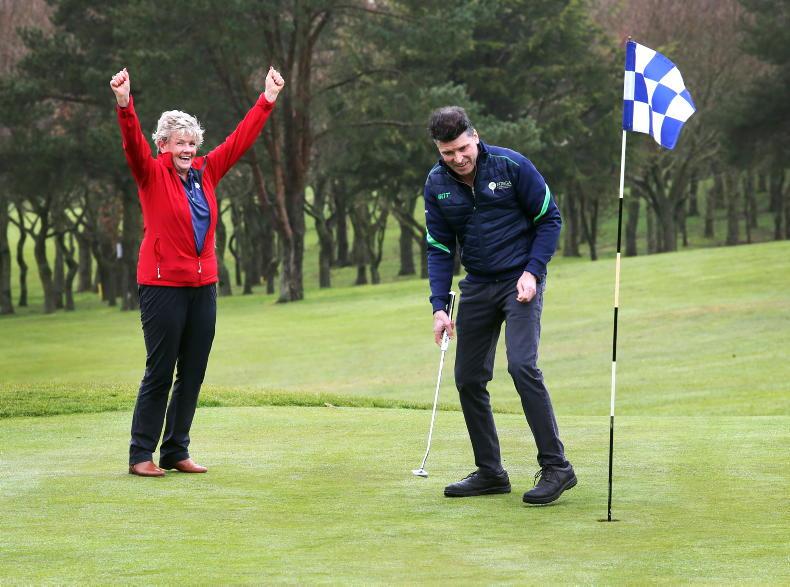
Guide Heather Gracey cheers as Tony McEvoy sinks his putt.
“The fact that they do this, I’m just completely in awe of the guys. There would be no blind golf without the guides.”
“Oh, it’s such a chore!” Heather teases her, laughing. “We’re in awe of you.”
“If it wasn’t for the guide – I mean, we’ve had players walking into the lakes and things,” Kate says, laughing.
“We were down at a golf course in Kildare and the lakes were all man-made. One of the golfers walked around and he just disappeared,” Tony quips. “He went straight down,” assuring he was OK.
Northern Ireland Blind Golf Association is affiliated with an umbrella body called International Blind Golf Association.
“All the different local associations are affiliated with it, and then we play international competitions against each other,” Kate explains. There are 22 players in the Northern Irish branch (excluding guides) and the team boasts more female players than any other association in International Blind Golf, Heather and Kate say proudly.
Being a member of NIBGA offers players the opportunity to compete internationally. The host organisation covers accommodation, food and rounds of golf; members only have to pay for flights. One of the NIBGA players is currently competing in the US Blind Golf Championship, and Kate will compete in the Spanish Blind Open in Spain in a few weeks.
Lots of members are also going to play in the Swedish Blind Golf Open in August. Next year, the members are also excited to host the British Blind Open in Templepatrick Golf Club.
International travel aside, Tony says that the “social side is definitely at least 50% of what we’re about, quite possibly more. It’s about getting people out of the house, exercise and just mental health.”
According to Vision Ireland, only one in five people with visual impairment is in employment. Visually impaired people also face significant barriers when it comes to exercise participation.
“Just getting out and walking for five hours, sometimes it can be six because we’re quite slow. Having a chat, and then coming into the clubhouse and having something to eat,” Kate reflects. “I mean, it can sometimes be the only interaction some people have every month, and it can be totally life changing.”
See nibga.org
It is a few days after Rory’s McIlroy’s second Masters win, and heavy rain is driving down the fairway at Temple Golf Club. On a good day, the nine-hole golf course in Lisburn offers some of the finest views in Co Down, of the rolling drumlin hills, Slieve Croob and Mourne mountains.
It may not be Augusta, but the wet and misty conditions have not dampened the spirit and enthusiasm of the Northern Ireland Blind Golf Association (NIBGA), whose members, Tony McEvoy, Heather Gracey, and Kate Daly, greet us in the warmth of the clubhouse.
“Oh my God,” they inhale sharply, when reflecting on the Rory-coaster in Augusta. McIlroy’s path to securing his second consecutive Masters title was not a smooth one, and the Irish golfer took fans on a fraught journey of emotions. “He just does it to us each time,” Kate smiles. “That’s what makes him box office.”
Northern Ireland Blind Golf Association was established in 1990 to support blind and visually impaired people through the game of golf. The charity hosts eight events per year for members, who join for a fee of £50 a year.
“For that, you get to play some of the best golf courses in Northern Ireland and the opportunity to play in international events,” says Kate.
All the players have varying degrees of visual impairment, starting from B1 which is the most severe. “If you had no light going into your eyes at all, you would be categorised as a B1,” Kate explains. “Tony is a B2 because he has some light going in and some vision, but it’s pretty poor. I’m a B3 as I have no vision in my right eye and pure peripheral vision in my left eye.”
Tony’s eyesight slowly deteriorated from the age of seven; and it wasn’t until he was in his late 20s when he met one of the founding members of NIBGA that he was encouraged to play. “Golf was one of those sports I thought I’d love to play, but that’s how I got involved.”
One of the members of the association is a former golf professional who lost sight in his eyes through diabetes, Tony says, but most players have gradually lost their sight over time.
“Golfers who are maybe in their 60s, and they’ve been playing golf all their life in a four ball every Saturday. Their sight starts to very, very slowly go, until such a time where they think they’re holding back their friends.
“Then they just don’t go one Saturday, and then don’t go the next Saturday, and then drift away from golf. We’re here for them. Unfortunately, not enough know that we exist, despite our efforts to publicise ourselves.”
There is no difference to the rules, except that the visually impaired and blind golfers can ground their club in the sand bunkers. “I like to emphasise that because some people think, how can they play golf?” says Tony. “It means we can stand on the same tee box as anybody else and play golf.
“There is no such thing as blind golf. It’s just golf played by blind people. We always talk about blind golf. It sounds like it’s a different game but it’s not.”

Guide Heather Gracey helps Kate Daly to set up for her first shot at the tee.
How it works
When a player joins NIBGA, they are paired with a guide who advises them on how to set their body up to hit the ball. The guides are all volunteers. Heather has been a guide for about three years, and although she has played golf for around 10 years, she adds that not all guides play golf. Some are friends or family of players. NIBGA tries to match players and guides depending on where they live.
“A guide keeps you right for everything,” says Kate. “The B1s won’t be able to get to the tee without the guide. I like to put the ball in the ground myself and then I’ll stop back from it, and my guide will straighten me. I’ll stand where I think I’m supposed to hit it.
“Then they’ll say ‘to me’, which means you’ll turn slightly towards them. Or ‘to you’, which means you’ll turn towards yourself. That’s how I work out whether I’m going in the right direction or not.
“They can put the club right behind the ball but once you go to hit the shot, they have to step away. They’re not allowed to interfere with the club in any way. At that stage, it’s up to you. They’ll set you up, and it’s up to you to do what you need to do with it.
“The commitment from guides is exceptional,” Kate continues. “If I’m playing golf in Ballymena, the guide will have to come to my house, pick me up with all my golf gear, clubs and trolley, take me to Ballymena, go and play a round of golf, and then bring me all the way back again. That’s not something somebody really wants to do with their day.

Guide Heather Gracey cheers as Tony McEvoy sinks his putt.
“The fact that they do this, I’m just completely in awe of the guys. There would be no blind golf without the guides.”
“Oh, it’s such a chore!” Heather teases her, laughing. “We’re in awe of you.”
“If it wasn’t for the guide – I mean, we’ve had players walking into the lakes and things,” Kate says, laughing.
“We were down at a golf course in Kildare and the lakes were all man-made. One of the golfers walked around and he just disappeared,” Tony quips. “He went straight down,” assuring he was OK.
Northern Ireland Blind Golf Association is affiliated with an umbrella body called International Blind Golf Association.
“All the different local associations are affiliated with it, and then we play international competitions against each other,” Kate explains. There are 22 players in the Northern Irish branch (excluding guides) and the team boasts more female players than any other association in International Blind Golf, Heather and Kate say proudly.
Being a member of NIBGA offers players the opportunity to compete internationally. The host organisation covers accommodation, food and rounds of golf; members only have to pay for flights. One of the NIBGA players is currently competing in the US Blind Golf Championship, and Kate will compete in the Spanish Blind Open in Spain in a few weeks.
Lots of members are also going to play in the Swedish Blind Golf Open in August. Next year, the members are also excited to host the British Blind Open in Templepatrick Golf Club.
International travel aside, Tony says that the “social side is definitely at least 50% of what we’re about, quite possibly more. It’s about getting people out of the house, exercise and just mental health.”
According to Vision Ireland, only one in five people with visual impairment is in employment. Visually impaired people also face significant barriers when it comes to exercise participation.
“Just getting out and walking for five hours, sometimes it can be six because we’re quite slow. Having a chat, and then coming into the clubhouse and having something to eat,” Kate reflects. “I mean, it can sometimes be the only interaction some people have every month, and it can be totally life changing.”
See nibga.org
SHARING OPTIONS