In these times, a double-decker bus may not seem such a big deal, but to a country boy in the early 1970s, these buses were exotic indeed. Being upstairs in a bus full of strangers, in a city where 1916 bullet holes were still visible, was a real fantasy ride.
I know these buses were in other cities, but I always associate the double decker with Dublin. Their presence in old film clips and on gaudy postcards helped to define the city in the same way that gondolas might define Venice.
The double decker was first introduced by the Dublin United Tramways Company (DUTC) in December 1937. A fleet of 242 buses were in service before wartime restrictions. These buses, with six-cylinder petrol engines, were replacing the aging tram system at the time.
CIE was created on 1 January 1945. The Dublin fleet in June 1950 consisted of 458 double decker buses
King among them was the Leyland Titan. It was built mainly for the UK market between 1927 and 1942. At that time, the Titans were widely used in the UK itself, but they were also exported successfully to Australia, India, Spain, South Africa and of course, Ireland. CIE was created on 1 January 1945. The Dublin fleet in June 1950 consisted of 458 double decker buses. By 1972, the fleet had grown to 780, all of them puffing their diesel engines to every corner of the city and the sprawling suburbs.
The big beige block
The earliest colour that really stuck was a shade of bright green. This was followed by a cream and navy two-tone that slightly resembled another Dublin institution; the pint of Guinness. These colours stayed around for many years until the colour scheme went through a garish change.
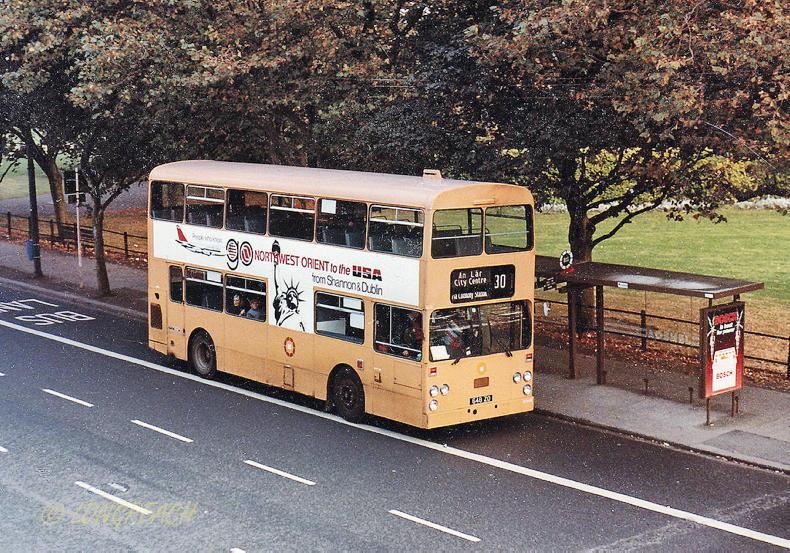
A new bus resembling a big beige block, the Leyland Atlantean AN68/1R built by VanHool McArdle, soon took over as the dominant colour on the streets as the buses themselves morphed into something more like the buses we know today.
In an effort not to offend anyone, the Beige Blocks ended up offending pretty much everyone
Van Hool McArdle was an Irish bus builder that operated from 1972. It was formed as a joint venture between the Belgian bus builder Van Hool and Irish coachbuilder Thomas McArdle of Dundalk to take over the bus building activities of CIE. The factory at Spa Road in Dublin closed in 1978.
Going back to the Big Beige Block in time, it took its place alongside over-grown greasy hair, platform shoes and bell-bottom jeans in a fashion time warp that won’t be easily forgotten. It was said at the time that: “In an effort not to offend anyone, the Beige Blocks ended up offending pretty much everyone.”
Confusion
Figuring out the routes and the numbers on the bus system in Dublin was like learning Irish – complicated, terribly confusing and with an exception to every rule.
In 1972, my reason for being in Dublin was to visit my newly married sister who lived near Rathfarnham. This year she celebrates her 50th wedding anniversary but finding my way anywhere on a Dublin bus still confounds me.
If the front seat was free, that’s where I sat
Fresh off the train, the trip from Aston Quay on the 49 bus was my target route. My heart was always in my mouth for fear of catching the wrong bus going in the wrong direction and having the wrong fare. I was presented with a situation akin to picking out the exact buffalo I needed in a High Plains’ stampede in order to get a ride home.
Miraculously, I mostly got lucky and when I did, I made my way upstairs. If the front seat was free, that’s where I sat. From there I could “drive” the bus as well as get a bird’s eye view of the city. It only remained for me to get off at the right stop – not as easy as you might think on a crowded bus and with a wet stairs to negotiate!
I refer to a time when the Liffey was filthy green, when the air in the city was filled with coal smoke and the fumes of misfiring diesel engines, a time when the double decker ruled the streets – the good old days!
Read more
Endearing Engines: the Transit van
Endearing Engines: the David Brown Esquire
In these times, a double-decker bus may not seem such a big deal, but to a country boy in the early 1970s, these buses were exotic indeed. Being upstairs in a bus full of strangers, in a city where 1916 bullet holes were still visible, was a real fantasy ride.
I know these buses were in other cities, but I always associate the double decker with Dublin. Their presence in old film clips and on gaudy postcards helped to define the city in the same way that gondolas might define Venice.
The double decker was first introduced by the Dublin United Tramways Company (DUTC) in December 1937. A fleet of 242 buses were in service before wartime restrictions. These buses, with six-cylinder petrol engines, were replacing the aging tram system at the time.
CIE was created on 1 January 1945. The Dublin fleet in June 1950 consisted of 458 double decker buses
King among them was the Leyland Titan. It was built mainly for the UK market between 1927 and 1942. At that time, the Titans were widely used in the UK itself, but they were also exported successfully to Australia, India, Spain, South Africa and of course, Ireland. CIE was created on 1 January 1945. The Dublin fleet in June 1950 consisted of 458 double decker buses. By 1972, the fleet had grown to 780, all of them puffing their diesel engines to every corner of the city and the sprawling suburbs.
The big beige block
The earliest colour that really stuck was a shade of bright green. This was followed by a cream and navy two-tone that slightly resembled another Dublin institution; the pint of Guinness. These colours stayed around for many years until the colour scheme went through a garish change.
A new bus resembling a big beige block, the Leyland Atlantean AN68/1R built by VanHool McArdle, soon took over as the dominant colour on the streets as the buses themselves morphed into something more like the buses we know today.
In an effort not to offend anyone, the Beige Blocks ended up offending pretty much everyone
Van Hool McArdle was an Irish bus builder that operated from 1972. It was formed as a joint venture between the Belgian bus builder Van Hool and Irish coachbuilder Thomas McArdle of Dundalk to take over the bus building activities of CIE. The factory at Spa Road in Dublin closed in 1978.
Going back to the Big Beige Block in time, it took its place alongside over-grown greasy hair, platform shoes and bell-bottom jeans in a fashion time warp that won’t be easily forgotten. It was said at the time that: “In an effort not to offend anyone, the Beige Blocks ended up offending pretty much everyone.”
Confusion
Figuring out the routes and the numbers on the bus system in Dublin was like learning Irish – complicated, terribly confusing and with an exception to every rule.
In 1972, my reason for being in Dublin was to visit my newly married sister who lived near Rathfarnham. This year she celebrates her 50th wedding anniversary but finding my way anywhere on a Dublin bus still confounds me.
If the front seat was free, that’s where I sat
Fresh off the train, the trip from Aston Quay on the 49 bus was my target route. My heart was always in my mouth for fear of catching the wrong bus going in the wrong direction and having the wrong fare. I was presented with a situation akin to picking out the exact buffalo I needed in a High Plains’ stampede in order to get a ride home.
Miraculously, I mostly got lucky and when I did, I made my way upstairs. If the front seat was free, that’s where I sat. From there I could “drive” the bus as well as get a bird’s eye view of the city. It only remained for me to get off at the right stop – not as easy as you might think on a crowded bus and with a wet stairs to negotiate!
I refer to a time when the Liffey was filthy green, when the air in the city was filled with coal smoke and the fumes of misfiring diesel engines, a time when the double decker ruled the streets – the good old days!
Read more
Endearing Engines: the Transit van
Endearing Engines: the David Brown Esquire
SHARING OPTIONS