Aisling Glynn was at the hairdresser’s recently when the woman beside her started to make small talk.
“‘Oh are you out for the day and what sort of service are you with?’” she relates wryly. “These kind of assumptions that people make.”
The “assumption” being that, as a wheelchair user, Aisling does not work. And it’s not the first time it’s happened.
She could be out with her sisters when a stranger will start to ask what they all do for a living; but skip her. And only last year, a medical professional remarked, “What else are you going to be doing?” when Aisling queried how she would fit a new set of therapy exercises into her already-packed schedule.
“I said, ‘Oh I’d be at work’,” she continues. “And she said, ‘Oh, what do you do?’ And I said, ‘I’m a solicitor’; and she was actually shocked.”

Solicitor Aisling Glynn pictured out and about with her assistance dog Gina, a labradoodle. \ John Kelly
That such attitudes still persist in 2019 might be the real surprise; but it was the main motivator for Aisling to share her experience as a young woman living – and working – with a disability in rural Ireland as part of The Irish Times Platform series, having been diagnosed with muscular dystrophy in her teens.
“I do have a serious and a progressive physical disability and there’s a lot that comes with that, in terms of having things in place every day and lots of planning and support and people to make every day actually possible,” she says.
“But I think it’s to show people that if I can make it work, well then lots of other people hopefully will be able to make it work too.”
Irish Country Living meets Aisling at McMahon & Williams Solicitor in Kilrush, which has been in practice in west Clare for 125 years. Sitting in on the interview is Gina, Aisling’s labradoodle assistance dog, who opens the front door to the office every morning for her; and presses the lift button.

Assistance dog Gina opens the office door for solicitor Aisling Glynn every morming. \ John Kelly
Though Aisling explains that her day usually starts two and a half hours earlier, when one of her personal assistants will come to her home to help her get ready for the day, from getting out of bed and dressed, to making breakfast; and her all-important coffee – “Black!” laughs Aisling of her order.
Some days, though, it’s not just physical challenges she faces, but pain and fatigue. A cough can lead to a week in hospital. She has two diaries on the go; one for what she calls her regular life – work, meetings, weddings. The other is for her life with a disability – doctor’s appointments, organising PA hours and rotas, wheelchairs, cushions, physiotherapy, hoists, prescriptions, splints, injections, nebulisers, painkillers – and not forgetting appointments for her assistance dog Gina.
“Nobody teaches you how to live your disabled life,” says Aisling. “You learn pretty quickly that planning is key.”

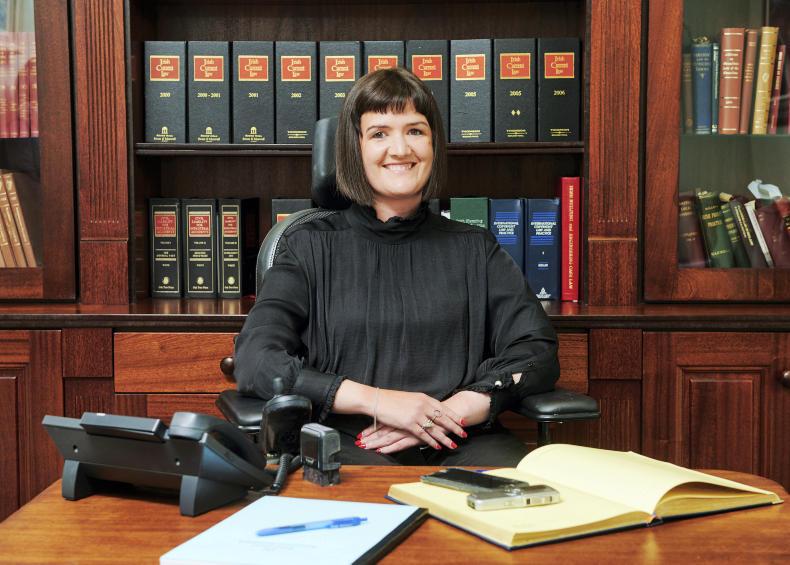
Solicitor Aisling Glynn at work with her assistance dog Gina. \ John Kelly.
Once she gets behind her desk, however, it’s almost like the wheelchair becomes like any other office chair, with Aisling reflecting that it’s the time she’s “most unaware” of her disability.
“At work, in a way, it’s the time that I feel most capable, because I’m hugely reliant on other people in the mornings and in the evenings and in my everyday life. But when I’m at my desk, I think that’s the time where I feel that people are coming to me looking for advice or looking for assistance,” she explains.
Life changing
One of five girls, Aisling lives just outside Kilrush in Cappa with her parents David and Colette, and credits her whole family throughout the interview for their support.
The Glynns are well-known locally; her grandfather and great-grandfather ran the former flour mill, while her father was involved in the seaweed factory, before moving to Killiner to run a petrol station beside the ferry for 15 years.

Solicitor Aisling Glynn pictured out and about with her assistance dog Gina, a labradoodle. \ John Kelly
Aisling recalls a healthy, happy childhood with no clue of the challenge to come, though looking back, she can pinpoint signposts along the way, like her first trip to Irish college.
“Suddenly we had to walk three, four miles a day and it was then I kind of noticed that I was finding it a bit difficult to keep up,” she says.
Initially, doctors suspected a back problem, until an assessment in Dublin revealed there was something more serious going on when the doctor asked her to lie down and lift her two legs.
“I was lying flat on my back and I couldn’t lift my leg at all,” she recalls. “And I remember his face went, ‘Oh my God’.”
Referral after referral followed, with Aisling receiving a general diagnosis of muscular dystrophy – a condition that causes the progressive weakening and loss of muscle mass – the year of her Junior Cert. But while it might have been a life-changing diagnosis, Aisling recalls how even then, she “wanted life to go on”.

Solicitor Aisling Glynn pictured out and about with her assistance dog Gina, a labradoodle. \ John Kelly
“I remember going to school the next day and I knew this and nobody else knew it; but I still had to do my homework,” she says.
“I suppose if I had known then how I am now, that would have been really daunting, so I decided not to think too far ahead and to take it a day at a time, and I suppose that’s what I’m still doing. I think my mind became trained in a way, to just deal with today, and tomorrow.”
Legal career
Though one thing the diagnosis did force her to think about was her future career, with Aisling deciding on law, as she felt that working as a solicitor would be a suitable role, bearing her future reduced mobility in mind. As it transpired, that happened sooner than expected, when she fell and broke her leg just before starting college in the University of Limerick due to muscle weakness.
Although she did recover from that accident, she could still fall “two, three times a day”, while it took all her energy to get from class to class. Simple tasks like getting out of bed also became more challenging and while lucky to have great flatmates, as things progressed, she needed daily support from a personal assistant.
But again, life went on.
“Exams and study and coffees and going out,” lists Aisling. “I think when people ask me, ‘How did you cope with all that?’ that was it: it was about just focusing on all of that other stuff and the things that I could do.”

Solicitor Aisling Glynn pictured with her colleague Grace and her assistance dog Gina, a labradoodle. \ John Kelly
Ultimately, Aisling lost the muscle strength to continue walking after breaking both legs at the same time just after finishing college and, from there, required an electric wheelchair. It was during this transition that she interviewed for an apprenticeship at McMahon & Williams Solicitors, who as luck would have it, had just moved to a new building with lift access.
More than 10 years on – plus a masters in international and comparative disability law and policy later – Aisling is part of the core legal team serving the predominantly rural client base. While she has experience in many areas, she specialises in litigation, including personal injuries and medical negligence. She describes some of the most rewarding work she has done as working with those who have suffered catastrophic injuries.
She also has a particular interest in disability and capacity law, particularly in discrimination, enduring powers of attorney and wills and working with vulnerable clients, including those with intellectual disabilities and older people.
One of her most significant cases to date was representing a boy with cerebral palsy, whose former primary school were found to have discriminated against him on disability grounds by refusing to allow him to bring in his specially trained assistance dog – which served as his mobility aid – when he was in sixth class.
“It was the first case in Ireland relating to an assistance dog and the right to education, so I was delighted to be involved in it,” says Aisling; but adds that the fact that it took five years for the case to be determined left much to be desired. Indeed, Aisling’s Masters thesis explored the barriers that people with disabilities face in seeking access to justice and highlighted the all-too-often lack of an effective legal remedy.
Changing attitudes
The case also illustrates the obstacles many people with disabilities have to negotiate to access basic rights like education or work, with an ESRI report revealing that they are four times less likely to be employed. Indeed, it raises the question of whether sometimes, it’s the environment that is disabling, rather than an individual’s condition.
From Aisling’s perspective, transport is one of the biggest challenges that people with disabilities face in rural Ireland, citing as an example the fact that there is no wheelchair accessible taxi within a 30-mile radius of where she lives. Infrastructure is also a frustration, even down to simple things like footpaths that have not been “dipped” correctly to allow chair access.
However, she sees the fact that Ireland finally ratified the UN Convention on the Rights of People with Disabilities last year as a step in the right direction, especially when it comes to implementing the concept of “universal design” ie design that works for not only those with disabilities, but everybody in society.
“If you have the correct dip on a footpath, it allows wheelchairs to move around the town, maybe older people who might have shopping trolleys, mothers with babies and as I see it, there’s no disadvantage at all to anybody,” she says.
“So I suppose it’s a way of thinking and it’s not just about disability, it’s about ability and all of us here in Ireland, how do we design our environment so that it suits as many people as possible?”
What might be just as important to change, however, are attitudes regarding ability versus disability.
Certainly – even outside work – Aisling rarely stops, whether she’s sitting on the board of the National Disability Authority or chairing the West Clare Mental Health Association, roles which saw her receive the Cissie Roughan civic accolade, as well as one of 10 “Outstanding Young Person” national awards from Junior Chamber Ireland. Then there’s just the regular stuff; meeting up with friends or her sisters for dinner and a glass of wine, chilling out in front of the TV with her mom, walks in Kilkee with Gina or breaks away.
Because at the end of the day, Aisling Glynn is making it work. In every way.
Follow Aisling Glynn on Twitter @AisGlynn
Aisling Glynn was at the hairdresser’s recently when the woman beside her started to make small talk.
“‘Oh are you out for the day and what sort of service are you with?’” she relates wryly. “These kind of assumptions that people make.”
The “assumption” being that, as a wheelchair user, Aisling does not work. And it’s not the first time it’s happened.
She could be out with her sisters when a stranger will start to ask what they all do for a living; but skip her. And only last year, a medical professional remarked, “What else are you going to be doing?” when Aisling queried how she would fit a new set of therapy exercises into her already-packed schedule.
“I said, ‘Oh I’d be at work’,” she continues. “And she said, ‘Oh, what do you do?’ And I said, ‘I’m a solicitor’; and she was actually shocked.”
Solicitor Aisling Glynn pictured out and about with her assistance dog Gina, a labradoodle. \ John Kelly
That such attitudes still persist in 2019 might be the real surprise; but it was the main motivator for Aisling to share her experience as a young woman living – and working – with a disability in rural Ireland as part of The Irish Times Platform series, having been diagnosed with muscular dystrophy in her teens.
“I do have a serious and a progressive physical disability and there’s a lot that comes with that, in terms of having things in place every day and lots of planning and support and people to make every day actually possible,” she says.
“But I think it’s to show people that if I can make it work, well then lots of other people hopefully will be able to make it work too.”
Irish Country Living meets Aisling at McMahon & Williams Solicitor in Kilrush, which has been in practice in west Clare for 125 years. Sitting in on the interview is Gina, Aisling’s labradoodle assistance dog, who opens the front door to the office every morning for her; and presses the lift button.
Assistance dog Gina opens the office door for solicitor Aisling Glynn every morming. \ John Kelly
Though Aisling explains that her day usually starts two and a half hours earlier, when one of her personal assistants will come to her home to help her get ready for the day, from getting out of bed and dressed, to making breakfast; and her all-important coffee – “Black!” laughs Aisling of her order.
Some days, though, it’s not just physical challenges she faces, but pain and fatigue. A cough can lead to a week in hospital. She has two diaries on the go; one for what she calls her regular life – work, meetings, weddings. The other is for her life with a disability – doctor’s appointments, organising PA hours and rotas, wheelchairs, cushions, physiotherapy, hoists, prescriptions, splints, injections, nebulisers, painkillers – and not forgetting appointments for her assistance dog Gina.
“Nobody teaches you how to live your disabled life,” says Aisling. “You learn pretty quickly that planning is key.”
Solicitor Aisling Glynn at work with her assistance dog Gina. \ John Kelly.
Once she gets behind her desk, however, it’s almost like the wheelchair becomes like any other office chair, with Aisling reflecting that it’s the time she’s “most unaware” of her disability.
“At work, in a way, it’s the time that I feel most capable, because I’m hugely reliant on other people in the mornings and in the evenings and in my everyday life. But when I’m at my desk, I think that’s the time where I feel that people are coming to me looking for advice or looking for assistance,” she explains.
Life changing
One of five girls, Aisling lives just outside Kilrush in Cappa with her parents David and Colette, and credits her whole family throughout the interview for their support.
The Glynns are well-known locally; her grandfather and great-grandfather ran the former flour mill, while her father was involved in the seaweed factory, before moving to Killiner to run a petrol station beside the ferry for 15 years.
Solicitor Aisling Glynn pictured out and about with her assistance dog Gina, a labradoodle. \ John Kelly
Aisling recalls a healthy, happy childhood with no clue of the challenge to come, though looking back, she can pinpoint signposts along the way, like her first trip to Irish college.
“Suddenly we had to walk three, four miles a day and it was then I kind of noticed that I was finding it a bit difficult to keep up,” she says.
Initially, doctors suspected a back problem, until an assessment in Dublin revealed there was something more serious going on when the doctor asked her to lie down and lift her two legs.
“I was lying flat on my back and I couldn’t lift my leg at all,” she recalls. “And I remember his face went, ‘Oh my God’.”
Referral after referral followed, with Aisling receiving a general diagnosis of muscular dystrophy – a condition that causes the progressive weakening and loss of muscle mass – the year of her Junior Cert. But while it might have been a life-changing diagnosis, Aisling recalls how even then, she “wanted life to go on”.
Solicitor Aisling Glynn pictured out and about with her assistance dog Gina, a labradoodle. \ John Kelly
“I remember going to school the next day and I knew this and nobody else knew it; but I still had to do my homework,” she says.
“I suppose if I had known then how I am now, that would have been really daunting, so I decided not to think too far ahead and to take it a day at a time, and I suppose that’s what I’m still doing. I think my mind became trained in a way, to just deal with today, and tomorrow.”
Legal career
Though one thing the diagnosis did force her to think about was her future career, with Aisling deciding on law, as she felt that working as a solicitor would be a suitable role, bearing her future reduced mobility in mind. As it transpired, that happened sooner than expected, when she fell and broke her leg just before starting college in the University of Limerick due to muscle weakness.
Although she did recover from that accident, she could still fall “two, three times a day”, while it took all her energy to get from class to class. Simple tasks like getting out of bed also became more challenging and while lucky to have great flatmates, as things progressed, she needed daily support from a personal assistant.
But again, life went on.
“Exams and study and coffees and going out,” lists Aisling. “I think when people ask me, ‘How did you cope with all that?’ that was it: it was about just focusing on all of that other stuff and the things that I could do.”
Solicitor Aisling Glynn pictured with her colleague Grace and her assistance dog Gina, a labradoodle. \ John Kelly
Ultimately, Aisling lost the muscle strength to continue walking after breaking both legs at the same time just after finishing college and, from there, required an electric wheelchair. It was during this transition that she interviewed for an apprenticeship at McMahon & Williams Solicitors, who as luck would have it, had just moved to a new building with lift access.
More than 10 years on – plus a masters in international and comparative disability law and policy later – Aisling is part of the core legal team serving the predominantly rural client base. While she has experience in many areas, she specialises in litigation, including personal injuries and medical negligence. She describes some of the most rewarding work she has done as working with those who have suffered catastrophic injuries.
She also has a particular interest in disability and capacity law, particularly in discrimination, enduring powers of attorney and wills and working with vulnerable clients, including those with intellectual disabilities and older people.
One of her most significant cases to date was representing a boy with cerebral palsy, whose former primary school were found to have discriminated against him on disability grounds by refusing to allow him to bring in his specially trained assistance dog – which served as his mobility aid – when he was in sixth class.
“It was the first case in Ireland relating to an assistance dog and the right to education, so I was delighted to be involved in it,” says Aisling; but adds that the fact that it took five years for the case to be determined left much to be desired. Indeed, Aisling’s Masters thesis explored the barriers that people with disabilities face in seeking access to justice and highlighted the all-too-often lack of an effective legal remedy.
Changing attitudes
The case also illustrates the obstacles many people with disabilities have to negotiate to access basic rights like education or work, with an ESRI report revealing that they are four times less likely to be employed. Indeed, it raises the question of whether sometimes, it’s the environment that is disabling, rather than an individual’s condition.
From Aisling’s perspective, transport is one of the biggest challenges that people with disabilities face in rural Ireland, citing as an example the fact that there is no wheelchair accessible taxi within a 30-mile radius of where she lives. Infrastructure is also a frustration, even down to simple things like footpaths that have not been “dipped” correctly to allow chair access.
However, she sees the fact that Ireland finally ratified the UN Convention on the Rights of People with Disabilities last year as a step in the right direction, especially when it comes to implementing the concept of “universal design” ie design that works for not only those with disabilities, but everybody in society.
“If you have the correct dip on a footpath, it allows wheelchairs to move around the town, maybe older people who might have shopping trolleys, mothers with babies and as I see it, there’s no disadvantage at all to anybody,” she says.
“So I suppose it’s a way of thinking and it’s not just about disability, it’s about ability and all of us here in Ireland, how do we design our environment so that it suits as many people as possible?”
What might be just as important to change, however, are attitudes regarding ability versus disability.
Certainly – even outside work – Aisling rarely stops, whether she’s sitting on the board of the National Disability Authority or chairing the West Clare Mental Health Association, roles which saw her receive the Cissie Roughan civic accolade, as well as one of 10 “Outstanding Young Person” national awards from Junior Chamber Ireland. Then there’s just the regular stuff; meeting up with friends or her sisters for dinner and a glass of wine, chilling out in front of the TV with her mom, walks in Kilkee with Gina or breaks away.
Because at the end of the day, Aisling Glynn is making it work. In every way.
Follow Aisling Glynn on Twitter @AisGlynn





SHARING OPTIONS