


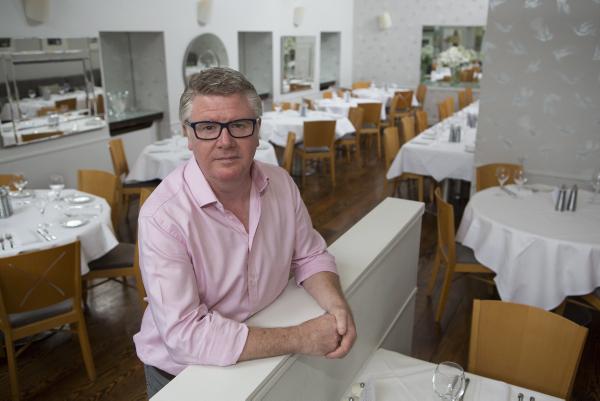
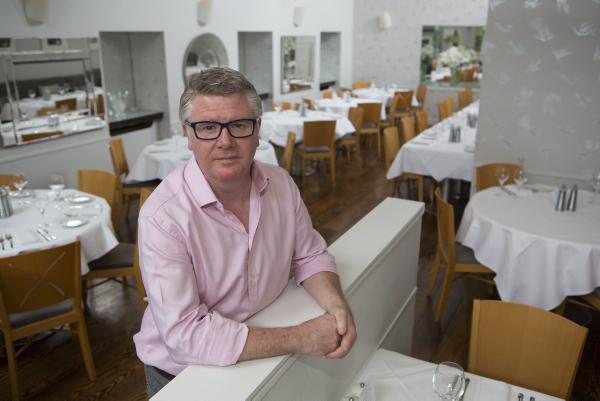
I arrive into The Tannery Restaurant at 11.45am on a Friday to find the hustle and bustle of lunch well underway – in the kitchen at least.
Cutlery is clanging, a kettle is whistling, and vegetables are being chopped with ferocity. But the man himself, Paul Flynn, is not here. I backtrack, heading around the corner to the cookery school, a place Paul later (and wickedly) describes as “a retirement home for chefs”.
Drawing near, I can see Paul through the front wall, which is made entirely of glass. He is pottering around in a blue polka-dot shirt (which resembles the dress Kate Middleton wore when she left hospital with baby George), and fitted jeans in a shade of indigo. Paul Flynn looks cool, and Paul Flynn is cool – as it turns out.
But his fun, lively demeanour doesn’t imply a relaxed approach towards his work. Quite the opposite in fact. Paul Flynn was head chef in a two-Michelin starred restaurant by the age of 23.
It all started with bad marks in the Leaving Cert, back in 1982.
“Getting into cheffing happened by accident,” says Paul. “I spent most of sixth year messing and felt I let my Dad down in the exams.
“I wanted to do well, I wanted him to be proud of me. I got a job through FÁS in a local restaurant. On the first day, I thought: ‘I like this.’ I was working under a great chef, Paul McCluskey, who inspired me to work better.”
Paul moved to London in 1983, and within five years was head chef in Chez Nico, one of four two-Michelin starred restaurants in the British Isles at the time. He left Chez Nico after a 10-year stint in September 1993, and the restaurant was awarded its third Michelin star four months later. Suffice it to say, his dad was very proud.
It quickly becomes obvious why Paul is world-class. Our interview is interspersed with his scattered musings and instructions to his staff : “We need to get that black mark off the floor,” and “can someone bring up teabags?”
“Resting on your laurels is never a good thing,” says Paul. “If you say it can always be better, people are always on their toes. If you do 300 dishes a day, you have to be good all the time. You can lose your reputation instantaneously if someone has a bad meal.”
Paul returned to Ireland in 1993. “I’d had enough of posh cooking. I wanted my cooking to be freer and natural.”
It’s refreshing that someone of Paul Flynn’s culinary calibre would choose bacon and cabbage “with lashings of mustard” as their death row meal.
“I hate elitism in food,” he says simply.
Paul returned to open La Stampa, a brasserie on Dublin’s Dawson Street. Frequented by the likes of Bono, La Stampa earned the Best Restaurant in Ireland title in just one year.
“It was a fun place with good simple food and a rocking atmosphere,” relays Paul. Paul stayed there for three years until he grew tired of the one-hour commute from Sandyford into the city centre in pre-M50 times.
“I saw Rick Stein (Paul’s favourite chef) in Cornwall and said: ‘I want that.’”
“That” was in his hometown of Dungarvan. 17 years later, he’s still there and runs a restaurant, culinary school and a 0.75-acre walled garden.
“If we didn’t have a garden, we mightn’t have access to some of the things we have, such as chantenay carrots and striped beetroot,” he says.
“It’s a labour of love. You’d buy a lot of vegetables for the money you’d pay a gardener. But what you get out of it is exceptional. For example, marmande tomatoes are ‘big and ugly’ (they look like a pear) but the juice is amazing for gazpacho, which is a fresh tomato sauce.
“There’s an element of surprise with a garden. I’ve never cooked with so many flowers in my life.”
Mid-discussing the fruits of his labour (literally), Paul’s wife Máire arrives in a gorgeous grass-green top and Barbie-pink cigarette pants. Earphones at the ready, she tells Paul she’s off for a walk and he’ll have to look after the school run. Máire is vital to the business side of Paul’s company.
“I couldn’t rub two pennies together. I’m the ideas person, Máire minds the ideas.”
Readers can meet Paul at the Ploughing this year in the Lidl tent, where he’ll be doing at least six cooking demos every day. A brand ambassador for Lidl, Paul is creating 45 recipes for the supermarket chain this year. It’s obvious he would never have put his name beside Lidl’s if he didn’t respect the company’s ethos.
“I feel strongly about their Irish connection. 47% of Lidl’s grocery market is Irish. They use 80 Irish suppliers and their fresh meat is almost entirely Irish. The vegetables are outstanding – they are so thorough and so meticulous in their standards.”
“Meticulous” standards are exactly what Paul and Lidl have in common.
Paul believes that “every bad meal you have is a moment out of your life lost”, and we’re in no doubt that this mentality has got him where he is today. In three of the five years The Tannery Cookery School has been open, it’s won best cookery school in the country. And The Tannery Restaurant won the 2013 Best Restaurant in Ireland at the Restaurant Association of Ireland awards.
But all this time, Paul has been cooking for ordinary people.
“Fundamentally, we are a local restaurant. We are in a busy market town with a farming hinterland. They’re our customers.”


SHARING OPTIONS