


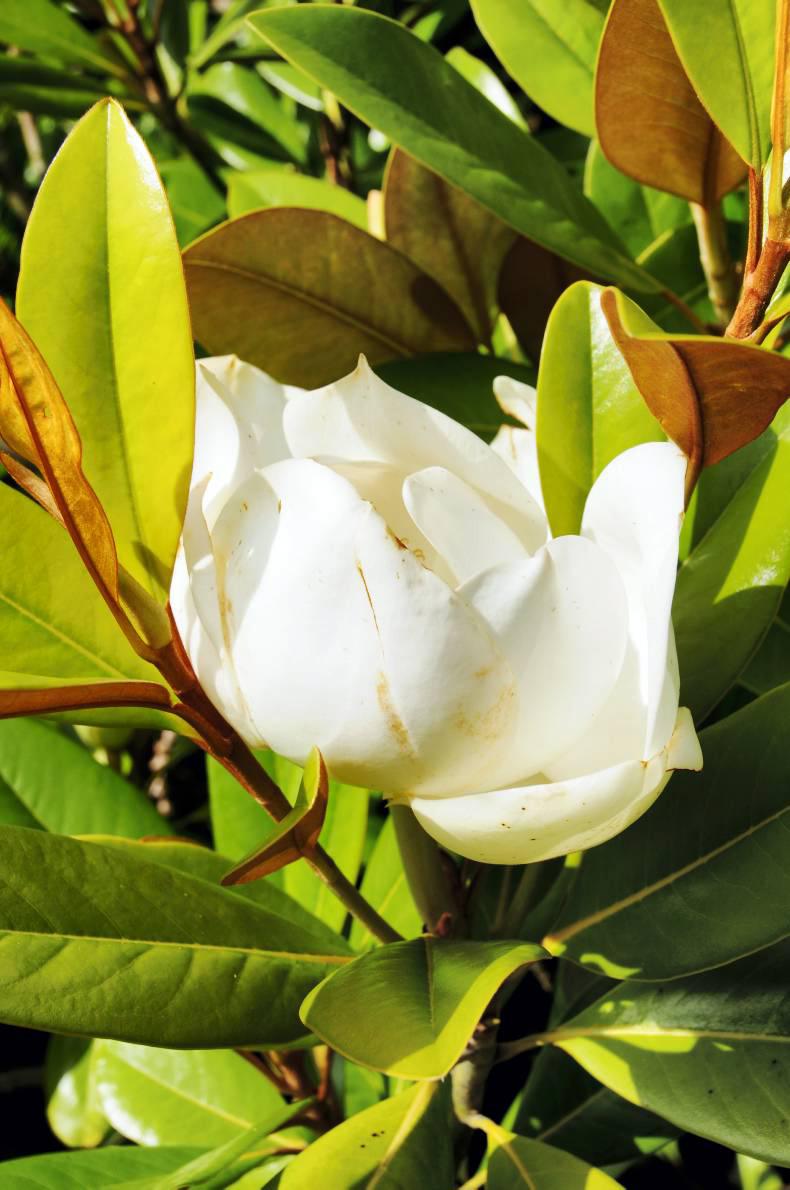
A lot of people know magnolias as spring and early summer small, flowering trees. Most have a star-shaped or a tulip-shaped flower. The bull bay, or southern magnolia, is different. For a start, it is evergreen and can grow much bigger than the kinds usually seen in gardens. It has large, bowl-shaped flowers, which can be more than 20cm across and more than half that tall. They look like they have been carved from off-white wax. The petals are thick, fleshy and long-lasting. The petals are cupped around the central stigma and a ring of pollen-carrying stamens, sheltering them and focusing the sunlight to encourage pollinating insects.
The flowers are very fragrant with a sweet, slightly lemony scent. They appear from mid-summer onwards, but are usually not that plentiful. Magnolia often flowers late into autumn and even winter and is one of the oldest flowering plants. It’s true that conifers are older, but the magnolia is a true flowering plant, although the flower centre still has a pine-cone-like structure that harks back to its predecessor.
The bull bay’s common name comes not from a sea bay of that name, but signifies that it looks like bay, being evergreen.
The leaves themselves are impressive. Large and a long oval shape, they are leathery hard and glossy, with cinnamon-brown fur on the back. These features reduce water loss and help the tree stay evergreen all year-round. This truly magnificent tree is native to the southeast US, from Virginia and North Carolina, south to Florida and west through Alabama and Louisiana to Texas and beyond. It is the state flower of Louisiana and Mississippi.
In its native land, the bull bay, or Magnolia grandiflora, can reach over 20m tall. A large imposing tree, with a heavy trunk and soaring branches, furnished from top to bottom with leaves. So while its potential size is large, in practice, in northern Europe it stays relatively small. However, it still makes specimens bigger than the more popular deciduous kinds.
In the case of flowering trees, being evergreen is usually an indication of warm climate origin, and such plants need a really good summer to grow and flower well, and this is the case with the bull bay.
As a result, it has succeeded very well in the warmer parts of Europe – especially France and Italy. It has long been grown in some old gardens in this country as a wall-trained tree, giving it the extra warmth of a large wall to encourage growth. But it is not naturally a wall plant and invariably tries to bush out as a tree.
Grown in the open as a free-standing tree it struggles, particularly if shelter is not good. The leaves tend to become blotchy and pale, and be a bit sparse on the branches. Flowers tend to be even less plentiful and usually open quite late – beginning in late summer and continuing sporadically until any frost destroys the last of them. There are some varieties, such as Exmouth, that are supposed to be a bit hardier.
Bull bay manages better in favoured areas near the coast. It needs well-drained, deep, fertile soil and a leafy mulch every few years. If you have space for it, as might be the case in a country garden, it is worth trying.
Being one of the oldest flowering plants, it is a bit of a curiosity, a beautifully scented one on the northern edge of its range, and every flower it produces is rewarding. CL
Potato blight
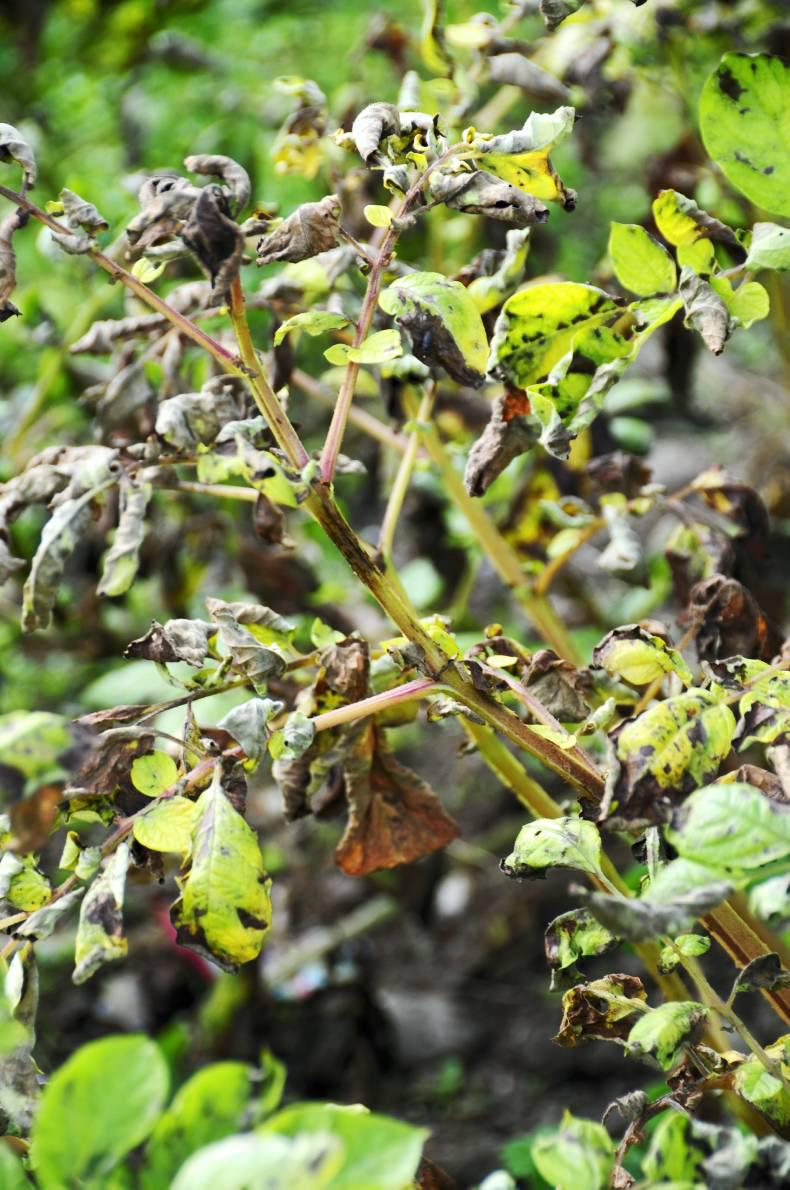
There has been plenty of potato blight, but it seems to have arrived late in many places. That is probably because the causative fungus likes warm conditions and this was not a warm summer. July, the usual blight month, was chilly (one of the coldest on record) and blight likes muggy, humid, warm days, and there were few of those. But blight did arrive in most areas in the end. If the stalks are still green and blight-affected, it is a good idea to cut them away to prevent the transfer by rain of the spores to the tubers. The cut stalks can be composted because blight is only carried over on living tissue.
Trees, shrubs and roses
Prune climbing roses that have finished flowering. It is a good time to prepare ground for planting, if not already done. The planting itself can take place now for evergreens or in eight or 10 weeks for bare-root deciduous trees. Planting can also be delayed until spring if the weather is wet and the ground becomes sodden.
Flowers
Bedding that is gone over can be removed in preparation for planting spring bedding. This is the main time for planting spring bulbs and containers for spring displays – the garden shops all have the bulbs and spring bedding in now. Perennial flowers can be planted or lifted, and divided in the case of existing plants.
Fruit, vegetables and herbs
Over-mature vegetables should be chopped up and composted to prevent pests and diseases spreading. Fruit crops can be picked and stored, using flat shelves or trays for pears, and plastic bags, open at the neck, for apples. Weeds should be removed or sprayed. Strawberries can be planted now. Tidy up herb plants.
Lawn
Sulphate of iron can be applied if moss was a problem last winter and spring. An autumn lawn fertiliser can be used or a low-nitrogen compound fertiliser. This will maintain a little growth through the winter and leave the lawn in good condition coming into spring. Continue occasional mowing as long as the soil is not soggy.
Greenhouse
Tidy up all debris and reduce watering to just keep pots from going bone dry. Most of the greenhouse crops can be cleared soon – tomatoes, chillies, melons and cucumbers. Throw out any old plants that are past their best or half-dead, because they are a source of pests and diseases. Place rooted cuttings in a bright position.





SHARING OPTIONS