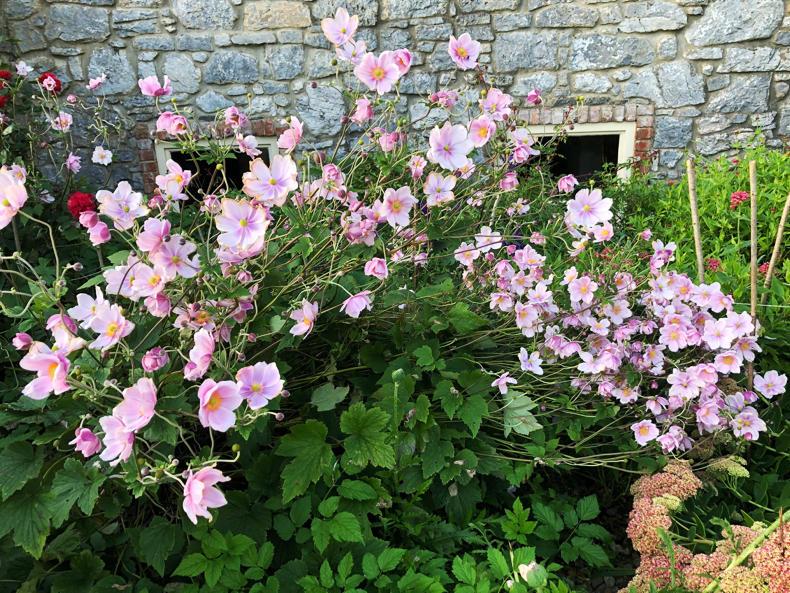
Japanese anemone ideal for the late summer early autumn flower border
ADVERTISEMENT
All gardeners strive to create a little bit of heaven on their own patch of earth. The year starts well. You clean away the debris of the previous year and look forward to the spring bulbs. They arrive in a burst of colour. So far so good.
But as the last tulips fade away, there’s a bit of a lull until the summer flowers begin to appear. You should be weeding furiously at this stage but often the weather isn’t nice, or the odd time it’s too nice and you abandon the garden for the beach.
You try to catch up in July but the slugs are there before you. By August you have given up the ghost and half the plants have been flattened by the gales and the ground elder is spreading at a rate of knots.
ADVERTISEMENT
Trouble free
You are about to give up when you are rescued by the arrival of the stately Japanese anemone. If you want trouble free perennials that thrive on neglect, this lovely flower is a must have for the late summer/autumn garden. It only asks for partial shade but it also tolerates full sun as long as its roots are kept damp.
There are lots of varieties that range in colour from white to deep lilac with cheery yellow centres. It is clump forming and it would do no harm to divide plants every five to ten years. It can be cut back hard in the spring and this will bring on new growth. Even better still most garden pests don’t go near them. If you want a flower to withstand winds and the wilderness of a late summer garden then the Japanese anemone is it.
Register for free to read this story and our free stories.
This content is available to digital subscribers and loyalty code users only. Sign in to your account, use the code or subscribe to get unlimited access.
The reader loyalty code gives you full access to the site from when you enter it until the following Wednesday at 9pm. Find your unique code on the back page of Irish Country Living every week.
CODE ACCEPTED
You have full access to the site until next Wednesday at 9pm.
CODE NOT VALID
Please try again or contact support.
All gardeners strive to create a little bit of heaven on their own patch of earth. The year starts well. You clean away the debris of the previous year and look forward to the spring bulbs. They arrive in a burst of colour. So far so good.
But as the last tulips fade away, there’s a bit of a lull until the summer flowers begin to appear. You should be weeding furiously at this stage but often the weather isn’t nice, or the odd time it’s too nice and you abandon the garden for the beach.
You try to catch up in July but the slugs are there before you. By August you have given up the ghost and half the plants have been flattened by the gales and the ground elder is spreading at a rate of knots.
Trouble free
You are about to give up when you are rescued by the arrival of the stately Japanese anemone. If you want trouble free perennials that thrive on neglect, this lovely flower is a must have for the late summer/autumn garden. It only asks for partial shade but it also tolerates full sun as long as its roots are kept damp.
There are lots of varieties that range in colour from white to deep lilac with cheery yellow centres. It is clump forming and it would do no harm to divide plants every five to ten years. It can be cut back hard in the spring and this will bring on new growth. Even better still most garden pests don’t go near them. If you want a flower to withstand winds and the wilderness of a late summer garden then the Japanese anemone is it.
If you would like to speak to a member of our team, please call us on 01-4199525.
Link sent to your email address
We have sent an email to your address. Please click on the link in this email to reset your password. If you can't find it in your inbox, please check your spam folder. If you can't find the email, please call us on 01-4199525.
ENTER YOUR LOYALTY CODE:
The reader loyalty code gives you full access to the site from when you enter it until the following Wednesday at 9pm. Find your unique code on the back page of Irish Country Living every week.








SHARING OPTIONS