



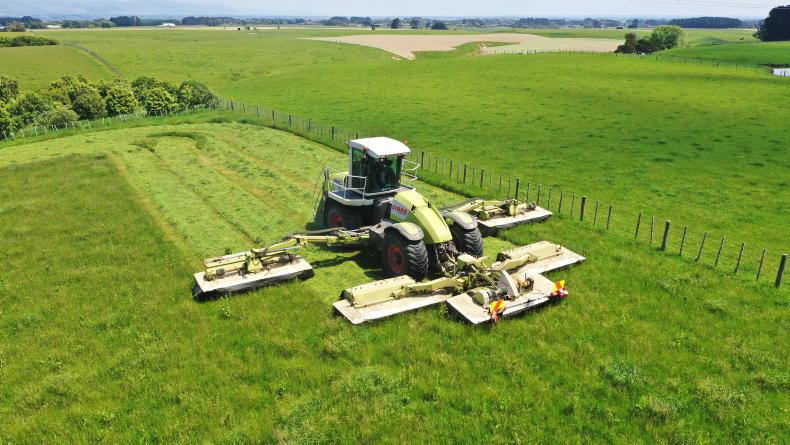
Silage-making equipment has come a long way in a single lifetime and it continues to develop. One such machine that has evolved immensely is the mower, having started out as a small horse-drawn finger-bar machine to today’s modern trailed and self-propelled machines capable of mowing up to 14.5m in a single pass.
Prior to the 1960s, all grass was mown with a finger-bar mower, as it had been since the beginning of horse-drawn mechanisation.
The finger-bar was quite energy efficient as it cut by shearing the grass. However, it was slow, prone to blockage and stone damage, and required a lot of maintenance. The need to mow high-yielding fertilised crops, and the availability of higher-powered tractors, brought the much simpler, but high-power demanding, rotary mower, originally as the PZ ‘cyclo-mower’. While most of the early models were top-driven drum mowers, bottom-drive disc-bed mowers quickly evolved.
Alternative cutting mechanisms
Drivers for mowing development
Output/labour efficiency: From the start of rotary mower development, the focus has been on speed of cutting and output in acres or ha/hr.
But the real endpoint is labour efficiency; how much one labour unit can cut in an hour or a day.
Unlike in tillage machinery or fertiliser spreading where quality of work is a major factor, with silage equipment, the overwhelming focus is on output and labour efficiency.
Output is achieved with wider mower widths and faster forward speeds. Early tractor mowers were mounted with cutting widths of 1.35m or 1.65m. With high yields, rough ground and contractors cutting big areas, trailed mowers were quickly preferred in the Irish market.
With working widths from 2.4 to 3.0m, Krone, Claas and JF produced early versions of trailed drum mowers. These quickly gave way to disc-bed trailed mowers and these typically had conditioners for swath formation and to speed up drying; sometimes coupled with auto-swather/groupers.
Tarrup, Kuhn and John Deere were popular offerings of the trailed mower conditioner in Ireland. The trailed configuration was considered to be a much more robust frame on which to mount a mowing bed with a conditioner while having a degree of suspension.
Self-propelled options
In the 1990s, the pursuit of work rate and labour efficiency in mowing was constrained by available power, as commonly available tractors simply hadn’t enough power for much more than a 3.3m mower in Irish conditions.
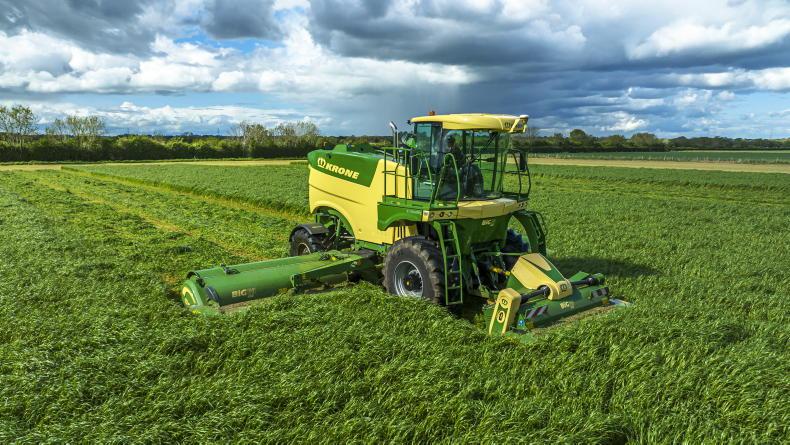
This led to many contractors converting used self-propelled forage harvesters, with worn-out chopping units, to self-propelled mowers using three mower beds. Manufacturers followed, with Krone introducing the Big M (three mower beds) in the mid 1990s, which continues to this day.
Claas briefly went one step further in size by producing the Cougar, with five mower beds cutting 14m of grass. While there is still a limited market for self-propelled mowers, tractor-powered units were soon to become dominant in the high-capacity market.
Mounted single, double and triple mower combinations
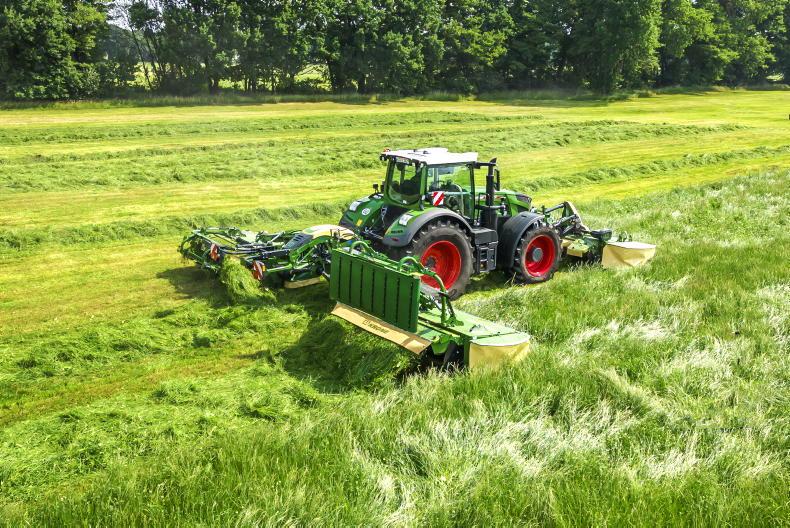
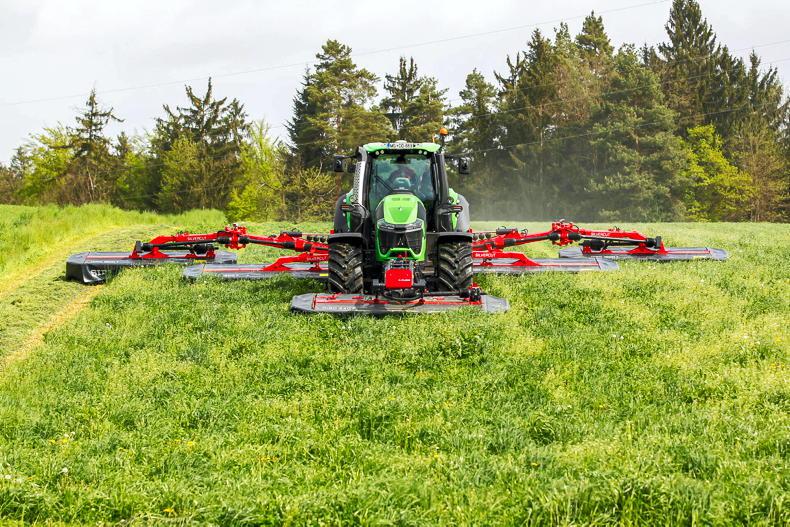
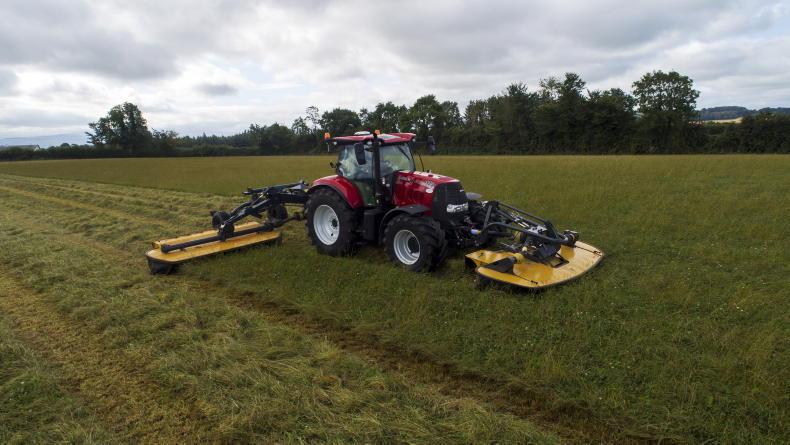
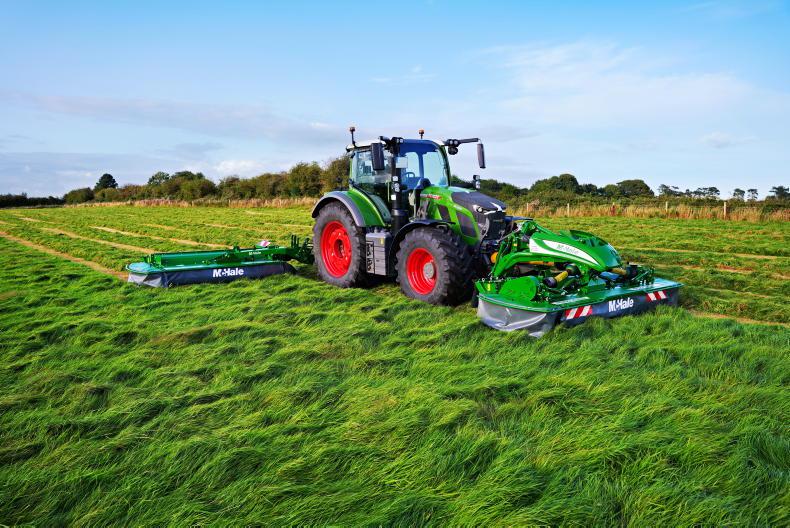
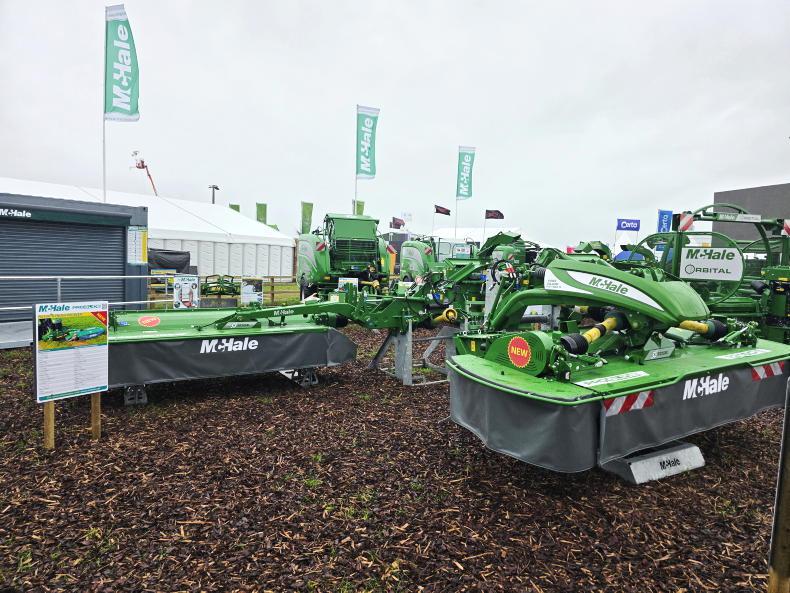
In recent years there has been a dramatic move to fully-mounted mowers either as single, double (front and one rear) or triple (front mower and both left and right rear mowers), the so-called ‘butterfly’ configuration. These combination mowers are facilitated by:
Tanco have produced a unique variant in combined mowers where the rear mowers are semi-mounted with a trailed axle taking part of the carrying load.
Technology continues to add to accuracy, convenience and performance of these mowers.
The overlap between the front and back mowers can be adjusted manually on triple mowers to give enough overlap to cater for mowing around curves or on side slopes, but at the expense of full mowing width. Now automatic overlap adjustment is possible using either position or angle sensors, allowing the optimum overlap to be achieved in all conditions.
Future mower developments
So where do we go with mower development in the future? Will the pursuit of capacity for labour efficiency continue, and are there limitations? Both SIP and Kuhn have produced five-bed, 14m+ cutting width tractor-powered mowers.
Before considering where this is going, it’s worth looking at limitations:
So when a larger-capacity machine is being considered, the extra purchase costs must be carefully pitted against the labour savings made – in particular the impact on total seasonal and machine lifetime costs must be considered. We cannot assume that bigger is always better just because a manufacturer produces a bigger machine!
Energy efficiency
There is absolutely no doubt that energy efficiency must become more important in the future. We will not have cheap fossil fuels (diesel) available endlessly for many reasons. Today, it is the impact of US-driven Middle East instability, but long-term it must be greenhouse gas emission reduction.
This will enforce a necessary complete rethink in machine design and use. In mowers it may be:
These were the subject of many research programmes in the late 1970s and 1980s, following the 1970s oil crises, but short-sighted policy change put an end to that work.
This time we need to consider energy efficiency as a long-term permanent goal. This will drive mower development, so expect some change.



SHARING OPTIONS