



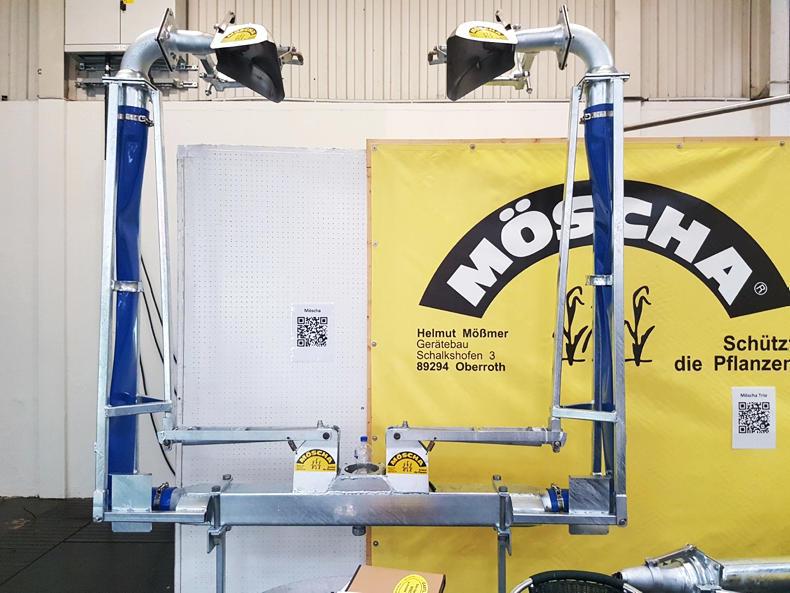

The Möscha swivel spreading system has been available in Ireland since 2014. It is becoming a more common sight, with 280 units sold in 2017. The original system works on the principle that the flow of slurry flicks the spout from side to side, but the ingenious inner diverter plate means that as the spout gets to either side of the arc, the flow of slurry also cushions the change of direction.
One of the main advantages of the Möscha is the fact that the slurry is leaving the spreader at a far lower velocity than from a splash plate system. This allows the slurry to form large droplets rather than a spray pattern.
These droplets are claimed to have numerous advantages, ranging from smell reduction and better utilisation of the nitrogen in the slurry to reducing the chances of water pollution, compared with splash plate and trailing shoe systems.
A spread width of 18m can be reached with a single spreader unit. Castle Agri imports the Möscha spreader to Ireland. Castle Agri’s Dermot Tobin has had lots of interest in wider spreading widths so as to match up to the more common tillage tramline widths.
Dermot will have the latest offering from Möscha at Grass & Muck, a folding twin spreader. This new machine will spread at least 24m. This will allow slurry to be spread evenly over 24m tramlines in a growing cereal crop.
There are many advantages to the Möscha, according to Dermot. Larger droplet size means reduced air pollution and a reduction in smell.
Pattern
Once on the ground, the pattern of the spread, which had been checked using a tray test, is perfectly even over the full spread width.
The spread can reach to 18m with a single spout and up to 24m with the new variant.
This even spreading means that no area of the ground becomes saturated with slurry, allowing both better uptake of the nutrient into the plant but also reducing the chances of water contamination as all the nutrients are being used.
The power requirement is much lower than for a trailing shoe system. This has a twofold advantage – firstly, the cost of the tractor is lower, and, secondly, the weight of the tractor is lower, meaning that there is far less compaction.
The width of the spread from the Möscha also means that less trips are required to cover the ground with a smaller tractor.
Operators claim that their output has improved dramatically since they fitted the swivel spout. This was due to many different reasons, including the spread width and a reduction in blockages of between 30% and 40%.
In the unlikely event of a blockage, Möscha has introduced a new blockage release system which allows it to be removed faster than previously.
The wider spreading width, along with this blockage removal system, makes the Möscha swivel spout a versatile and cost-efficient way of spreading slurry across different agricultural sectors.




SHARING OPTIONS