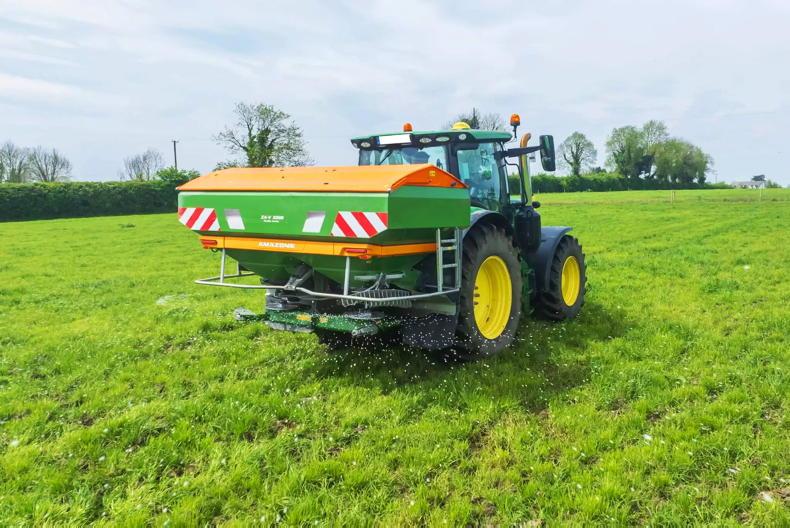
After 67 years, production of the Vicon pendulum spreader, which is better known in Ireland as the wagtail spreader, will come to an end this year. Production was taking place in Nieuw-Vennep, the Netherlands.
Since its introduction in 1957, it’s fair to say this spreader has grown into an icon on farms, known for its simplicity and durability.
The Kverneland Group Ireland showcased the spreader front and centre on its stand at the Ploughing Championships last week, which will likely be its last showing in Ireland.
History of the spreader
It was at the Verona trade fair in Italy in 1958 when the pendulum fertiliser spreader system, invented by the Italian fertiliser merchant Luigi Steffenino, was first presented. Steffenino was an art dealer and built limited numbers of machines for customers on request. He had applied for a patent and wanted to do business abroad.
The Dutch-born brothers Herbert and Joop Vissers, who created the Vicon brand, did a deal to acquire the sales rights worldwide. Within a month they put the spreader into production.
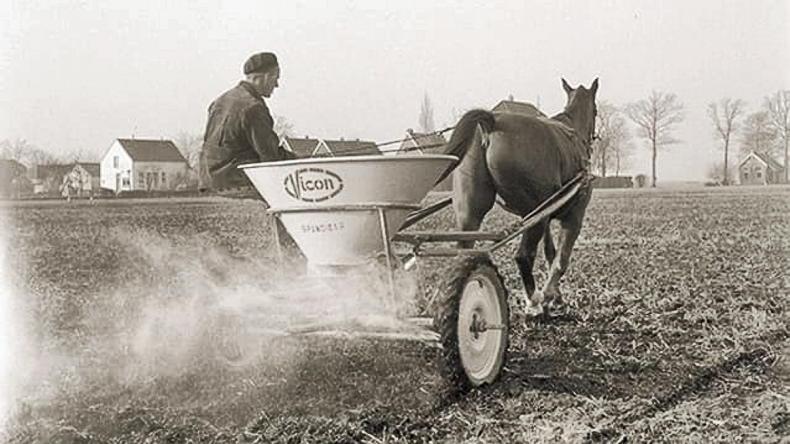
The very first pendulum spreader appeared in both trailed and three-point versions. A special type was also mounted on trucks to spread salt for winter road maintenance. The original name Spandicar was used for many years. Over time, Vicon’s development department worked on eliminating teething problems, and in the early 1960s the first improved models appeared.
Success
The pendulum spreader became a worldwide success, though not immediately. At first the system was unfamiliar and few believed it could spread fertiliser properly. But faith in the machine at Vicon gave it momentum, and the company established its own sales organisations in the most important markets. Vicon was thus one of the first agricultural machinery manufacturers with its own branches across Europe and beyond.
The working width of the first Spandicar spreaders was limited to 5m. Later generations spread up to 8m, and by the 1970s the 02 series reached a maximum width of 12m, with hopper capacities from 300l to 10,000l. Special versions also appeared for row fertilisation and orchards. The current 04 series offers working widths of 9m to 15m.
More than one million sold
Since its introduction in 1957, Vicon claims to have sold more than one million pendulum spreaders worldwide. In peak years, the company says that around 1,000 spreaders were produced per week. Thanks to its accuracy, easy adjustment and short spreading pattern, the Vicon pendulum spreader also became an ideal machine outside of agriculture, such as for vineyards, fruit growers, sports fields, golf courses and for spreading salt during winter maintenance.

Since Kverneland Group was acquired by Kubota, the pendulum spreaders have also been marketed in Kubota’s orange colour.
Production stopped in August 2025
The Kverneland Group announced that production of pendulum spreaders at the Nieuw-Vennep factory has stopped inside the last month. The company says that this decision follows a careful evaluation of the necessary investments required to keep the product range future-proof.
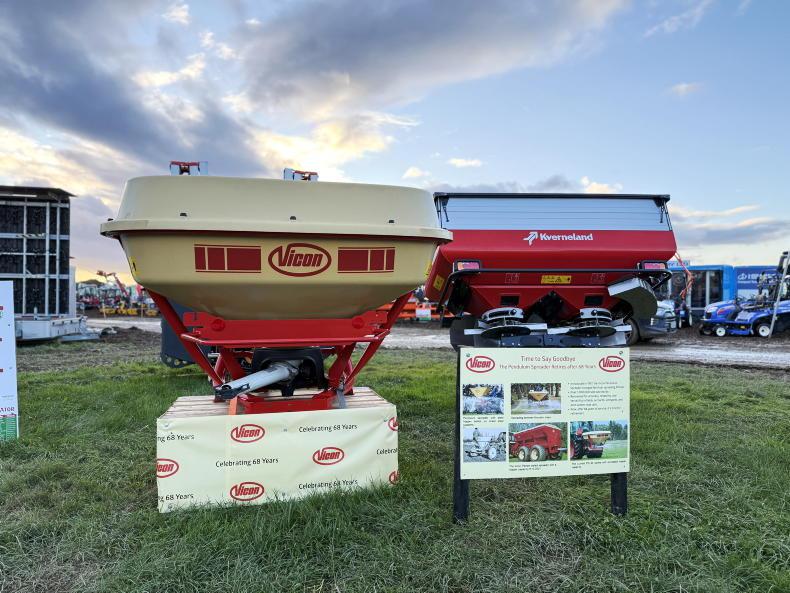
Although production has now stopped definitively, the Kverneland Group Ireland has said that it has enough stock in Ireland to supply the market for another two years.