With eight sawmills and three wood-based panel mills processing over 90% of all logs in Ireland, there would seem to be little scope for small mills. Add in wood energy outlets and the space is even more congested.
The trend towards large-scale timber processing has continued apace in Ireland since the 1980s, leaving little scope for small mills.
Michael Grace Limited is one of Ireland’s smaller sawmills that has bucked this trend. Now run by the Grace brothers – Dermot and Ken – this west Wicklow sawmill demonstrates how smaller mills can not only survive, but thrive in this fiercely competitive marketplace.
Success
Part of the answer to their success is that they don’t compete with the large mills for spruce – Sitka and Norway – which dominate the Irish timber processing market.
“We specialise in diverse species, while the large mills depend on spruce and, to a lesser extent, pine,” explains Dermot Grace. The brothers leave the “white deal” to the main mills and concentrate on “red deal”.
“Our main species are Douglas fir, Japanese larch and Scots pine,” Dermot says. “These are getting scarcer, but they are still out there,” he adds.
“We would also take European larch and western hemlock if available,” but he says these species are almost impossible to source now “as they haven’t been planted for decades”.
The Graces specialise in squared fencing posts, cladding, gates and planks for boardwalks, such as the spectacular Coillte Treetop Walk in Avondale, which they are extremely proud of.

The Grace brothers provided Douglas fir for the spectacular Coillte Treetop Walk in Avondale. \ Adrian McGreevy
These markets require quality material, which needs to be dried to at least 16% moisture content and, in most outdoor use, needs to be treated with environmentally safe preservatives.
Advantage over big sawmills
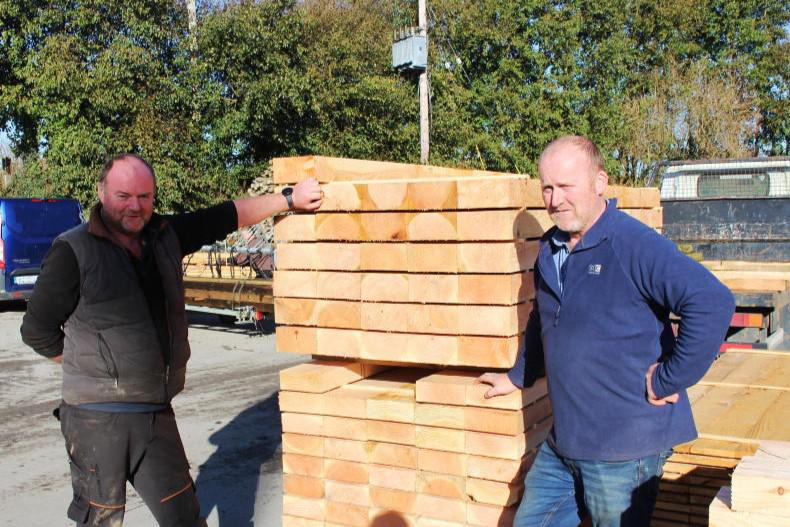
The mill yard has a variety of species and sawn timber products, while large logs are stacked nearby ready for sawing. And it’s these large logs that illustrate one major advantage the Grace brothers have over the big sawmills.
The technology in modern large mills is geared for logs in the 0.3m3 to 0.9m3 size range as a result of premature clearfelling in Ireland over the past 40 years.
“We can saw logs from trees up to 5m3, which is a major advantage,” Dermot says.
Like every successful mill, they plan to diversify to add value as they utilise every piece of the log. Instead of selling on waste wood, they will chip it on site and transport it to Bord na Móna’s biomass power plant in Edenderry.
They also plan to utilise small and medium logs for stakes and strainers.
Ken says he would like to see foresters and farmers plant more Douglas fir, Scots pine, western hemlock and, if Phytophthora ramorum could be kept in check, a return to European larch, which he says “is far superior to Japanese larch”.
Co Wicklow still has good, diverse coniferous forests, such as Douglas fir and Scots pine, although in many instances these are being replaced by Sitka spruce.
After visiting the Grace sawmill, I met Jim Keogh, who was clearfelling Douglas fir in Coillte’s Ballard property near Laragh.

Jim Keogh harvesting Douglas fir in Coillte’s forest, Ballard near Laragh, Co Wicklow, for Grace’s sawmill. \Donal Magner
This 56-year-old quality timber crop was bound for Grace’s mill. Jim was carefully felling trees, up to 33m tall, so they didn’t shatter on ground impact.
Nearby, a recent clearfelled crop has been replaced by Douglas fir, which is encouraging, as the trend has been to reforest with Sitka spruce in many instances, often because Douglas is much more prone to deer damage.
The recent attractive increases in grants and premium payments for diverse conifer afforestation and continuous cover forestry (CCF) are worth exploring by farmers who are thinking about planting non-spruce species.
The Grace brothers and other specialist mills demonstrate that there is a market for this material.
The old adage that “quality sells” is particularly true in well managed Douglas fir, pine and larch forests.
Michael Grace Timber – growing for generations
Ken and Dermot Grace are proud of their forestry tradition, which goes back to their grandfather, Jack Grace, who was involved in timber extraction in the 1950s.
The sawmill owes its name to their father, Mick, who made the transition from timber extraction to sawmilling in the 1980s.
Both brothers worked in the forest, which was not uncommon for sawmillers in Ireland at the time.
“I began extracting timber by horse in forests, around the Hollywood area, when Mick Smith was the forester-in-charge,” Dermot says.
“He was one of the old-style foresters, who would check work in progress to make sure that only what was marked for sale left the forest.”
Specialisation had to come, however, as the industry began to invest in better, more productive cutting technology as the volumes of timber dramatically increased from 0.4m m3 in the 1970s to around 3.8m m3 today.
The Grace mill has evolved steadily over the years, and is now in a position to expand further. “We will increase annual intake to over 20,000m3 over the coming years and will shortly build an all-timber office using mainly Douglas fir,” Dermot says.
The sawmill now employs 14 people, as well as generating many more jobs in forest harvesting and haulage.
Meer Bomen Nu – a Dutch tree-planting lesson
Ireland received a Dutch arboreal lesson recently as part of a new tree planting scheme, launched in the Dunsany Estate, Co Meath.

Pictured at the Irish launch of More Trees Now at Dunsany Estate (back row, left to right): Evelyn Murphy, Easy Treesie (ET); Aideen O Rourke, More Trees Now (MTN); Bob Hamilton, Irish Trees, Dunsany (ITD); Tsjeard Hofstra, Meer Bomen Nu (MBM), Franke Van der Laan, MBN; Grant Holton, MBN; Leonie Caesar, MBN; Brendan Fitzsimons, Tree Council of Ireland, Orla Farrell, ET; John Doran, ITD (front row) Emma Carrigan, ET; Marga Witteman, MBM: Ciaran Conneelly, Santry Community Gardens.
Organised by Meer Bomen Nu (MBN), More Trees Now (MTN) – the tree-planting campaign – originated in The Netherlands and has spread to France, Belgium, Britain and now Ireland.
The voluntary tree-planting campaign caught the public’s imagination in the Netherlands, where 1.4 million saplings have been planted over the past three winters.
The approach by MBN is to take cuttings or carefully remove excess saplings from forests, roadsides and woodland pathways, and store them in tree hubs, where they are collected by voluntary groups and planted out.
The Irish pilot version of MTN resulted in over 2,000 saved saplings being collected and stored in tree hubs in Carrickmacross and Co Dublin venues.
With eight sawmills and three wood-based panel mills processing over 90% of all logs in Ireland, there would seem to be little scope for small mills. Add in wood energy outlets and the space is even more congested.
The trend towards large-scale timber processing has continued apace in Ireland since the 1980s, leaving little scope for small mills.
Michael Grace Limited is one of Ireland’s smaller sawmills that has bucked this trend. Now run by the Grace brothers – Dermot and Ken – this west Wicklow sawmill demonstrates how smaller mills can not only survive, but thrive in this fiercely competitive marketplace.
Success
Part of the answer to their success is that they don’t compete with the large mills for spruce – Sitka and Norway – which dominate the Irish timber processing market.
“We specialise in diverse species, while the large mills depend on spruce and, to a lesser extent, pine,” explains Dermot Grace. The brothers leave the “white deal” to the main mills and concentrate on “red deal”.
“Our main species are Douglas fir, Japanese larch and Scots pine,” Dermot says. “These are getting scarcer, but they are still out there,” he adds.
“We would also take European larch and western hemlock if available,” but he says these species are almost impossible to source now “as they haven’t been planted for decades”.
The Graces specialise in squared fencing posts, cladding, gates and planks for boardwalks, such as the spectacular Coillte Treetop Walk in Avondale, which they are extremely proud of.
The Grace brothers provided Douglas fir for the spectacular Coillte Treetop Walk in Avondale. \ Adrian McGreevy
These markets require quality material, which needs to be dried to at least 16% moisture content and, in most outdoor use, needs to be treated with environmentally safe preservatives.
Advantage over big sawmills
The mill yard has a variety of species and sawn timber products, while large logs are stacked nearby ready for sawing. And it’s these large logs that illustrate one major advantage the Grace brothers have over the big sawmills.
The technology in modern large mills is geared for logs in the 0.3m3 to 0.9m3 size range as a result of premature clearfelling in Ireland over the past 40 years.
“We can saw logs from trees up to 5m3, which is a major advantage,” Dermot says.
Like every successful mill, they plan to diversify to add value as they utilise every piece of the log. Instead of selling on waste wood, they will chip it on site and transport it to Bord na Móna’s biomass power plant in Edenderry.
They also plan to utilise small and medium logs for stakes and strainers.
Ken says he would like to see foresters and farmers plant more Douglas fir, Scots pine, western hemlock and, if Phytophthora ramorum could be kept in check, a return to European larch, which he says “is far superior to Japanese larch”.
Co Wicklow still has good, diverse coniferous forests, such as Douglas fir and Scots pine, although in many instances these are being replaced by Sitka spruce.
After visiting the Grace sawmill, I met Jim Keogh, who was clearfelling Douglas fir in Coillte’s Ballard property near Laragh.
Jim Keogh harvesting Douglas fir in Coillte’s forest, Ballard near Laragh, Co Wicklow, for Grace’s sawmill. \Donal Magner
This 56-year-old quality timber crop was bound for Grace’s mill. Jim was carefully felling trees, up to 33m tall, so they didn’t shatter on ground impact.
Nearby, a recent clearfelled crop has been replaced by Douglas fir, which is encouraging, as the trend has been to reforest with Sitka spruce in many instances, often because Douglas is much more prone to deer damage.
The recent attractive increases in grants and premium payments for diverse conifer afforestation and continuous cover forestry (CCF) are worth exploring by farmers who are thinking about planting non-spruce species.
The Grace brothers and other specialist mills demonstrate that there is a market for this material.
The old adage that “quality sells” is particularly true in well managed Douglas fir, pine and larch forests.
Michael Grace Timber – growing for generations
Ken and Dermot Grace are proud of their forestry tradition, which goes back to their grandfather, Jack Grace, who was involved in timber extraction in the 1950s.
The sawmill owes its name to their father, Mick, who made the transition from timber extraction to sawmilling in the 1980s.
Both brothers worked in the forest, which was not uncommon for sawmillers in Ireland at the time.
“I began extracting timber by horse in forests, around the Hollywood area, when Mick Smith was the forester-in-charge,” Dermot says.
“He was one of the old-style foresters, who would check work in progress to make sure that only what was marked for sale left the forest.”
Specialisation had to come, however, as the industry began to invest in better, more productive cutting technology as the volumes of timber dramatically increased from 0.4m m3 in the 1970s to around 3.8m m3 today.
The Grace mill has evolved steadily over the years, and is now in a position to expand further. “We will increase annual intake to over 20,000m3 over the coming years and will shortly build an all-timber office using mainly Douglas fir,” Dermot says.
The sawmill now employs 14 people, as well as generating many more jobs in forest harvesting and haulage.
Meer Bomen Nu – a Dutch tree-planting lesson
Ireland received a Dutch arboreal lesson recently as part of a new tree planting scheme, launched in the Dunsany Estate, Co Meath.
Pictured at the Irish launch of More Trees Now at Dunsany Estate (back row, left to right): Evelyn Murphy, Easy Treesie (ET); Aideen O Rourke, More Trees Now (MTN); Bob Hamilton, Irish Trees, Dunsany (ITD); Tsjeard Hofstra, Meer Bomen Nu (MBM), Franke Van der Laan, MBN; Grant Holton, MBN; Leonie Caesar, MBN; Brendan Fitzsimons, Tree Council of Ireland, Orla Farrell, ET; John Doran, ITD (front row) Emma Carrigan, ET; Marga Witteman, MBM: Ciaran Conneelly, Santry Community Gardens.
Organised by Meer Bomen Nu (MBN), More Trees Now (MTN) – the tree-planting campaign – originated in The Netherlands and has spread to France, Belgium, Britain and now Ireland.
The voluntary tree-planting campaign caught the public’s imagination in the Netherlands, where 1.4 million saplings have been planted over the past three winters.
The approach by MBN is to take cuttings or carefully remove excess saplings from forests, roadsides and woodland pathways, and store them in tree hubs, where they are collected by voluntary groups and planted out.
The Irish pilot version of MTN resulted in over 2,000 saved saplings being collected and stored in tree hubs in Carrickmacross and Co Dublin venues.





SHARING OPTIONS