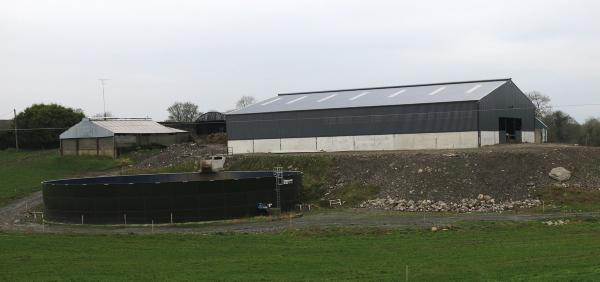
This week, I feature an interesting job: building a slatted shed on top of an existing open tank. The farmer is Richard Healy of Annagh, Galbally, Co Limerick and the job is being done for him by Jack Crosse who operates as Shuttcon Ltd.
Richard, who runs a suckler herd, built the big, square, underground tank under a Department of Agriculture grant aid scheme back in the early 1990s, to full scheme specification. Since then, he has scraped slurry into the tank from a nearby cubicle house and other sheds. Putting a roof over the tank has been planned for a number of years — now it’s going ahead. Doing so will reduce labour, give significantly better effluent control and give additional winter accommodation. Richard plans to switch half of his cows to autumn calving.
Picture one
The original tank was large and square in shape: 40 feet by 40 feet. The plan is to put in a 15 foot central feed passage with slatted pens on each side. The centre passage will of course be suspended over the tank.
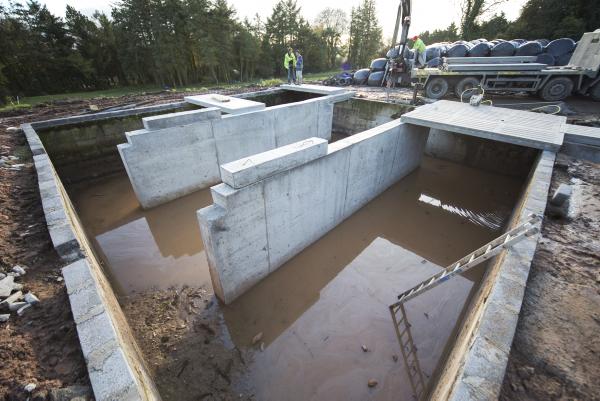
Slats and a suspended passage require internal spine walls in the tank to hold them up. There were no such spine walls in this tank, so adding them was the first thing Jack Crosse had to do. In this picture, we can see the original four walls of the tank plus the two new spine walls.
As normal, gaps are left at each end of the spine walls to allow slurry circulate during agitation. In addition, the gaps allow the slurry keep a level height in all three tanks. Otherwise, when one tank is emptied, there would be huge force acting on the other side of the wall from the neighbouring full tank of slurry. But to guarantee safety, spine walls are always reinforced with steel on both sides so that they can withstand pressure from either direction.
The five foot gaps at the end of the spine walls will be bridged by pre-cast beams which Shuttcon cast on site and which we see temporarily resting on the spine walls. They will be lowered into position by a crane or excavator using the two steel hoops as hooking points.
Picture two
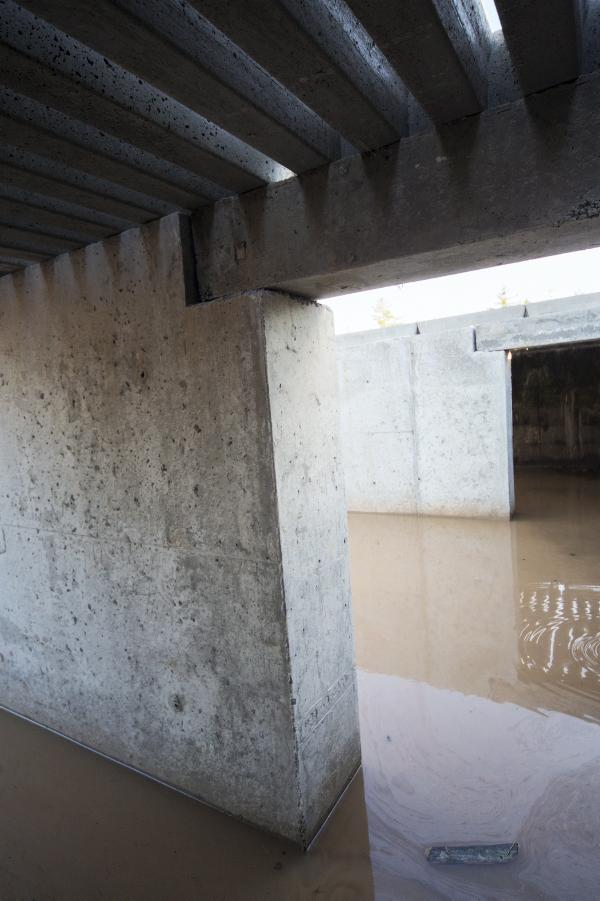
As with slats and passage slabs, it is critical that pre-cast beams like those have adequate support. The beams here have 12 inches (300mm) of bearing. The 18-inch (450mm) width of the spine walls also ensure that the beams are well supported.
The beams are 16 inches wide, 12 inches deep and seven feet long (400mm x 300mm x 2.1m). They weigh about 0.75 tonnes each and are obviously reinforced with steel. Beams, slats and passage slabs are always made with high cement concrete, e.g. 40N or 50N.
Picture three
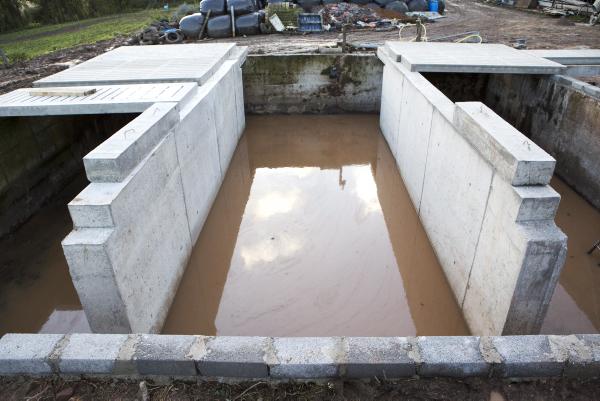
The spine walls are wide (450mm) so as to be able to support a slat end on one side and beside it an end of the pre-cast centre passage slabs. Normally, in a new tank, the supporting steel for spine walls will be footed in the floor slab when the slab is being poured, giving the wall steel very good anchorage. When the walls are being added afterwards, as here, the procedure is to drill holes in the floor slab for the steel and secure it in place using a mortar or epoxy resin mix, etc. It is a time consuming procedure.
Crosse poured the spine walls at 2.1m (seven feet four inches) high. However, the external walls of the tank were just 2.1m (six feet 11 inches ) high, so he raised them by adding a row of four-inch solid blocks. This was done to maximise the storage capacity of the tank. The slats above are lying level.
The older walls were made to Department spec and are structurally sound.
Picture four
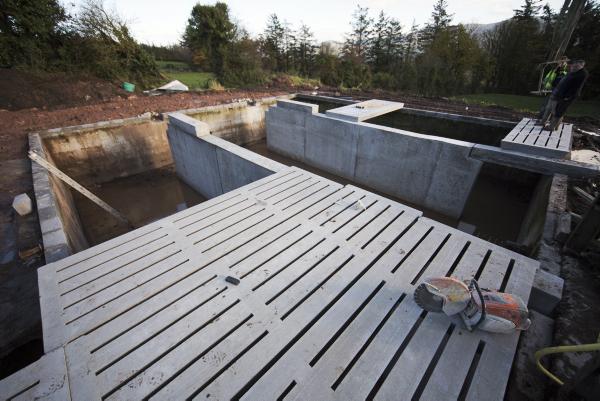
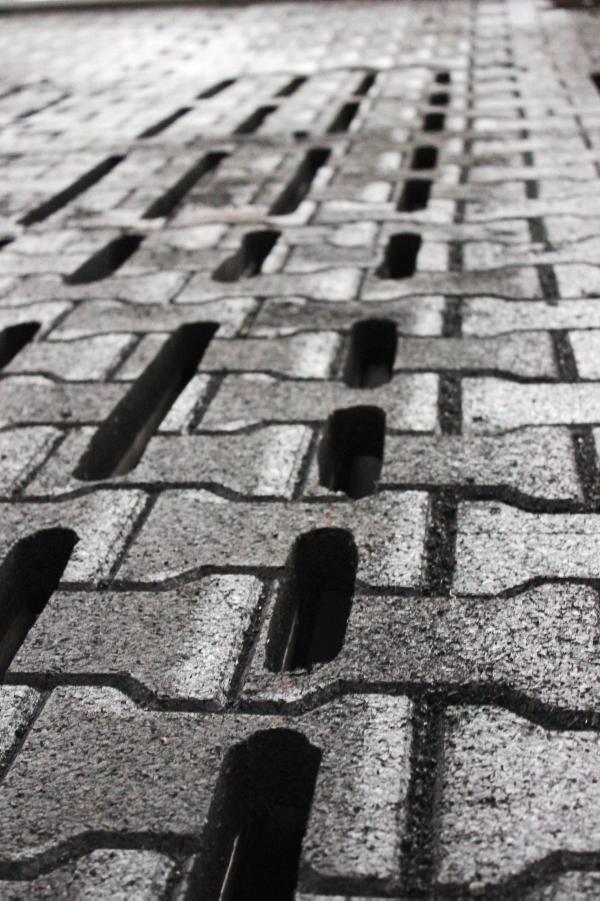
The 12 feet six inch slats and the pre-cast slabs for the centre passage were supplied by Croom Concrete and will be lowered into place by the firm’s crane.
Croom’s Joe Costello told me that he now has the CE mark on his slats, claiming to be one of the first manufacturers here to have it in place. All manufacturers are moving to have CE certification.
Picture five
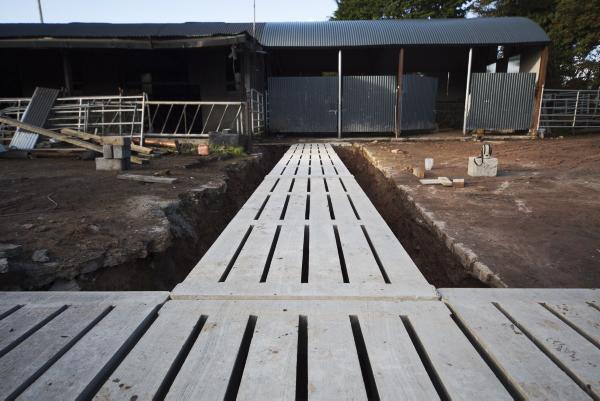
To reduce the labour of cleaning his existing winter accommodation, Richard has built a 36 foot flow channel to carry slurry to the new tank. This required breaking into the yard’s concrete slab — this will be backfilled and resurfaced later. An opening was cut into the tank wall.
Jack Crosse has built a small reception tank in the cubicle house to let the slurry down into the flow channel. The channel is covered with three gangs of 12 foot six-inch slats laid end to end.
Picture six
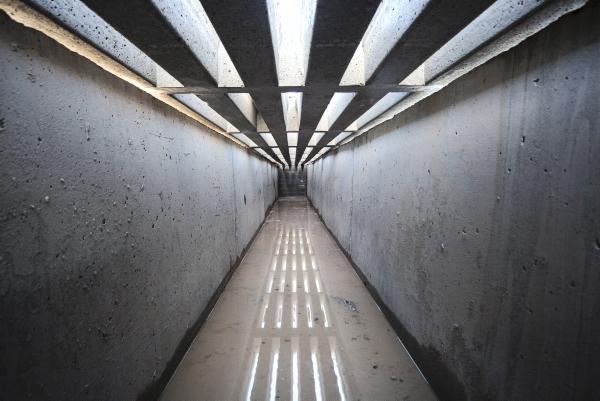
The channel is four feet (1.2m) deep and wide enough to accept a slat gang. It has a 200mm (eight-inch) poured concrete floor and 225mm (nine-inch) walls.
When a flow channel falls sharply as it approaches an underground, it may be necessary to step the floor and build small retaining walls to ensure there is a bed of water at the high end.
The solids will then flow along the top of the tanks, over the walls, and into the underground tank.
Here, the slope is gradual and just one wall at the bottom will be enough to ensure an 18-inch bed of water sits along the length of the channel.
Picture seven
Richard Healy (left) is looking forward to easier slurry management and having extra accommodation. He also plans to have a bedded lieback and a bull pen in the new shed.
Jack Crosse (right) has now installed the slats and the passage slabs. A concrete floor will be laid on the slabs and then Jack will erect the shed overhead.
Cost
Jack Crosse gave me some costs for covering this tank.
The spine walls, channel and the cast beams required 31m2 of concrete at a cost of €69 per cube. Reinforcing steel cost €1,000, plus VAT. Slats for the tanks and channel, and the pre-cast slabs for the passage cost €8,200, plus VAT.Labour for the tank and channel, including digger work, cost €5,000, plus VAT. Meanwhile, Jack Crosse is proceeding with the shed and now has the steelwork erected.
I hope to feature the shed after it is completed.
This week, I feature an interesting job: building a slatted shed on top of an existing open tank. The farmer is Richard Healy of Annagh, Galbally, Co Limerick and the job is being done for him by Jack Crosse who operates as Shuttcon Ltd.
Richard, who runs a suckler herd, built the big, square, underground tank under a Department of Agriculture grant aid scheme back in the early 1990s, to full scheme specification. Since then, he has scraped slurry into the tank from a nearby cubicle house and other sheds. Putting a roof over the tank has been planned for a number of years — now it’s going ahead. Doing so will reduce labour, give significantly better effluent control and give additional winter accommodation. Richard plans to switch half of his cows to autumn calving.
Picture one
The original tank was large and square in shape: 40 feet by 40 feet. The plan is to put in a 15 foot central feed passage with slatted pens on each side. The centre passage will of course be suspended over the tank.
Slats and a suspended passage require internal spine walls in the tank to hold them up. There were no such spine walls in this tank, so adding them was the first thing Jack Crosse had to do. In this picture, we can see the original four walls of the tank plus the two new spine walls.
As normal, gaps are left at each end of the spine walls to allow slurry circulate during agitation. In addition, the gaps allow the slurry keep a level height in all three tanks. Otherwise, when one tank is emptied, there would be huge force acting on the other side of the wall from the neighbouring full tank of slurry. But to guarantee safety, spine walls are always reinforced with steel on both sides so that they can withstand pressure from either direction.
The five foot gaps at the end of the spine walls will be bridged by pre-cast beams which Shuttcon cast on site and which we see temporarily resting on the spine walls. They will be lowered into position by a crane or excavator using the two steel hoops as hooking points.
Picture two
As with slats and passage slabs, it is critical that pre-cast beams like those have adequate support. The beams here have 12 inches (300mm) of bearing. The 18-inch (450mm) width of the spine walls also ensure that the beams are well supported.
The beams are 16 inches wide, 12 inches deep and seven feet long (400mm x 300mm x 2.1m). They weigh about 0.75 tonnes each and are obviously reinforced with steel. Beams, slats and passage slabs are always made with high cement concrete, e.g. 40N or 50N.
Picture three
The spine walls are wide (450mm) so as to be able to support a slat end on one side and beside it an end of the pre-cast centre passage slabs. Normally, in a new tank, the supporting steel for spine walls will be footed in the floor slab when the slab is being poured, giving the wall steel very good anchorage. When the walls are being added afterwards, as here, the procedure is to drill holes in the floor slab for the steel and secure it in place using a mortar or epoxy resin mix, etc. It is a time consuming procedure.
Crosse poured the spine walls at 2.1m (seven feet four inches) high. However, the external walls of the tank were just 2.1m (six feet 11 inches ) high, so he raised them by adding a row of four-inch solid blocks. This was done to maximise the storage capacity of the tank. The slats above are lying level.
The older walls were made to Department spec and are structurally sound.
Picture four
The 12 feet six inch slats and the pre-cast slabs for the centre passage were supplied by Croom Concrete and will be lowered into place by the firm’s crane.
Croom’s Joe Costello told me that he now has the CE mark on his slats, claiming to be one of the first manufacturers here to have it in place. All manufacturers are moving to have CE certification.
Picture five
To reduce the labour of cleaning his existing winter accommodation, Richard has built a 36 foot flow channel to carry slurry to the new tank. This required breaking into the yard’s concrete slab — this will be backfilled and resurfaced later. An opening was cut into the tank wall.
Jack Crosse has built a small reception tank in the cubicle house to let the slurry down into the flow channel. The channel is covered with three gangs of 12 foot six-inch slats laid end to end.
Picture six
The channel is four feet (1.2m) deep and wide enough to accept a slat gang. It has a 200mm (eight-inch) poured concrete floor and 225mm (nine-inch) walls.
When a flow channel falls sharply as it approaches an underground, it may be necessary to step the floor and build small retaining walls to ensure there is a bed of water at the high end.
The solids will then flow along the top of the tanks, over the walls, and into the underground tank.
Here, the slope is gradual and just one wall at the bottom will be enough to ensure an 18-inch bed of water sits along the length of the channel.
Picture seven
Richard Healy (left) is looking forward to easier slurry management and having extra accommodation. He also plans to have a bedded lieback and a bull pen in the new shed.
Jack Crosse (right) has now installed the slats and the passage slabs. A concrete floor will be laid on the slabs and then Jack will erect the shed overhead.
Cost
Jack Crosse gave me some costs for covering this tank.
The spine walls, channel and the cast beams required 31m2 of concrete at a cost of €69 per cube. Reinforcing steel cost €1,000, plus VAT. Slats for the tanks and channel, and the pre-cast slabs for the passage cost €8,200, plus VAT.Labour for the tank and channel, including digger work, cost €5,000, plus VAT. Meanwhile, Jack Crosse is proceeding with the shed and now has the steelwork erected.
I hope to feature the shed after it is completed.







SHARING OPTIONS