



I had a farmer call in to me at the Ploughing who, I expect, was in a similar predicament to many others.
After waiting for the planning exemption for slurry storage to come in and the reference costs to increase for a long time, they eventually bit the bullet, got full planning permission and put their application in for tranche 6 back in early March. By the time the Ploughing came around, the increase in reference cost had come and the planning exemption for one-off slurry storage was given the green light, but too late for this farmer.
The quandary they were in now was this; do they stick with their earlier applied-for application at a lower reference cost or do they pull that one and re-apply? Several factors come into play here which we will discuss below.
1. Timing
This farmer had applied for their new slatted suckler shed back in March, ahead of the closure of TAMS III tranche 6. As of last week, 3,958 of the tranche 6 applications had received approval, with just 549 outstanding applications awaiting approval.
Quite often we see 200-300 applications within a tranche drag on a while; this is often due to the Department going back to the farmer looking for missing documentation etc.
The likelihood is that this farmer who applied in tranche 6 has now received approval and can crack on with work. It’s maybe not an ideal time to start at a building project facing into the winter months, but ground conditions are good and with this farmer being a spring calving system, there is hope that if they started relatively soon, then the job would be completed by February where pressure on accommodation usually comes to a head, all going well.
If they opt to pull their application and reapply, they are looking at reapplying now ahead of the 5 December deadline for tranche 10. Going by previous tranches, this would hopefully (but not guaranteed) be approved by March-April with building work commencing after this, ready in time for winter 2026.
The one glaring issue with this is that while all applications up to tranche 8 were/are to be granted TAMS aid, ranking and selection will come into play for tranches 9 onwards. Essentially, this farmer is guaranteed, once they have a valid application) of receiving grant aid as they applied in tranche 6, but is not guaranteed through applying in tranche 10.
2. Pricing
After a long wait, reference costs have risen; some to a respectable level while others still fall behind the mark.
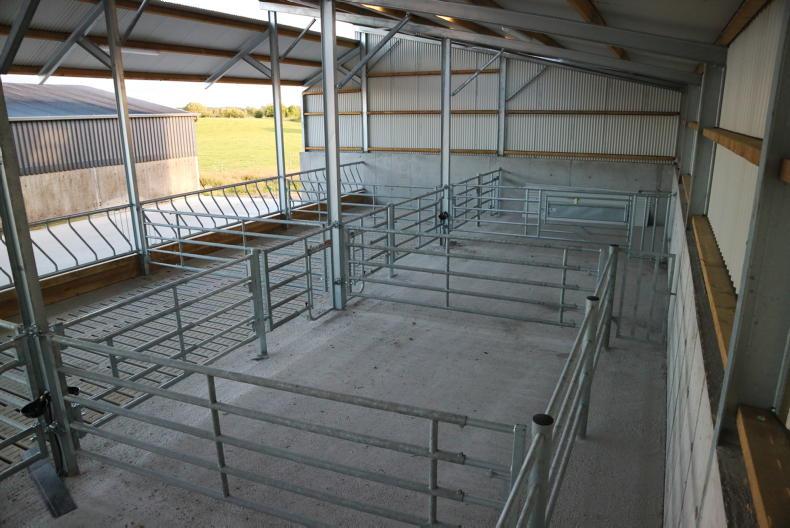
The farmer in question was building a four-bay open-fronted slatted shed with a creep/lie back area plus crush. The shed measured 19.2m in length (four standard bays) with agitation points extending 1.5m out from either end and a 14ft 6in slat used.
There was a 2.5m overhang on the feed area to the front, while the lie back area was relatively deep at 10.8m; this was done to allow the farmer to have calving/creep areas in the lie back while still giving space for a safe area around the crush for operators, which extends out two bays in length. A rough sketch of the shed is shown below.
Looking at table 1, one of the big things that stands out is the minimal increase in the reference cost of the tank at just €787.69; this isn’t enough of an increase in my opinion.
All costs have increased bar the crush (which we specced with a skulling gate and backing gate) and doors which did not rise or fall in the recent changes.
At an increase in cost of just €7,312.58, this equates to €3,082.51 more in the farmers pocket at a 60% grant rate for the tank and 40% for the shed (all farmers qualify for the 60% rate).
In this case, the farmer is a young trained farmer and qualifies for 60% aid across the entire project, so this puts €4,387.54 more in their pocket.
It will be up to this farmer, and many more like him, to decide which they wish to do.
While over €4,000 is nothing to be sniffed at, it will come down to whether you need the facilities sooner rather than later, as the scoring system could push you down a further tranche or two, while the incoming exemption on slurry storage projects will likely see increased interest resulting in increased competition for money.



SHARING OPTIONS