



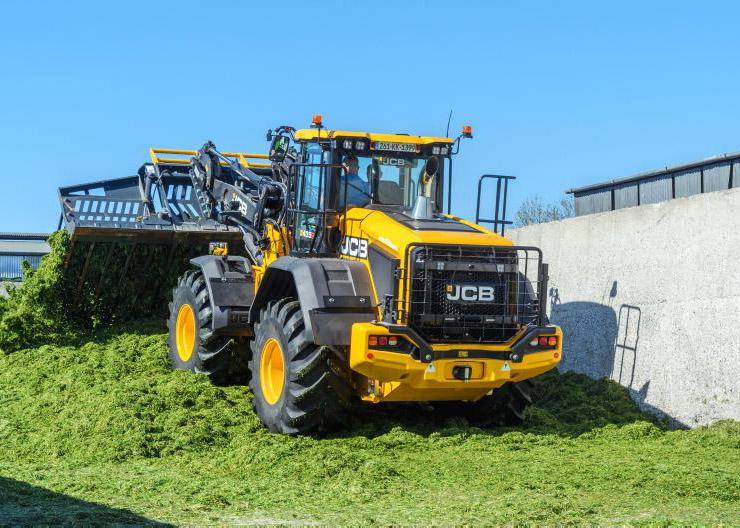
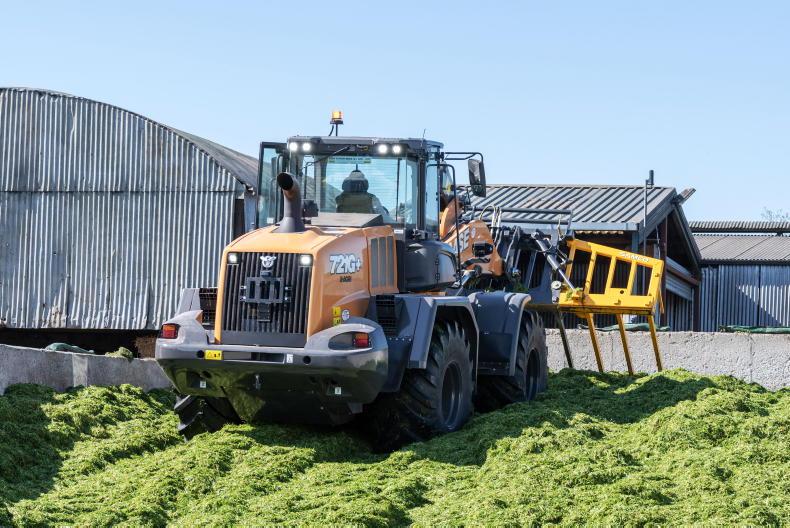
Silage has kicked off in some parts of the south and south east, albeit it at a relatively slow pace. At Grass 2026 last week, a perfectly presented pit was available, power washed and free from cracks with solid concrete walls.
It will be the case for many this year that pits have been emptied entirely due to the long winter-feeding period, so it’s an excellent time to get pits prepared and assess just how much silage they can handle this season.
Pit walls should be measured on farm, but will typically run between 2.1m (7ft) and 3m (10ft) in height. Pits of any wall height should not exceed 3.6m (12ft) of settled silage.
The settled height will be between 1 and 2m lower than the height the pit was clamped at, with grass of a lower dry matter closer to the 2m mark and high DM grass closer to 1m.
Grass of a 25% dry matter has a density of approximately 1 tonne grass: 1.39 cubic metres (at settled capacity).
To calculate capacity of the pit several calculations and measurements need to be taken. The pit width, length and wall height need to all be taken into consideration firstly.
Firstly, a calculation has to be completed to deduct capacity lost from the front of the pit, as pits angle up from the ground. If we are working off a pit height of 3.6m, we will see the pit reach full height 3.6m from the front (assuming the pit is sloped from the ground up at a 45° angle).
A simple way to calculate this is to work off an average height of 1.8m for this first 3.6m of pit and multiply by your length. Secondly, the pit will be angled from the wall to the top of the silage mound, again at a 45° angle for safety of operator, which will result in lost capacity.
If we are working off a 3m wall and a 3.6m high pit the sides of the pit will have to be sloped for the 0.6 (difference between wall height and pit height) to create our 45° angle.
Again, using and average height of 0.3m (half our difference) we can this by our full height pit length to sufficiently deduct this loss of capacity.
We will take a silage pit of 3m wall height (H) which is 15m in width(W) and 30m in length(L) and fill it to a max settled height of 3.6m. To calculate our pit capacity, we first subtract the wedge in the first 3.6m:
Now, by multiplying the pit height, width and length and subtracting our two deductions above we can calculate actual pit capacity.
To calculate this in to tonnes of grass, divide the answer by 1.39, as 1 tonne of 25% dry matter grass has a capacity of 1.39m3.
Capacity of pit
The above pit therefore has a capacity of 1,088 tonnes of silage. A higher dry matter grass will increase the capacity of the pit, though will possibly lead to more difficult preservation.
Resurfacing and repairing pits
In order to establish what repair works are necessary, the pit floor should be thoroughly cleaned to expose any cracks or subsistence.
Heavier machinery on aged pits are most likely to cause cracking.
Cracks in concrete are best repaired using hot bitumen; this will seep in to the cracks and seal them, preventing the escape of effluent into the groundwater below.
Where there is subsidence with concrete being broken, this area should be cut out and repaired using 45N concrete at the appropriate depth. Where this, or the resurfacing of the floor area using fresh concrete is complete, then the concrete needs to be cured for a minimum of 28 days before silage can be pitted in it, as use before proper curing can lead to failure of the concrete. Resurfacing with asphalt can allow for pits to be filled in a matter of days after resurfacing, though resurfacing on the whole is not recommended where there is high levels of subsistence and is generally more for concrete that has had acid damage.
Baled silage is generally drier in nature, but effluent losses can still occur.
Silage bales, including high dry matter silage or haylage, can only be stored a maximum of two bales high in the absence of adequate facilities for the collection and storage of any effluent that may arise.
Silage and haylage bales must be stored at least 20m from surface water or a drinking water abstraction point.
There are still farmers consistently stacking bales three or more high without appropriate effluent facilities and are leaving themselves at risk of an inspection and possible fine.



SHARING OPTIONS