



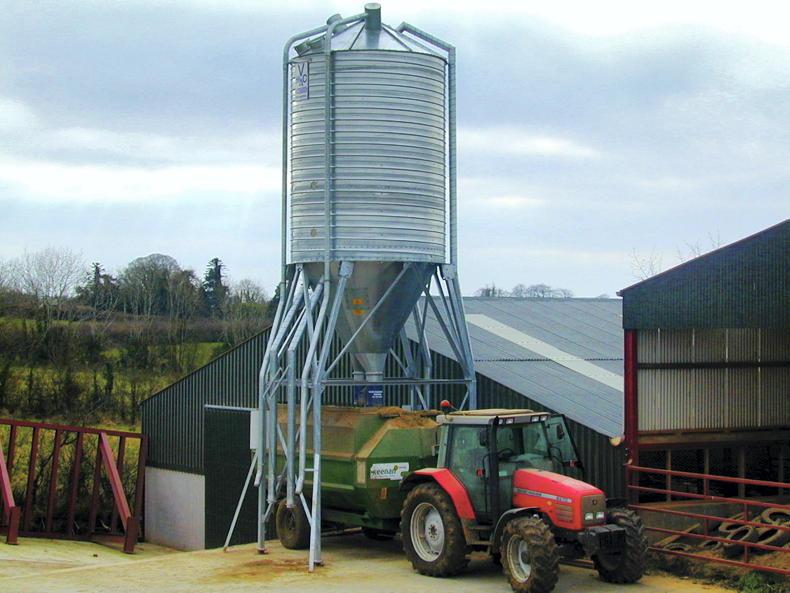
A popular option under TAMS I and II for those looking to spend more modest amounts of money was investment in feed silos/meal bins.
Previous iterations of the specifications for meal bins had two different reference costs; one for meal bins on existing concrete bases and one for meal bins on new concrete bases.
Now, we have seen the separation of solid and split meal bins in TAMS III regarding reference costs, while no allowance is given for installation of new concrete bases.
As per the Department’s spec, meal bins/grain silos must be installed on a concrete base measuring at least 3m x 3m, 250mm thick concrete base or to a base as specified by the manufacturer.
Concrete cannot be produced onsite and should only be purchased from an EN 206 certified manufacturer.
To order the correct type of concrete for underneath a meal bin, a farmer should request Mix B or 37N concrete and ensure it is certified as per concrete specifications S.101.
A well-known requirement of TAMS II meal bins was the requirement for bins to be painted. This rule has been carried forward in to TAMS III; the likely reasoning for this is to reduce the visual impact of feed silos.
Nearly all feed silos are galvanised for longevity, although this can be reflector of sunlight and cause glare, especially in the first few years of its life.
Most manufacturers will use powder coating of a pre-galvanised feed silo to comply with the TAMS requirements, with a range of colours available. It is best to choose the predominant sheeting colour (grey, green) of the farm buildings around the feed silo to allow it to blend in to the farm yard.
An information plate must be attached to all meal bins and grain silos for TAMS. The plate should be permanently fixed to the meal bin / grain silo in a position where it can be easily read from ground level when the meal bin/grain silo is erected.
The information is to be printed/embossed/stamped onto the plate with the following information noted as a minimum: company name and address, serial number, year of manufacture and capacity in cubic metres.
Due to meal bins being a fixed asset, planning permission is required for their installation, although many county councils will issue a letter of exemption in lieu of full planning.
At the time of application, planning permission or a letter of exemption will not be sought by the Department.
However, if the Department chooses to seek proof of planning/letter of exemption, the application will not be processed further and no monies paid until such proof is provided by the farmer. As with all fixed items requiring planning, full planning permission/letter of exemption must be dated before or on the date of application of the grant.
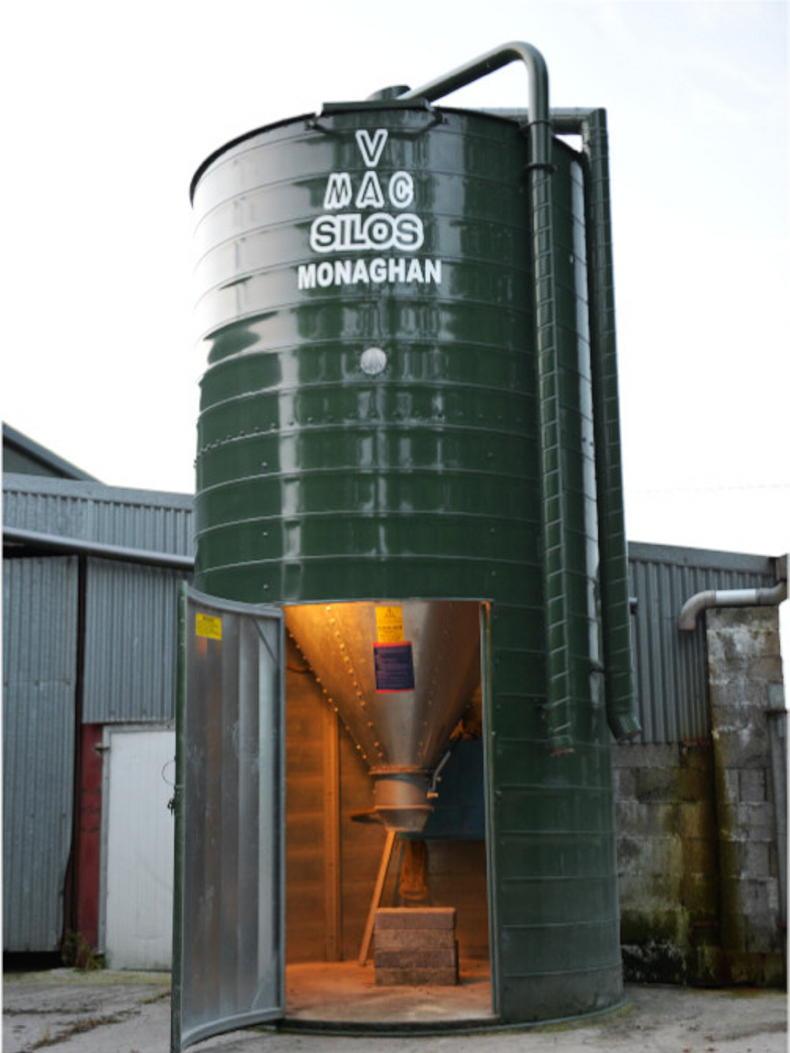
In cases where meal bins are constructed in existing buildings, then the bins are not required to be painted; however, the building in which it is installed must be in compliance with planning permission regulations (ie have full planning approval or relevant letter of exemption).
In a similar way to slurry storage, costings of meal bins are not linear with size, with smaller bins generally being more expensive per m3/tonne than larger units.
For this reason, the department has created a calculation for reference costs of meal bins; Y=180.03X+1969.8 where Y is the cost of the meal bin and X is the metre cubed capacity of the bin. For example, an 8-tonne (12.7m³) meal bin reference cost can be calculated as 12.7 multiplied by 180.03 plus 1969.8 or (12.7 x 180.03) + 1968.8 which creates a reference cost of €4,256.38 for the 8-tonne meal bin.
This is actually a decrease in reference cost compared to the old costings, with reference costs updated in September of last year. Under the old costs, the same 8-tonne meal bin carried a reference cost of €4,836.6. For split bins, the equation is y = 178.23x + 3,210.8. For a 16 tonne (25.4m³) split meal bin, the reference cost can be calculated as follows; (178.23 x 25.4) + 3,210.8 = €7,737.84 of a reference cost which is €1,240.04 higher than it had been before the review in reference costs.
Applicants should note that grant aid will be paid out on whichever is the lower amount, either the reference cost or the actual cost. If a farmer purchases the 8-tonne meal bin above for €4,256.38, they will be paid a grant rate of 40% or 60% of this figure and not the reference cost.
The submission of costs should be exclusive of VAT as grant aid will not be paid out on the VAT amount. The above costings remain the same for livestock farmers applying for meal bins under the Young Farmers, Women Farmers, Organic Farmers Capital Investment Scheme, the Animal Welfare and Nutrient Storage Scheme or the Pig and Poultry Investment Scheme. For tillage farmers applying under the Tillage Capital Investment Scheme, the above costings are also the same.
Sourcing a meal bin
This list of manufacturers of meal bins in Table 1 details all the companies that are accepted as producing meal bins/grain silos for grant-aid.
If a manufacturer is not included on this list, then initial approval for grant aid shall not be given unless the applicant arranges for the Departmental acceptance of the chosen system.
Some manufacturers may offer the below tailor-made optional extras, or these may come as standard depending on the manufacturer in question. It should be noted that where the addition of extras drives the price of your meal bin above the reference cost, you will not be paid above the reference cost figure.
Weigh cells: Some manufacturers will give an option to fit weigh cells underneath each leg of the feed silo to accurately measure feed usage and indicate when feed levels are running low. While sight glasses are installed in many feed silos across manufacturers, uneven settling of feed can give an inaccurate display, showing feed to be either plentiful or in short supply when the opposite might be the case.
The silos can also be fitted with pressure monitors on the legs which measure exerted on each leg which will then convert this to an accurate weight of feed. Some more high tech units can assess feed levels and send an alert to farmer’s phones to warn them of a need to order feed.
Inspection hatches: A highly recommended addition to any meal bin is access door installed in the base cone of the feed silo for personal access for repairs or cleaning, with annual cleaning recommended to keep feed fresh and ensure a long working life of the meal bin.
Auger/bagged chute options: Nearly all meal bins and silos come as standard with a bagging chute option, which can be a useful addition for meal bins fitted with an auger system to pipe meal to feeders in a parlour, piggery etc. Small amounts of meal can be easily collected from the bag chute to feed to animals on an out farm etc.
Fully enclosed silos: Fully enclosed silos are an option that farmers purchasing silos for out farms may opt for. The enclosed room allows as a secure storage area while also preventing any theft or tampering with the silo and enclosed feed. Reinforced doors are fitted which are 1m wide to allow access with a large wheel barrow for feeding out.
Diet feeder access: Farmers operating a TMR system with diet feeders may be interested in a centre discharge fitted with an auger while raised free standing silos are an also an option. A drive through gantry can also be manufactured which allows tractors and diet feeders to park directly under the meal bin, avoiding the need for an auger.





SHARING OPTIONS