



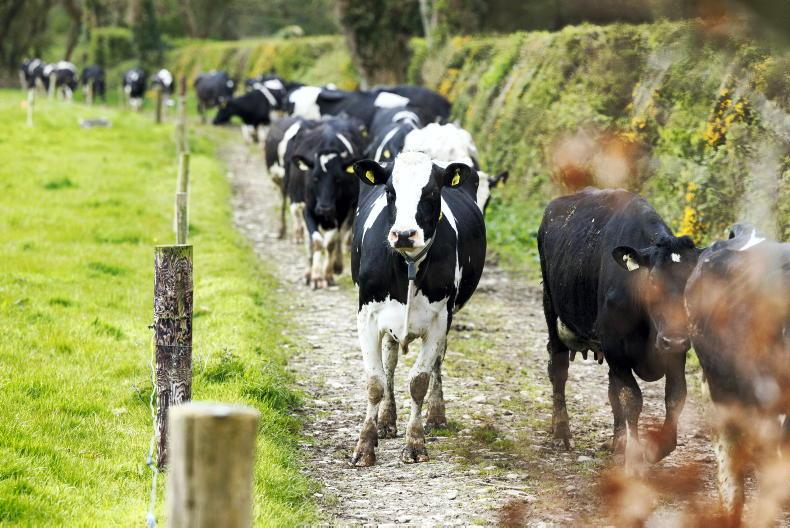
A drop in livestock numbers offset the higher levels of greenhouse gas emissions resulting from increased fertiliser use on farms in 2024, Teagasc's latest sustainability report compiled using national farm survey data has found.
A rise in the levels of nitrogen fertiliser spread on dairy farms did not hit farm-level emissions due to a reduction in the stock numbers carried on dairy farms.
A further cut in emissions was seen on the average beef and sheep farm, also driven by a decline in livestock numbers.
The report flagged a decrease in the nitrogen use efficiency of the average dairy farm as a result of the uptick in chemical nitrogen use.
Teagasc reported that the higher intensity of dairy production sees the average dairy farm utilising around one quarter of its system’s nitrogen input, a figure which rises slightly for cattle farms at 27% and 29% for sheep farms, but which was a significantly higher 70% for tillage farms.
Protected urea
A shift towards the use of protected urea as a source of nitrogen, rather than CAN, and another annual rise in the proportion of slurry going out with low emissions slurry spreading (LESS) application methods ensure that the overall nitrogen use increase did not see ammonia emissions upped for 2024.
Some 85% of slurry on the average dairy farm and 45% of the slurry on the average cattle farm was applied with LESS equipment last year, up from a respective 32% and 12% in 2019.
Protected urea accounted for two-fifths of all chemical nitrogen applied on dairy farms in 2024, up by over a factor of 10 on the 3% the fertiliser type represented five years previous.
Cattle and sheep farms still reported lower levels of protected urea usage last year, as the fertiliser type accounted for the source of just 14% of cattle farms’ chemical nitrogen and 9% for sheep farms.
Hours worked and income
On economic sustainability, Teagasc repeated the national farm survey finding that dairy farms topped the average sectoral family farm income league in 2024.
A family farm income of €1,570/ha on the average surveyed dairy farm in 2024 contrasted with an equivalent of just €519/ha on cattle farms, €782/ha on sheep farms and €621/ha on tillage farms.
However, the sustainability findings dug into the numbers on a labour unit basis, finding that the average labour unit returned an income of just over €75,800 on dairy farms, around the €19,000 mark on cattle and sheep farms and €54,500 on tillage farms.
Teagasc reported that the thee-year rolling average of hours worked yearly on farms across all sectors bar dairy “declined slightly” from 2017-2019 to 2022-2024.
The figures for the latter period were 2,549 hours/year for dairy farms, having been 2,374 five years before.
The equivalent for cattle, sheep and tillage farms averaged a respective 1,407, 1,551 and 1,505 hours per year between 2022 and 2024.
The gap between the hours worked by dairy farmers and farmers in other sectors narrowed when Teagasc accounted for the hours worked in off-farm jobs - it narrowed to fewer than 500 hours/year.





SHARING OPTIONS