




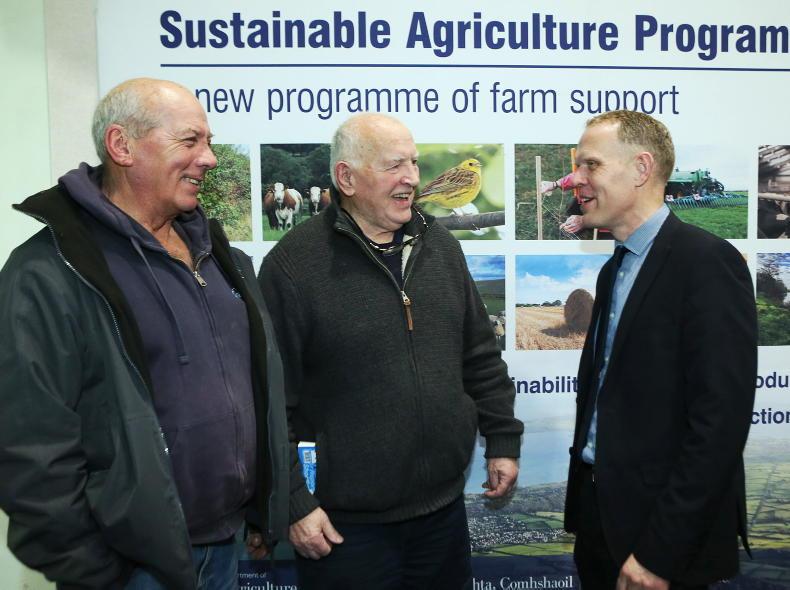
Various changes are currently being considered by DAERA for the second year of the Farming With Nature (FWN) scheme.
Speaking at Greenmount on Monday, Albert Johnston from CAFRE confirmed that a second tranche of the new agri environment scheme will open in 2026.
Five measures were available under FWN in 2025, namely establishing hedges, trees, riparian buffers, multi-species winter cover crop and retaining winter stubble.
“We are working to see if we can increase the number of environmental actions that can be delivered to widen that list from five actions last year. The payment rates are being considered for an uplift too,” Johnston said.
He said there would be a focus on “actions that can deliver multiple benefits” and gave the example of new hedgerows which can provide wildlife habitat and improve biosecurity between neighbouring farms.
Other changes under consideration for FWN this year include reducing the minimum scheme agreement threshold from £2,500, and increasing the maximum limit from £9,500.
In the first year of FWN, any farmers that still had an Environmental Farming Scheme (EFS) agreement were not able to apply, although Johnston indicated this rule was set to change.
“That issue has now been addressed so, for any business that is already in EFS, the aim is that they will be eligible to apply for FWN in 2026,” he said.
“Non-farming landowners will still be ineligible in this current year, as issues around that are still unable to be resolved,” he added.
Priority habitats
A new aspect of FWN for 2026 is the rollout of the “priority habitats” strand of the scheme which is a follow-on to EFS higher level for environmentally designated land.
Johnston said the new scheme will initially be aimed at farmers who were in tranche four of EFS higher level, as their scheme agreements ended in December 2025.
Participants in tranche five of EFS, who are due to finish up in December 2026, will also have preference in the first phase of FWN priority habitats.
Johnston said payments under the new scheme are being updated, but there would initially be no new capital measures when compared to EFS higher level.
“We recognise there is a desire to get new applicants into the scheme as well. Policy is under development and the aim is to introduce management actions for new land in 2027,” he said.
Landscape
A third strand of FWN is for landscape projects that aims to be a follow on to EFS group level.
“This new element will allow groups of farmers to work collaboratively to have innovative approaches to restore nature at a landscape scale,” Johnston said.
He said a “competitive call” for applications will open in 2026 with a focus on three themes, namely protected site management, nature recovery networks and priority species recovery.
“It is planned that 10 projects will be commissioned in year one.
“Each of those projects must have between five and 50 farmers, with a minimum of 500 hectares of land,” he said.
Carbon footprinting to start in autumn 2026
A new carbon footprinting project will begin to be rolled out on NI farms from autumn 2026, said Albert Johnston from CAFRE.
“Data collection will be carried out by the LMC and it will be fed into a carbon calculator to produce whole-farm, enterprise-level and product-level carbon footprints,” he said.
DAERA has previously said that participation in carbon footprinting will eventually become a condition for claiming the Farm Sustainability Payment (FSP).
Plans are already in place for two other FSP conditions, with the first being participation in the Soil Nutrient Health Scheme before 15 May 2027.
For anyone who does not participate, payments under FSP will be cut by 10% in 2027 and 15% from 2028 onwards.
Similarly, registering and completing training under the new Bovine Genetics Project will be a condition from 2028, with payments cut by 10% in the first year and 15% from 2029 onwards.
Beef scheme led to drop in slaughter ages
The first year of the Beef Carbon Reduction Scheme in 2024 led to a drop in cattle slaughter ages in NI, according to Albert Johnston from CAFRE.
Comparing 2024 kill data to 2020, Johnston said average age of slaughter had fallen by 14 days, resulting in emission savings of 13,300 tonnes of carbon and 54.9 tonnes of ammonia.
He said 74% of prime cattle in NI met the 30-month slaughter age target for the £75/head payment in the first year of the scheme.
The age criteria then dropped to 28 months in 2025 and is now sitting at 27 months for the 2026 scheme year.
Johnston said £19.8m was paid out to over 8,000 beef finishers in spring 2025 for the first year of the scheme, and a similar level of payout is expected again this spring for year two.


SHARING OPTIONS