



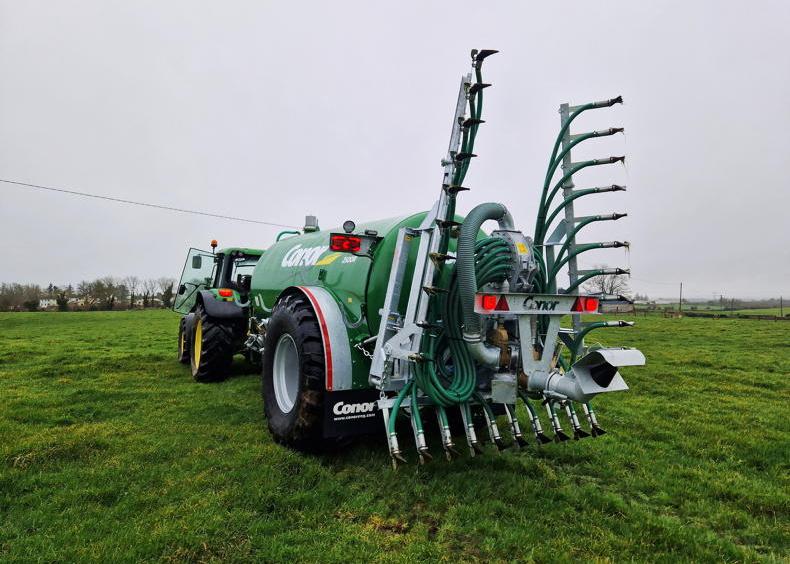
A green quango set up post-Brexit to ensure government bodies comply with environmental law has said the proposals for a new Nutrients Action Programme (NAP) in NI do not go far enough.
In a letter to Agriculture Minister Andrew Muir, the chair of the Office for Environmental Protection (OEP), Dame Helen Ghosh, has recommended that DAERA should adjust and clarify various NAP requirements, particularly relating to intensive livestock farms in NI.
At Stormont on Monday, Minister Muir told MLAs it is “imperative” that NI protects the environment and adheres to the law. “The OEP has raised issues that need to be considered and that will lead to changes to the final NAP proposals,” he said.
It had been thought that a new NAP was near completion, following on from the work done by a Task and Finish Group appointed by Minister Muir, which brought together government officials, farmers, food processors and environmental organisations.
The proposals from that group formed the basis for a public consultation on NAP, which concluded on 7 September.
However, following the intervention by the OEP, it looks like further changes will be required.
Stewardship
The letter from the OEP does recognise the significant progress made by the industry-led group, but raises a number of issues. In particular, it cites proposals for a new Nutrient Stewardship Programme (NSP) to replace the current nitrates derogation.
Under the current derogation, intensive livestock farms over a limit of 170kg of manure Nitrogen (N) per ha, can operate at up to 250kg N/ha so long as they meet a number of requirements, including a phosphorus (P) balance of under 10kg/ha.
However, there are around 2,000 farm businesses above the 170kg limit, but not in derogation so they are in breach of current NAP rules. The plan set out in the latest consultation is that they would join a second tier of the NSP and commit to reducing P over the next four years.
The OEP has raised concerns, noting that the removal of he 10kg P limit would effectively make it “a viable option” for a lot more farms to operate at up to 250kg N/ha.
The letter also recommends that the starting point for P levels on these farms should be a “fixed, past period”, to prevent farmers increasing their surplus in the short term, before reducing it at a later date.
Below 170kg
For those farms who decide to stay out of the new stewardship programme, the DAERA NAP consultation does state that these farms will need to get their N loading below 170kg/ha.
However, later in the document it adds that farms over 170kg will be seen as “high risk” and subject to a 10% annual inspection rate.
The OEP letter suggests this wording could be interpreted as offering farms above 170kg the option of continuing to do so without having to join the NSP.
“DAERA should ensure it is clear that operating above the 170kg N/ha/year limit without permission will be treated as a serious offence and enforced robustly,” states the OEP letter.
Suitable land
One other significant issue raised by the OEP relates to the suitability of some land for spreading slurry.
The latest NAP proposal does suggest that exports of slurry to land such as bog or upland rough grazing will be deemed ineligible when calculating N loads.
However, the OEP also want DAERA to exclude this type of land from manure N load calculations on all farms.



SHARING OPTIONS