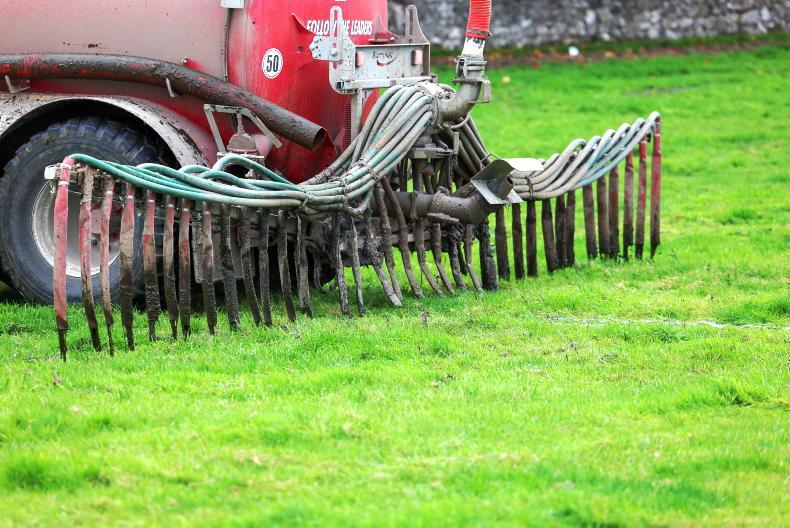
All the main political parties at Stormont, outside of the Alliance party, voted in favour of a motion on Tuesday, which called for increased flexibility around the closed period for spreading slurry in NI.
Introducing the debate, UUP MLA, Diana Armstrong pointed to the dry conditions which prevailed in early November.
“Farmers knew that conditions were suitable and that the environmental risk was low, yet, because a particular date had passed, they could do nothing,” she said.
Armstrong also argued that the fixed dates of 15 October to 31 January create a scenario where a lot of slurry is spread in “poor, wet conditions” just before and after the ban. If some of this slurry was applied in dry conditions during the current closed period, the risks would be reduced, she said.
In his response to the motion, DAERA Minister Andrew Muir said he did not intend changing dates for the closed period set out in the Nutrients Action Programme (NAP).
“The central issue is not whether machinery can enter a field during a dry spell, nor is it about spreading slurry in dry conditions. It is about whether growing grass can use the nutrients that are applied, whether those nutrients remain vulnerable and whether there is a loss to our waterways when rain returns. That distinction is fundamental to the debate,” he said.
The DAERA minister said research by the Agri-Food and Biosciences Institute provides “a strong scientific basis” for the closed period, while the current NAP prohibits spreading on any waterlogged, frozen or snow-covered ground, or when heavy rain is forecast.
Excuse
He also told MLAs he wouldn’t be publishing detailed criteria on when a “reasonable excuse” can be relied on by farmers.
That provision is included within the NAP and allows a farmer to spread some slurry in the closed period when there was “no reasonable alternative”.
“Publishing prescriptive criteria could create an expectation that particular circumstances would be automatically accepted,” he said, adding that it could potentially undermine enforcement work.
He also took aim at the other parties. “If members consider the issue that we are facing at Lough Neagh, it defies belief that we are considering this motion,” he said.