The Mayers family from Tempo is continuing to improve soil fertility to aid successful establishment of clover on their beef and sheep enterprise in Co Fermanagh.
The farm comprises 120 acres of grassland, all in one block, with an additional 60 acres of lakes, laneways and woodlands. It is stocked with 270 predominantly Suffolk, Texel and Belclare-cross ewes, alongside a Wagyu dairy calf-to-beef enterprise.
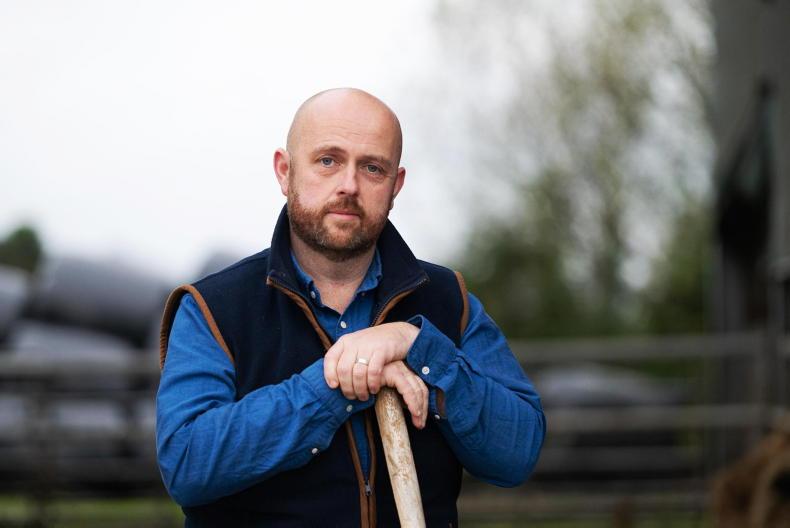
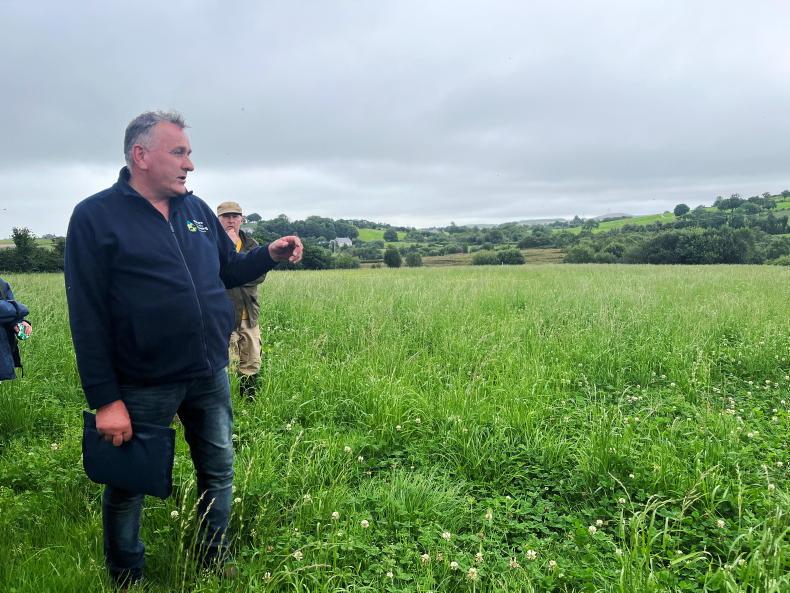
At the farm walk organised by Nature Friendly Farming Network (NFFN), Roy outlined how he has reduced chemical fertiliser usage by growing more clover. The farm has also increased output and profit while protecting and creating new habitats.
Grassland
In total, 40 acres of grass clover swards have been established on the farm, with an aim to reseed 15 acres annually.
Medium leaf clover is used extensively, with a minimum 1.5kg/ac added to seed mixtures. A total of 40t of lime is applied annually to maintain soil pH levels. Fertiliser use in 2024 was reduced to just 14t, with the majority of this spread early in the season in the form of urea to kick-start growth.
Roy has been sowing clover alongside festulolium, which is a hybrid of ryegrass and fescue species: “This year we sowed clover and festulolium into a grass sward and grazed it quickly with 200 ewes to trample in the seed. This was a cheap and quick way to boost a field that’s not preforming.”
Paddocks
Sheep on the Mayers’ farm are grazed in large groups across three-day paddocks. Paddock grazing and grass measuring has resulted in the Mayers growing and utilising more grass. However, with high levels of rainfall and difficult ground conditions, livestock are housed late September to mid-October in order to ensure grass is available for lambing in March.
Roy is also a participant in the AgriSearch-led zeroNsile programme. He said red clover established as part of the project has yielded multiple cuts of high-quality silage, but it must be targeted at fields with good soil fertility.
Sheep breeding
In recent times, the Mayers have focused on New Zealand Suffolk genetics, sourcing recorded rams that suit a grass-based system.
When it comes to selecting ewe lamb replacements, Roy used to select on the basis of litter size and that led to an improved flock scanning percentage, which is now above two lambs per ewe. However, his focus has moved towards selecting on the basis of growth rates, with the heaviest ewe lambs targeted as potential replacements.
Wagyu beef
The Mayers’ dairy calf-to-beef enterprise currently involves the rearing of Wagyu dairy-cross calves through to slaughter, at approximately 30 months.
In order to improve carcase marbling scores, calves and young stock at grass are currently receiving 4kg of concentrate, while older animals over 27 months are being offered 8kg of a finishing ration along with red clover silage.
The Wagyu are sold through an M&S scheme, with a guaranteed margin over cost.
Improving wildlife habitat
As the farm is situated on an exposed site running to 500m above sea level, some 7km of hedges have been established by Roy in order to create shelter for livestock. All fields have hedgerow boundaries, which enable two colonies of red squirrels on the farm to freely move between woodland areas without risk of predation. Hedges are cut every two to three years in rotation, to allow them to flower and fruit to further enhance the habitat.
A RSPB survey conducted three years ago confirmed 40 different species of bird inhabit the farm.
Weed management
Docks have the potential to reduce yields by 40% and treatment, with various commercial herbicides is unfeasible as they kill clover.
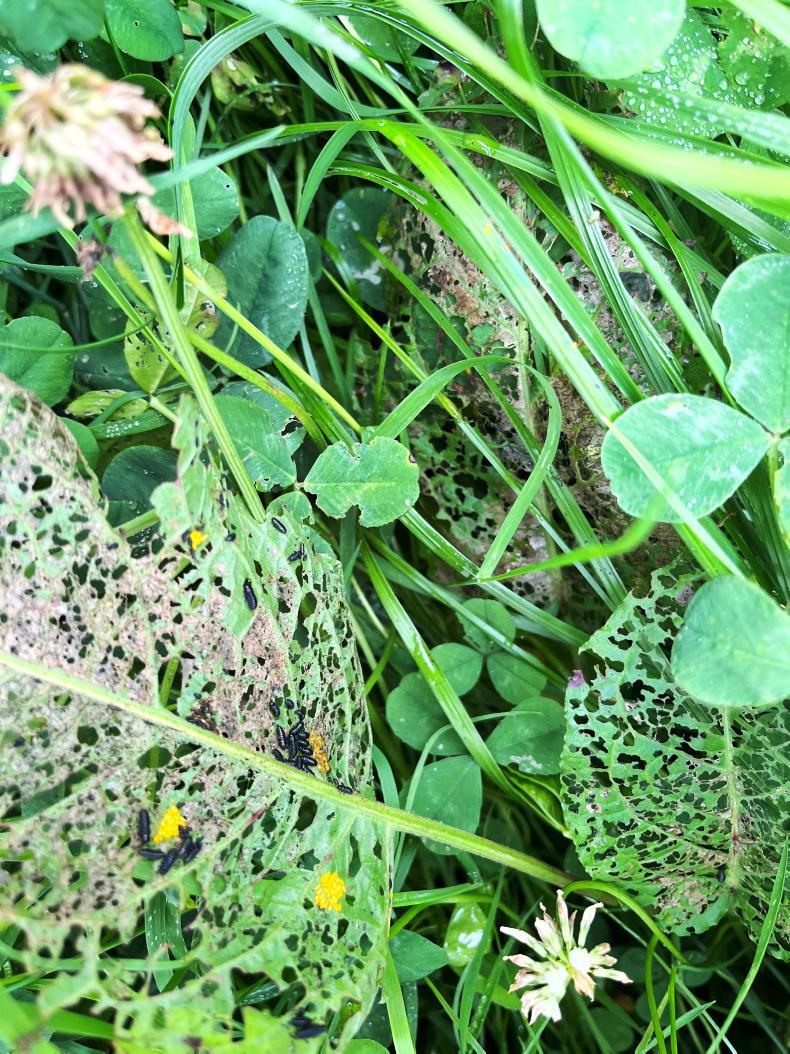
In order to tackle this issue Roy said he uses the sheep to graze out docks. However, in one paddock the dock beetle has established itself, consuming large amounts of dock leaves before the plants flower, thereby acting as a form of biological control.
When it comes to rushes, Roy explained that if soil fertility is good and pH is high, it will naturally reduce numbers.
“The use of a weed wiper aids control as the clover and grass remain intact underneath while the rushes are killed,” he said.
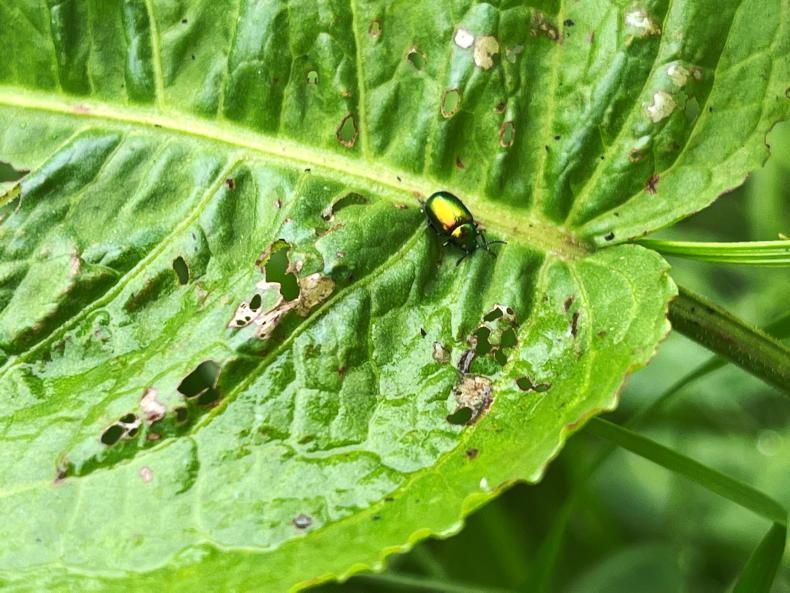
The dock beetle on Roy Mayers' farm .

The underside of a dock leaf, with beetle larvae and bright yellow eggs.
The Mayers family from Tempo is continuing to improve soil fertility to aid successful establishment of clover on their beef and sheep enterprise in Co Fermanagh.
The farm comprises 120 acres of grassland, all in one block, with an additional 60 acres of lakes, laneways and woodlands. It is stocked with 270 predominantly Suffolk, Texel and Belclare-cross ewes, alongside a Wagyu dairy calf-to-beef enterprise.
At the farm walk organised by Nature Friendly Farming Network (NFFN), Roy outlined how he has reduced chemical fertiliser usage by growing more clover. The farm has also increased output and profit while protecting and creating new habitats.
Grassland
In total, 40 acres of grass clover swards have been established on the farm, with an aim to reseed 15 acres annually.
Medium leaf clover is used extensively, with a minimum 1.5kg/ac added to seed mixtures. A total of 40t of lime is applied annually to maintain soil pH levels. Fertiliser use in 2024 was reduced to just 14t, with the majority of this spread early in the season in the form of urea to kick-start growth.
Roy has been sowing clover alongside festulolium, which is a hybrid of ryegrass and fescue species: “This year we sowed clover and festulolium into a grass sward and grazed it quickly with 200 ewes to trample in the seed. This was a cheap and quick way to boost a field that’s not preforming.”
Paddocks
Sheep on the Mayers’ farm are grazed in large groups across three-day paddocks. Paddock grazing and grass measuring has resulted in the Mayers growing and utilising more grass. However, with high levels of rainfall and difficult ground conditions, livestock are housed late September to mid-October in order to ensure grass is available for lambing in March.
Roy is also a participant in the AgriSearch-led zeroNsile programme. He said red clover established as part of the project has yielded multiple cuts of high-quality silage, but it must be targeted at fields with good soil fertility.
Sheep breeding
In recent times, the Mayers have focused on New Zealand Suffolk genetics, sourcing recorded rams that suit a grass-based system.
When it comes to selecting ewe lamb replacements, Roy used to select on the basis of litter size and that led to an improved flock scanning percentage, which is now above two lambs per ewe. However, his focus has moved towards selecting on the basis of growth rates, with the heaviest ewe lambs targeted as potential replacements.
Wagyu beef
The Mayers’ dairy calf-to-beef enterprise currently involves the rearing of Wagyu dairy-cross calves through to slaughter, at approximately 30 months.
In order to improve carcase marbling scores, calves and young stock at grass are currently receiving 4kg of concentrate, while older animals over 27 months are being offered 8kg of a finishing ration along with red clover silage.
The Wagyu are sold through an M&S scheme, with a guaranteed margin over cost.
Improving wildlife habitat
As the farm is situated on an exposed site running to 500m above sea level, some 7km of hedges have been established by Roy in order to create shelter for livestock. All fields have hedgerow boundaries, which enable two colonies of red squirrels on the farm to freely move between woodland areas without risk of predation. Hedges are cut every two to three years in rotation, to allow them to flower and fruit to further enhance the habitat.
A RSPB survey conducted three years ago confirmed 40 different species of bird inhabit the farm.
Weed management
Docks have the potential to reduce yields by 40% and treatment, with various commercial herbicides is unfeasible as they kill clover.
In order to tackle this issue Roy said he uses the sheep to graze out docks. However, in one paddock the dock beetle has established itself, consuming large amounts of dock leaves before the plants flower, thereby acting as a form of biological control.
When it comes to rushes, Roy explained that if soil fertility is good and pH is high, it will naturally reduce numbers.
“The use of a weed wiper aids control as the clover and grass remain intact underneath while the rushes are killed,” he said.
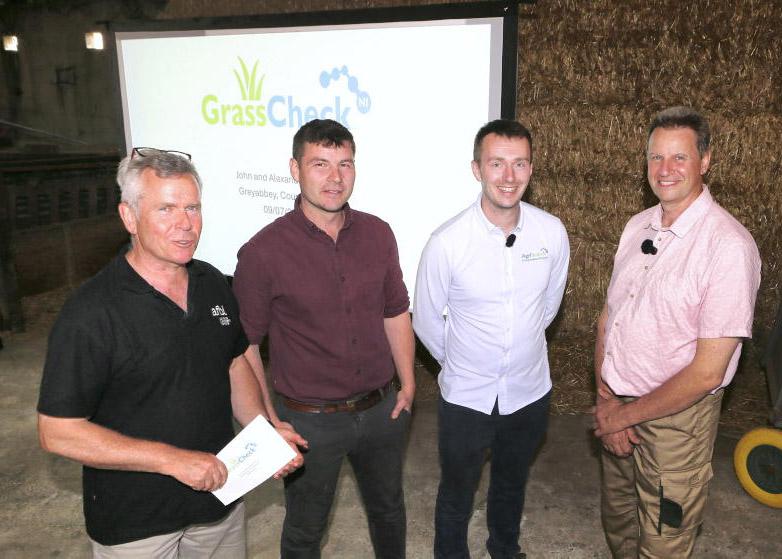
The dock beetle on Roy Mayers' farm .

The underside of a dock leaf, with beetle larvae and bright yellow eggs.
SHARING OPTIONS