



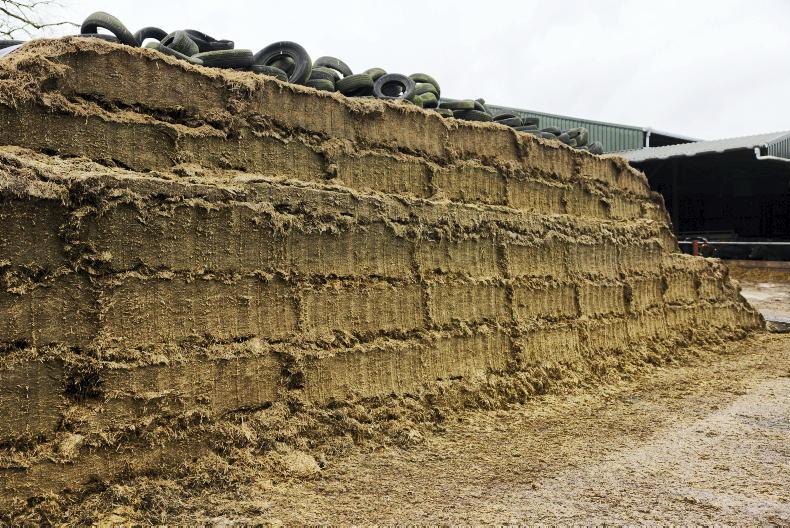
Wet weather throughout the spring means there is an increased risk of silage becoming contaminated this year, a leading grassland researcher has said. Speaking at an online event on Tuesday, Dr Sinclair Mayne said it has been difficult to get slurry onto silage fields across NI due to poor ground conditions.
“The ideal time to apply slurry is in February and March, but we have missed that opportunity on the majority of farms.
“The best thing is to hold that slurry until first-cut aftermath rather than put it on too late and risk contaminating silage,” he said.
If ground conditions remain wet at harvest time, Mayne said farmers should reduce the risk of soil contamination by avoiding excessive tedding.
He said another important factor is to aim for good compaction and sealing within silage clamps.
Mycotoxin study
During his presentation, Mayne outlined results from an AgriSearch study into mycotoxins in silage which was conducted across 13 farms in NI.
Mycotoxins are natural substances that can be produced by moulds and fungi in silage fields and clamps.
“Over 500 different mycotoxins have been identified and the majority are harmless. But if you get certain concentrations of particular mycotoxins, they can have animal health impacts,” Mayne said.
The AgriSearch study involved analysing samples from 43 different silages, with two of these subsequently showing moderate levels of mycotoxins.
The cause of the contamination is not fully clear as there were adequate intervals between slurry spreading and harvesting, and both fodders produced excellent feed value analysis. Mayne said a potential issue with one of the silages was a slow feed out rate which led to some heating at the pit face.
LESSE lines
Interestingly, slurry was spread with splash plates on both farms, so the mycotoxins were not caused by slurry lines from low emission slurry spreading equipment (LESSE).
Mayne said eight of the nine project farms that used LESSE reported visible slurry lines at harvest, but no mycotoxin issues were subsequently found on these farms.
“We can’t say that LESSE is absolutely not a factor as it may be on some farms, but in this particular case there was no evidence that LESSE resulted in increased mycotoxin concentrations,” Mayne said. “Further monitoring is really needed to determine the extent and the causes of mycotoxin contamination at farm level.”





SHARING OPTIONS