Northern Ireland farmers are continuing to invest in solar energy systems despite having no direct government grants available.
Speaking at the Balmoral Show, dairy farmer and Glenfield Renewables Ireland owner Gary McConnell said demand for solar installations remains strong as farmers focus on cutting electricity costs and improving efficiency.
“We predominantly work in agriculture, commercial and domestic installations, but farming is a huge part of the business because I’m a dairy farmer myself. I know what the costs are,” McConnell said.
Changing tech
He added that the technology has changed over the past 15 years, with solar panels becoming more efficient and battery storage systems transforming how farms use electricity.
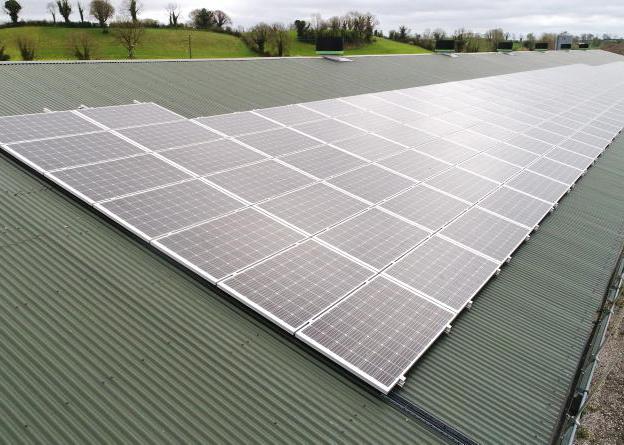
“When we started, you needed five panels to make one kilowatt. Now we’re fitting 655-watt panels and hybrid battery systems that allow farmers to charge batteries on cheaper night-rate electricity and use that power during peak demand periods,” he said. According to McConnell, many farmers who initially installed smaller systems are now returning to increase solar capacity and add battery storage as electricity costs continue to rise.
“A lot of men now realise it works,” he said. “They’re increasing capacity, adding batteries and trying to become more efficient because costs keep rising year on year.”
No grants
Unlike the Republic of Ireland, where solar investment has been supported through schemes such as SEAI and TAMS grants, Northern Ireland currently offers no direct grant support for farm solar systems.
However, McConnell said strong tax incentives and improving farm incomes have helped maintain demand.
“The North is the 100% tax relief,” he explained. “Dairy, beef and sheep farmers had good returns last year and they realise they can put solar on, claim the tax relief and become more competitive.”
He also said that Northern Ireland Electricity (NIE) had become easier to deal with compared to previous years as grid infrastructure upgrades continue.
Grid
The issue of grid capacity still remains one of the biggest challenges facing renewable energy expansion across the island however. McConnell said Glenfield Renewables has developed “microgrid” systems to help farmers maximise solar generation while working within connection restrictions.
“Originally the network here was designed to import electricity, not export it,” he said. “But demand for electricity is increasing all the time with EVs, chargers and modern technology, so the infrastructure is improving.”
Returns
McConnell believes dairy farms in particular can achieve significant savings through solar and battery systems because of the high electricity demands associated with milking and milk cooling.
He estimated that an efficient 100-cow dairy herd producing between 8,500 and 9,000 litres can spend around 1.3p per litre on electricity costs alone.
For a typical dairy unit operating a 10-unit parlour, he said a 25kW solar array combined with approximately 25kWh of battery storage would now be a common recommendation.
“The batteries charge through the day from solar and can also charge overnight on cheaper tariffs for morning milking,” he explained. “Everything can be monitored remotely and we monitor every system we install.”
Such systems generally cost between £35,000 and £40,000 depending on roof layout and installation requirements, with estimated payback periods of four to five years.
Mr McConnell said the shift towards renewable energy on farms is no longer being driven purely by environmental concerns, but by the need to improve profitability.
Turbines still deliver
Farm-scale wind turbines continue to generate significant income for Northern Ireland farmers more than a decade after the introduction of renewable energy incentives, according to Ross McDaid Service Technician at Realise Energy Services. Speaking to the Irish Farmers Journal at the Balmoral Show, McDaid said Northern Ireland’s support schemes helped create a strong market for single-turbine and small-scale wind developments on farms, a market that never developed to the same extent in the Republic of Ireland.
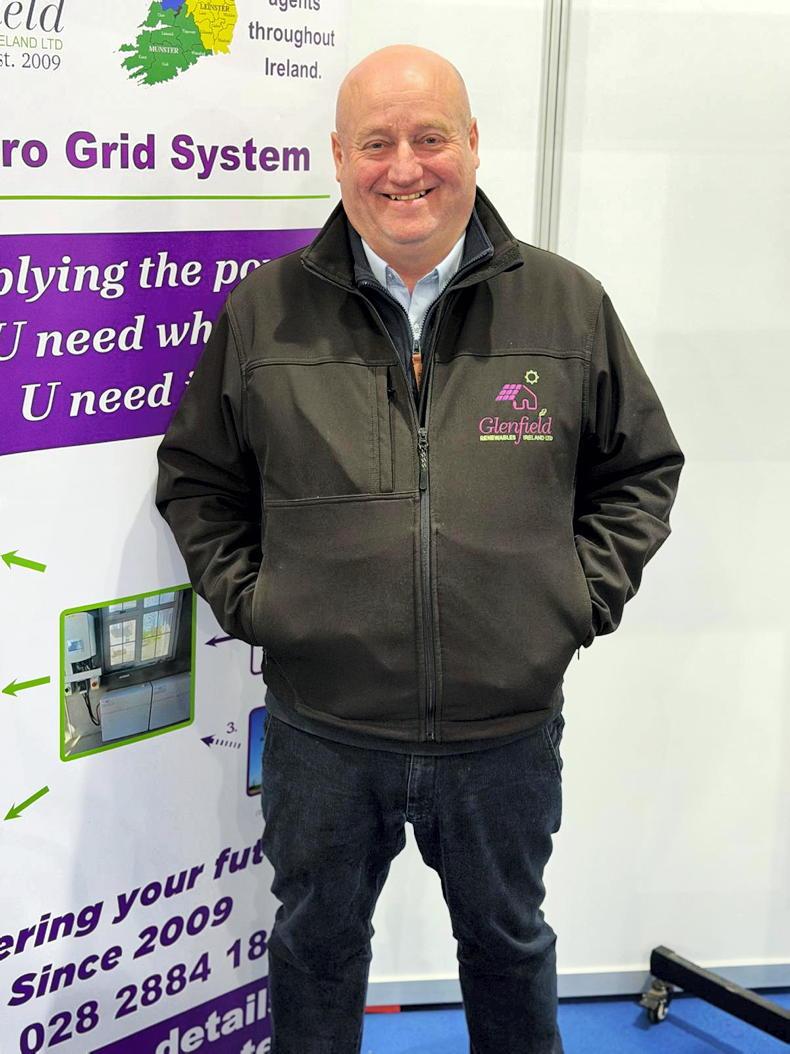
Glenfield Renewables Ireland owner Gary McConnell
“We mostly work in wind turbines,” McDaid said. “We work on turbines from 250kW right up to 3MW, but a lot of what we deal with would be farmer-owned assets”.
Unlike large commercial wind farms, many of the turbines installed across Northern Ireland are located on individual farms and are used both to generate income and offset farm electricity usage.
“They’re popular with farmers,” he said. “A lot of farmers use the electricity on dairy farms, poultry farms and other agricultural businesses, while also exporting power to the grid.”
ROC
Northern Ireland experienced a major expansion in on-farm wind generation during the early years of the Northern Ireland Renewables Obligation (NIRO) scheme, which provided additional payments for renewable electricity generation in the form of Renewables Obligation Certificate (ROC)payments.
McDaid said the ROC support mechanism played a key role in making projects financially viable. “The ROC payment was the incentive that encouraged people to build the turbines,” he explained. “Farmers still had to organise the finance themselves, but the subsidy gave them confidence that there would be a return.”
Expiry
Many of those schemes are now approaching the latter stages of their support periods, with some farmers beginning to question what happens once the payments expire.
“We’ve customers now asking what happens when the subsidy ends,” he said. “When the ROC support finishes, they’ll just be relying on the grid payment.”
The current ROC payments will end in the coming years, although uncertainty remains around what support, if any, may follow.
Despite those concerns, McDaid said farm-scale turbines are still capable of generating strong returns on suitable sites.
He pointed to one second-hand V27 turbine currently operating in Northern Ireland which was purchased for around £100,000 and can generate annual revenues of up to £220,000 on an exceptional high-wind site.
“That would be one of the best sites we have,” he admitted. “But even average sites are still generating decent income.”
Maintenance
However, he stressed that wind energy systems involve significantly higher maintenance requirements than solar PV systems.

oss Mc Daid Service Technician at Realise Energy Services
“There’s definitely more maintenance involved,” he said. “You’ve servicing, breakdowns, cranes on-site at times, it’s not just fit-and-forget.”
Nevertheless, McDaid argued that Ireland’s climate remains ideally suited to wind generation.
“The advantage is they run day and night,” he said. “You don’t need sunlight for them to work, and we live on a very windy island.”
No wind in ROI
While solar investment has accelerated in the Republic of Ireland, McDaid believes the lack of financial incentives has severely limited the development of small-scale wind projects south of the border.
“We currently have no single-turbine projects in the South,” he said. “There doesn’t seem to be any real push for farm-scale wind there.”
Under current schemes in the Republic, small-scale wind generators can receive approximately 8 cent per kilowatt hour for exported electricity. By comparison, Northern Ireland wind turbine operators historically benefited from both electricity export payments and ROC support payments.
McDade estimated that ROC support alone could be worth between 20p and 30p per kilowatt hour, in addition to electricity sale income.
“When you compare maybe 30 to 40 pence per kilowatt hour in the North versus around 8 cent in the South, it just doesn’t stack up,” he said. He believes stronger long-term support will be required if policymakers want to encourage more farm-based wind energy investment in the Republic of Ireland.
“If they want a green energy future, there has to be something there to make it worthwhile,” he said.
Listen
Stephen Robb talks to Glenfield Renewables Ireland owner Gary McConnell and Ross McDaid, Service Technician at Realise Energy Services live at the Balmoral Show.
Northern Ireland farmers are continuing to invest in solar energy systems despite having no direct government grants available.
Speaking at the Balmoral Show, dairy farmer and Glenfield Renewables Ireland owner Gary McConnell said demand for solar installations remains strong as farmers focus on cutting electricity costs and improving efficiency.
“We predominantly work in agriculture, commercial and domestic installations, but farming is a huge part of the business because I’m a dairy farmer myself. I know what the costs are,” McConnell said.
Changing tech
He added that the technology has changed over the past 15 years, with solar panels becoming more efficient and battery storage systems transforming how farms use electricity.
“When we started, you needed five panels to make one kilowatt. Now we’re fitting 655-watt panels and hybrid battery systems that allow farmers to charge batteries on cheaper night-rate electricity and use that power during peak demand periods,” he said. According to McConnell, many farmers who initially installed smaller systems are now returning to increase solar capacity and add battery storage as electricity costs continue to rise.
“A lot of men now realise it works,” he said. “They’re increasing capacity, adding batteries and trying to become more efficient because costs keep rising year on year.”
No grants
Unlike the Republic of Ireland, where solar investment has been supported through schemes such as SEAI and TAMS grants, Northern Ireland currently offers no direct grant support for farm solar systems.
However, McConnell said strong tax incentives and improving farm incomes have helped maintain demand.
“The North is the 100% tax relief,” he explained. “Dairy, beef and sheep farmers had good returns last year and they realise they can put solar on, claim the tax relief and become more competitive.”
He also said that Northern Ireland Electricity (NIE) had become easier to deal with compared to previous years as grid infrastructure upgrades continue.
Grid
The issue of grid capacity still remains one of the biggest challenges facing renewable energy expansion across the island however. McConnell said Glenfield Renewables has developed “microgrid” systems to help farmers maximise solar generation while working within connection restrictions.
“Originally the network here was designed to import electricity, not export it,” he said. “But demand for electricity is increasing all the time with EVs, chargers and modern technology, so the infrastructure is improving.”
Returns
McConnell believes dairy farms in particular can achieve significant savings through solar and battery systems because of the high electricity demands associated with milking and milk cooling.
He estimated that an efficient 100-cow dairy herd producing between 8,500 and 9,000 litres can spend around 1.3p per litre on electricity costs alone.
For a typical dairy unit operating a 10-unit parlour, he said a 25kW solar array combined with approximately 25kWh of battery storage would now be a common recommendation.
“The batteries charge through the day from solar and can also charge overnight on cheaper tariffs for morning milking,” he explained. “Everything can be monitored remotely and we monitor every system we install.”
Such systems generally cost between £35,000 and £40,000 depending on roof layout and installation requirements, with estimated payback periods of four to five years.
Mr McConnell said the shift towards renewable energy on farms is no longer being driven purely by environmental concerns, but by the need to improve profitability.
Turbines still deliver
Farm-scale wind turbines continue to generate significant income for Northern Ireland farmers more than a decade after the introduction of renewable energy incentives, according to Ross McDaid Service Technician at Realise Energy Services. Speaking to the Irish Farmers Journal at the Balmoral Show, McDaid said Northern Ireland’s support schemes helped create a strong market for single-turbine and small-scale wind developments on farms, a market that never developed to the same extent in the Republic of Ireland.

Glenfield Renewables Ireland owner Gary McConnell
“We mostly work in wind turbines,” McDaid said. “We work on turbines from 250kW right up to 3MW, but a lot of what we deal with would be farmer-owned assets”.
Unlike large commercial wind farms, many of the turbines installed across Northern Ireland are located on individual farms and are used both to generate income and offset farm electricity usage.
“They’re popular with farmers,” he said. “A lot of farmers use the electricity on dairy farms, poultry farms and other agricultural businesses, while also exporting power to the grid.”
ROC
Northern Ireland experienced a major expansion in on-farm wind generation during the early years of the Northern Ireland Renewables Obligation (NIRO) scheme, which provided additional payments for renewable electricity generation in the form of Renewables Obligation Certificate (ROC)payments.
McDaid said the ROC support mechanism played a key role in making projects financially viable. “The ROC payment was the incentive that encouraged people to build the turbines,” he explained. “Farmers still had to organise the finance themselves, but the subsidy gave them confidence that there would be a return.”
Expiry
Many of those schemes are now approaching the latter stages of their support periods, with some farmers beginning to question what happens once the payments expire.
“We’ve customers now asking what happens when the subsidy ends,” he said. “When the ROC support finishes, they’ll just be relying on the grid payment.”
The current ROC payments will end in the coming years, although uncertainty remains around what support, if any, may follow.
Despite those concerns, McDaid said farm-scale turbines are still capable of generating strong returns on suitable sites.
He pointed to one second-hand V27 turbine currently operating in Northern Ireland which was purchased for around £100,000 and can generate annual revenues of up to £220,000 on an exceptional high-wind site.
“That would be one of the best sites we have,” he admitted. “But even average sites are still generating decent income.”
Maintenance
However, he stressed that wind energy systems involve significantly higher maintenance requirements than solar PV systems.

oss Mc Daid Service Technician at Realise Energy Services
“There’s definitely more maintenance involved,” he said. “You’ve servicing, breakdowns, cranes on-site at times, it’s not just fit-and-forget.”
Nevertheless, McDaid argued that Ireland’s climate remains ideally suited to wind generation.
“The advantage is they run day and night,” he said. “You don’t need sunlight for them to work, and we live on a very windy island.”
No wind in ROI
While solar investment has accelerated in the Republic of Ireland, McDaid believes the lack of financial incentives has severely limited the development of small-scale wind projects south of the border.
“We currently have no single-turbine projects in the South,” he said. “There doesn’t seem to be any real push for farm-scale wind there.”
Under current schemes in the Republic, small-scale wind generators can receive approximately 8 cent per kilowatt hour for exported electricity. By comparison, Northern Ireland wind turbine operators historically benefited from both electricity export payments and ROC support payments.
McDade estimated that ROC support alone could be worth between 20p and 30p per kilowatt hour, in addition to electricity sale income.
“When you compare maybe 30 to 40 pence per kilowatt hour in the North versus around 8 cent in the South, it just doesn’t stack up,” he said. He believes stronger long-term support will be required if policymakers want to encourage more farm-based wind energy investment in the Republic of Ireland.
“If they want a green energy future, there has to be something there to make it worthwhile,” he said.
Listen
Stephen Robb talks to Glenfield Renewables Ireland owner Gary McConnell and Ross McDaid, Service Technician at Realise Energy Services live at the Balmoral Show.
SHARING OPTIONS