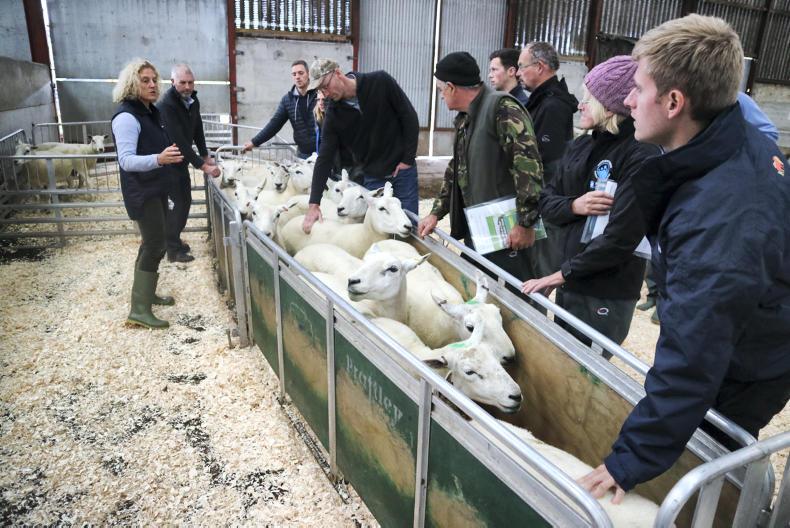
A recent workshop on getting ewes and tups ready for the breeding season was run on the farm of Sandy, Mary and their son Niall Duncanson from Beattock, Moffat. The family run a flock of 1,050 ewes. The workshop, titled “Are ewe ready to breed?”was organised by QMS and had industry specialists and vets talking about what farmers need to focus on as they approach the breeding season.
“The profitability of any sheep system comes from output,” according to sheep veterinary consultant Fiona Lovatt of Flock Health who was leading the workshop. “You need to keep the cost of production low by reducing your costs where possible.”
Looking ahead
“Lambing 2019 starts now, you need to get your ewes and tups into good condition. You can’t let what has happened this year impact on 2019. The key areas that farmers need to focus on are: health, breeding and both of these are underpinned by good management, which includes nutrition,” according to Fiona.
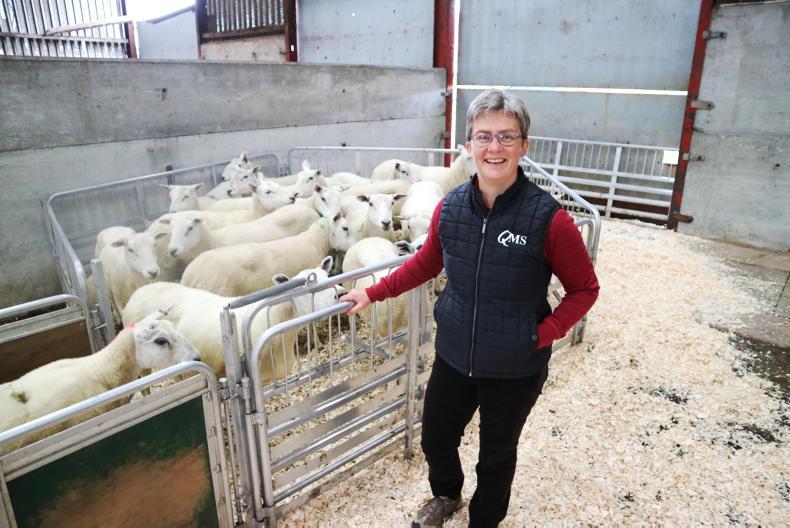
This sentiment was echoed by Emily Grant, QMS Knowledge Transfer specialist: “Next year’s lambing starts at weaning. You need to be checking body condition score (BCS) at least 10 weeks before tupping. There is a huge energy cost in a ewe putting on a BCS as they need to gain 10% of their body weight for one BCS. Ideally you want your ewe to conceive and you want to have twins, the target should be to only have 2% barren. Nutrition drives this.”
Emily continued: “The ewe will also need to maintain herself as well as putting on condition so a lot of energy is required. The most efficient system will maintain her BCS at 3 to 3.5.”
Fiona highlighted the need for farmers to focus on their ewes for the next few months during the build up to the breeding season. “Looking at the BCS of ewes over the past few weeks while out on farms, there are very few fat ewes which is not a surprise considering the year we have had.
“When it comes to thin ewes, you need to do something now. If you don’t and you flush thin ewes then you could have the situation where thin ewes are carrying more lambs than they are able to, which will lead to more and more issues as you progress through their pregnancy,” Fiona explained.
Ideally you are looking for ewes to have a BCS of 3 to 3.5 at tupping according to Fiona. “First thing you should do is look at ewes and divide them between, thin, fit and fat. If ewes are in BCS of 3 to 3.5 now then all you need to do is keep them at that until about 10 days before breeding when most farmers will flush them.”
It can take six weeks on good grass to gain one BCS according to Fiona, but where grass quality may not be as good then you could be looking at eight to 10 weeks to gain that extra BCS. If farmers intend on putting tups with ewes from the beginning of November then they only have 10 weeks to ensure they are in the correct BCS. This is especially important for ewes who are currently too thin.
Over fat ewes
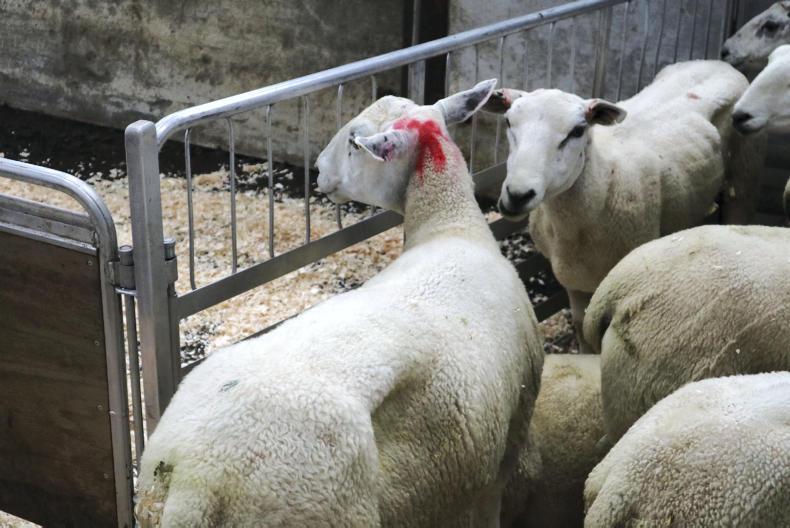
Some farmers may also have issues where ewes are carrying too much condition. “It can be hard to get condition off fat ewes,” Fiona admitted. “If ewes have a BCS of over four then one option could be to pack them into a pretty bare field. You will have to be quite strict with them in order to get it off. The issue is that if they are going into pregnancy too fat then you don’t really want to be trying to take condition off them after tupping. Now is the time to change them as they currently have no lambs in them or no lambs on them.
“Don’t let lambs overshadow ewe condition,” Fiona continued, “and on all but the very latest of lambing systems, I would expect lambs to have be weaned by now .”
Fiona outlined that while there are a number of different factors contributing to prolapses, she has experienced ewes going into pregnancy over fat as more likely to have more prolapses next year.
Speaking on his own experiences of ewes prolapsing Sandy Duncanson admits that they are strict on culling. “We will have enough new problems at lambing next year without carrying over last year’s problems.
“If anything gives trouble at lambing then they get lug marked and will be culled. Even if we come back to them later in the year and don’t know why they have been marked they will still go.”
Time to look deeper
Also talking on the day was vet Graham Baird, a specialist in sheep health and production. He was looking deeper into the reasons why ewes were in poor BCS.
“You have to look at your group of thin ewes that you are planning to cull, they are a very important group to be aware of,” Graham said. “Is there an obvious reason for their poor condition?
“There could be a lot of ewes that are too thin to go to the tup, this year more than others it could be a big issue and a lot of this could be down to nutritional reasons.”
However, there could be many others reasons for ewes in poor BCS, including a broken mouth/dental issues which could mean that they would be unable to eat sufficiently according to Graham. Other issues such as mastitis, lameness or arthritis were also highlighted as potential causes of poor BCS.
“It is very important to get lameness under control,” Graham explained.
“And a part of this could be to implement a three-strike rule. If a ewe gets treated for footrot three times then she is probably chronically infected and the source of infection for other ewes and should be culled.”
Iceberg diseases
While the issues mentioned so far are relatively easy to identify there are a whole raft of other diseases which could cause ewes to be thin or cause ill-thrift that show no visible signs, or very small signs. These are known as iceberg diseases according to Graham, as the majority of the disease is below the surface and cannot be seen.
“These are diseases to look out for post-weaning, they are difficult to identify but could be the main issue. Thin ewes can act as a warning sign that you have these diseases,” said Graham.
Johnes disease – “It is the same bug that causes Johnes in both sheep and cattle,” according to Graham. “In cows you will have scouring and the cows will slowly melt away. However, in sheep you generally will not see the scour but they will lose condition. There is otherwise no external evidence to show that she has it.” OPA (Jaagsiekte) – “This is a virus which causes cancer in the lungs. The ewe would pick it up early in life and it develops slowly. Oftentimes you will just see a ewe in poor condition,” according to Graham. “Another sign could be ewes lagging behind and not being able to breathe properly when you are moving them. It can also lead to sudden death.”MV (Maedi Visna) – “Again this is another chronic virus disease where ewes can lose condition without any other signs. It can also lead to mastitis, but not conventional mastitis. It will decrease milk production which can lead to lambs struggling or even dying. This disease seems to be spreading within the sheep population,” said Graham. CLA (Caseous lymphadenitis) – This is where abscesses develop in the lymph nodes of sheep. It is not as big of an issue in commercial flocks but could still cause issues. It could lead to pneumonia or cause chronic weight loss due to restricted intake. When it comes to MV, blood sampling is one option to identify the disease. Graham recommends that if you are having issues then take a selection of your poorest ewes and get them tested. Another option is to send cull ewes for a post-mortem as this is one of the best ways of identifying what underlying issues you have in your flock.
Tup MOT
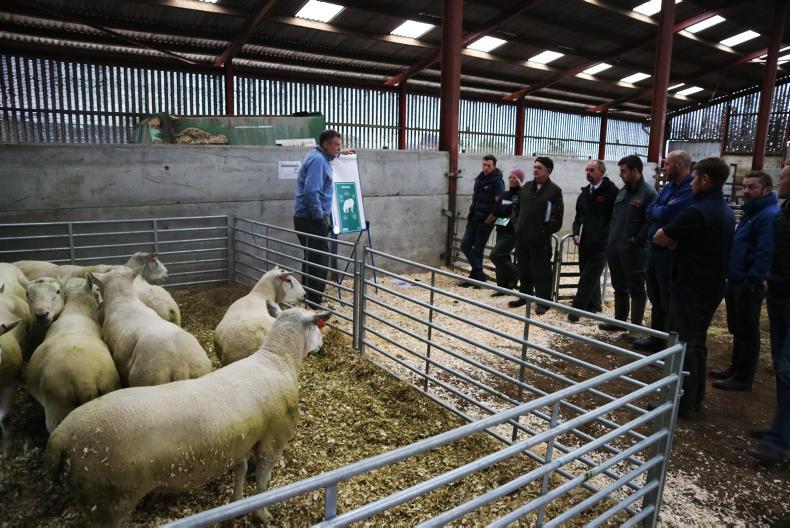
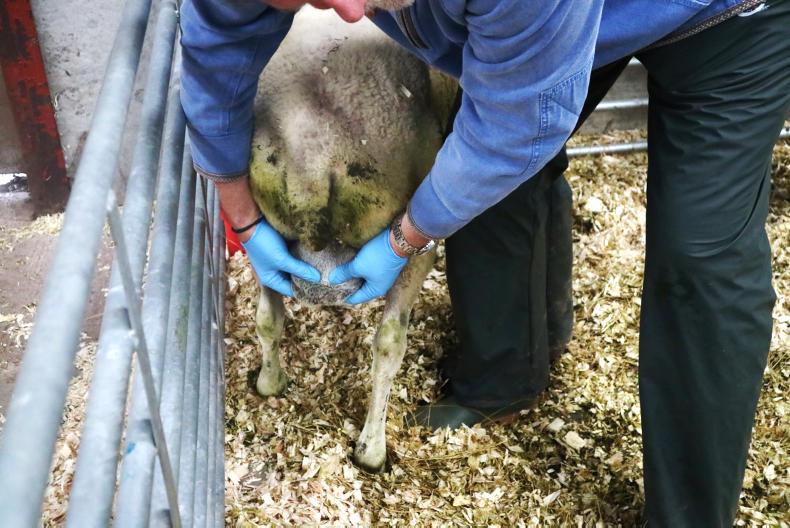
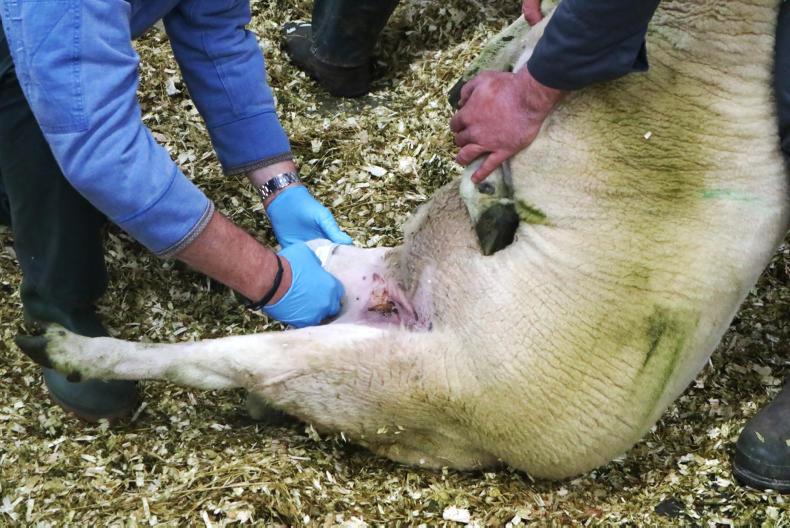
There was a practical demonstration on the day by Graham on what to look out for in tups prior to breeding.
“It is important to carry out an MOT on tups at least six to eight weeks pre-tupping,” Graham said. “You can identify up to 90% of potential problems if you carry out a thorough inspection. It’s also important that tups are in good condition, BCS of 3.5 to 4 coming up to breeding as they can lose up to 15% of their bodyweight during tupping.
“It is also important that you make sure that he has all of the vaccinations that the ewes have had, especially clostridial and pasteurella vaccinations,” said Graham.
Other areas to look at when carrying out the inspection include the feet and legs to ensure he has good locomotion and no lameness issues. Teeth are also important as they could affect intake potential of the tup.
One of the most important aspects of the ram to check is his testicles. “You want symmetry in the testes and that they are freely moveable in the scrotum. You want them to be firm but with a bit of give in them and free from any lumps. You should also watch out for too much fat around the scrotum as this can affect sperm production,” according to Graham.
“You should also carry out a scrotal measurement at the widest point of the testicles. The minimum circumference that you want in a young tup, three weeks prior to breeding is 30cm, while in a mature tup this is 36cm.
“It is very rare that you will get a ram that is completely infertile,” according to Graham.
“However, very often you will get a sub-fertile tup which can have a major impact on performance of the flock.”
A recent workshop on getting ewes and tups ready for the breeding season was run on the farm of Sandy, Mary and their son Niall Duncanson from Beattock, Moffat. The family run a flock of 1,050 ewes. The workshop, titled “Are ewe ready to breed?”was organised by QMS and had industry specialists and vets talking about what farmers need to focus on as they approach the breeding season.
“The profitability of any sheep system comes from output,” according to sheep veterinary consultant Fiona Lovatt of Flock Health who was leading the workshop. “You need to keep the cost of production low by reducing your costs where possible.”
Looking ahead
“Lambing 2019 starts now, you need to get your ewes and tups into good condition. You can’t let what has happened this year impact on 2019. The key areas that farmers need to focus on are: health, breeding and both of these are underpinned by good management, which includes nutrition,” according to Fiona.
This sentiment was echoed by Emily Grant, QMS Knowledge Transfer specialist: “Next year’s lambing starts at weaning. You need to be checking body condition score (BCS) at least 10 weeks before tupping. There is a huge energy cost in a ewe putting on a BCS as they need to gain 10% of their body weight for one BCS. Ideally you want your ewe to conceive and you want to have twins, the target should be to only have 2% barren. Nutrition drives this.”
Emily continued: “The ewe will also need to maintain herself as well as putting on condition so a lot of energy is required. The most efficient system will maintain her BCS at 3 to 3.5.”
Fiona highlighted the need for farmers to focus on their ewes for the next few months during the build up to the breeding season. “Looking at the BCS of ewes over the past few weeks while out on farms, there are very few fat ewes which is not a surprise considering the year we have had.
“When it comes to thin ewes, you need to do something now. If you don’t and you flush thin ewes then you could have the situation where thin ewes are carrying more lambs than they are able to, which will lead to more and more issues as you progress through their pregnancy,” Fiona explained.
Ideally you are looking for ewes to have a BCS of 3 to 3.5 at tupping according to Fiona. “First thing you should do is look at ewes and divide them between, thin, fit and fat. If ewes are in BCS of 3 to 3.5 now then all you need to do is keep them at that until about 10 days before breeding when most farmers will flush them.”
It can take six weeks on good grass to gain one BCS according to Fiona, but where grass quality may not be as good then you could be looking at eight to 10 weeks to gain that extra BCS. If farmers intend on putting tups with ewes from the beginning of November then they only have 10 weeks to ensure they are in the correct BCS. This is especially important for ewes who are currently too thin.
Over fat ewes
Some farmers may also have issues where ewes are carrying too much condition. “It can be hard to get condition off fat ewes,” Fiona admitted. “If ewes have a BCS of over four then one option could be to pack them into a pretty bare field. You will have to be quite strict with them in order to get it off. The issue is that if they are going into pregnancy too fat then you don’t really want to be trying to take condition off them after tupping. Now is the time to change them as they currently have no lambs in them or no lambs on them.
“Don’t let lambs overshadow ewe condition,” Fiona continued, “and on all but the very latest of lambing systems, I would expect lambs to have be weaned by now .”
Fiona outlined that while there are a number of different factors contributing to prolapses, she has experienced ewes going into pregnancy over fat as more likely to have more prolapses next year.
Speaking on his own experiences of ewes prolapsing Sandy Duncanson admits that they are strict on culling. “We will have enough new problems at lambing next year without carrying over last year’s problems.
“If anything gives trouble at lambing then they get lug marked and will be culled. Even if we come back to them later in the year and don’t know why they have been marked they will still go.”
Time to look deeper
Also talking on the day was vet Graham Baird, a specialist in sheep health and production. He was looking deeper into the reasons why ewes were in poor BCS.
“You have to look at your group of thin ewes that you are planning to cull, they are a very important group to be aware of,” Graham said. “Is there an obvious reason for their poor condition?
“There could be a lot of ewes that are too thin to go to the tup, this year more than others it could be a big issue and a lot of this could be down to nutritional reasons.”
However, there could be many others reasons for ewes in poor BCS, including a broken mouth/dental issues which could mean that they would be unable to eat sufficiently according to Graham. Other issues such as mastitis, lameness or arthritis were also highlighted as potential causes of poor BCS.
“It is very important to get lameness under control,” Graham explained.
“And a part of this could be to implement a three-strike rule. If a ewe gets treated for footrot three times then she is probably chronically infected and the source of infection for other ewes and should be culled.”
Iceberg diseases
While the issues mentioned so far are relatively easy to identify there are a whole raft of other diseases which could cause ewes to be thin or cause ill-thrift that show no visible signs, or very small signs. These are known as iceberg diseases according to Graham, as the majority of the disease is below the surface and cannot be seen.
“These are diseases to look out for post-weaning, they are difficult to identify but could be the main issue. Thin ewes can act as a warning sign that you have these diseases,” said Graham.
Johnes disease – “It is the same bug that causes Johnes in both sheep and cattle,” according to Graham. “In cows you will have scouring and the cows will slowly melt away. However, in sheep you generally will not see the scour but they will lose condition. There is otherwise no external evidence to show that she has it.” OPA (Jaagsiekte) – “This is a virus which causes cancer in the lungs. The ewe would pick it up early in life and it develops slowly. Oftentimes you will just see a ewe in poor condition,” according to Graham. “Another sign could be ewes lagging behind and not being able to breathe properly when you are moving them. It can also lead to sudden death.”MV (Maedi Visna) – “Again this is another chronic virus disease where ewes can lose condition without any other signs. It can also lead to mastitis, but not conventional mastitis. It will decrease milk production which can lead to lambs struggling or even dying. This disease seems to be spreading within the sheep population,” said Graham. CLA (Caseous lymphadenitis) – This is where abscesses develop in the lymph nodes of sheep. It is not as big of an issue in commercial flocks but could still cause issues. It could lead to pneumonia or cause chronic weight loss due to restricted intake. When it comes to MV, blood sampling is one option to identify the disease. Graham recommends that if you are having issues then take a selection of your poorest ewes and get them tested. Another option is to send cull ewes for a post-mortem as this is one of the best ways of identifying what underlying issues you have in your flock.
Tup MOT
There was a practical demonstration on the day by Graham on what to look out for in tups prior to breeding.
“It is important to carry out an MOT on tups at least six to eight weeks pre-tupping,” Graham said. “You can identify up to 90% of potential problems if you carry out a thorough inspection. It’s also important that tups are in good condition, BCS of 3.5 to 4 coming up to breeding as they can lose up to 15% of their bodyweight during tupping.
“It is also important that you make sure that he has all of the vaccinations that the ewes have had, especially clostridial and pasteurella vaccinations,” said Graham.
Other areas to look at when carrying out the inspection include the feet and legs to ensure he has good locomotion and no lameness issues. Teeth are also important as they could affect intake potential of the tup.
One of the most important aspects of the ram to check is his testicles. “You want symmetry in the testes and that they are freely moveable in the scrotum. You want them to be firm but with a bit of give in them and free from any lumps. You should also watch out for too much fat around the scrotum as this can affect sperm production,” according to Graham.
“You should also carry out a scrotal measurement at the widest point of the testicles. The minimum circumference that you want in a young tup, three weeks prior to breeding is 30cm, while in a mature tup this is 36cm.
“It is very rare that you will get a ram that is completely infertile,” according to Graham.
“However, very often you will get a sub-fertile tup which can have a major impact on performance of the flock.”







SHARING OPTIONS