



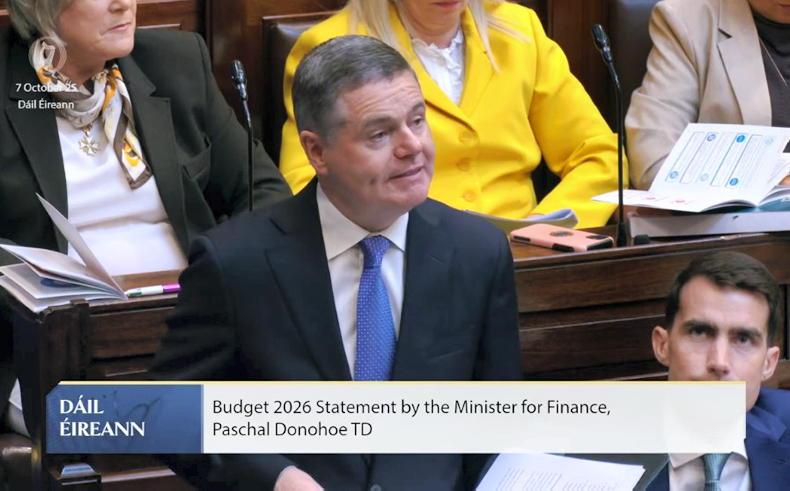
For many, necessities – including food, prices – are still going in the wrong direction,” said Finance Minister Paschal Donohoe as part of his budget speech. The “wrong direction” he spoke of, is of course, upwards. Food is a necessity, and food affordability is one of the metrics used to evaluate cost of living. The minister said the budget was seeking “to address this through targeted supports for those most in need”. Very few would argue with that.
Underneath that laudable sentiment, however, lurks the inference that rising food prices are intrinsically a bad thing. And that is very bad news for farmers. If food prices don’t rise, but costs go up, they go broke. And costs have been going up consistently over the last four decades, much faster than farm gate food prices have risen.
Farmers have been squeezed between input suppliers where a few global corporations have a pretty tight grip on supplies, and processor and retailers where power has similarly been concentrated into a few familiar hands. The farmgate price proportion of the retail price has been consistently falling.
The Common Agricultural Policy (CAP) was precisely designed to fill the gap. Its founding principles include maintaining farmer numbers, supporting farmer incomes and ensuring the affordability and availability of high-quality food. But now the CAP has been diluted, with environmental oversight a key component. High environmental value systems are high-cost.
But instead of the CAP budget being increased to meet this new challenge, the CAP has been static since the late 1980s, when a new car cots £10,000, and a house cost £30,000. That static CAP had to accommodate 12 new EU member states, doubling the number of farmers. And now Brussels wants to hack 20% off the next budget.
Farmers have been mostly left to cope with the cost/price squeeze, with little clout to set the prices for their inputs or outputs. Farmer numbers have dwindled and there is a crisis around succession. Should anyone be surprised?
Inevitably, ageing farmers have reduced suckler and sheep numbers. Ironically, restricted supply is now a major factor in the rising prices Donohoe bemoans. Chickens are coming home to roost.
Donohoe also announced an increase in the minimum wage, bringing it to €14.15 per hour. That will impact hugely on the wage bills of horticulture producers, and also larger dairy farms.
Meanwhile, the first retail milk price reduction since 2023 is celebrated in the media. But no one is clamouring for a price increase of the pint, despite malting barley prices halving since 2022. Three beer and stout price increases, putting a cumulative 22c on every pint, occurred in an 18-month period following that harvest. They all cited grain price as a factor. We’ve heard nothing in the other direction. It would be funny if it wasn’t so serious.



SHARING OPTIONS