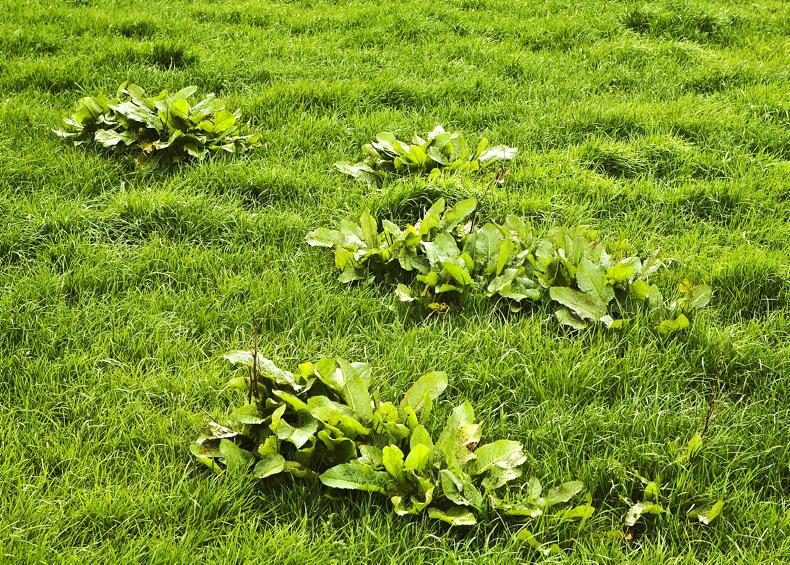
Only good fields grow docks, that’s my excuse and I’m sticking to it.
The first field of red clover I sowed was in 2022, so it is now in its fifth season. I still call it a red clover sward but, if I’m honest, it’s probably just a white clover sward at this stage. I don’t think there is much red clover left. But by God, there is some crop of white clover in it. Maybe too much at times.
This field has been cut three times every year, except for the first year when it was only cut twice, and is then grazed with lambs up until Christmas. It is still yielding very well with little or no chemical nitrogen. It usually receives 75kg of 10-10-20 per acre in the spring and then just cattle slurry. For a field in its fifth season, it is still producing a serious crop.
My father used to tell me a story about an old farmer and his son who went to look at a farm with a view to buying it. The old farmer had very poor eyesight and, when they arrived at the field, he told his son to tie the horse to the nearest dock plant. The son looked around and told him there wasn’t a dock plant to be seen anywhere.
The old farmer replied: “Come on, we’re here long enough.”
His reasoning was simple enough. If there were no docks growing, then the land couldn’t be all that good. Docks, after all, don’t grow on poor land. They like good, fertile ground. So, in his eyes, a field without a dock, was a field not worth buying.
I often think of that story when I look at this field. Because if that old farmer was ever brought up this lane, he would probably have bought the whole farm before I had a chance to stop him.
Dock crop
While the crop of clover is impressive, unfortunately the crop of docks is even more impressive. If there was a competition for growing docks, then this field would be in with a heck of a shout for first prize.
It was bad last year, and it was my intention to spray it after second cut, but there was so much clover in the sward that I couldn’t bring myself to do it. I kept looking at the clover and thinking that surely I couldn’t kill off such a good crop just to get rid of a few docks. Well, there is no point pretending there were only a few docks. There were plenty of them then, and by God, things haven’t gotten any better this year.
Thankfully, the field is up a lane where very few people can see it, because it’s bordering on embarrassing at this stage. It is probably just as well there isn’t much passing traffic, because I’d hate to have to explain that this is actually a productive silage field and not a dedicated dock-growing enterprise.
The third cut is almost ready, so I can’t do anything for the moment, but I’m definitely going to have to get my finger out and grasp the nettle after that , or should I say grasp the dock?
But the next question is, what spray do I use? Clover-safe or non-clover-safe? The non-clover-safe option will obviously do a good job on the docks, but it will wipe out my clover. The clover-safe option will leave my clover, but will probably only do an okay job on the docks.
At this point, I’m leaning towards the clover-safe option. The clover has done everything I could have asked of it over the last five years, so it seems a bit harsh to finally reward it by spraying it out of existence. If I can knock the docks back without sacrificing the clover, that has to be worth a try. It’ll be an education if nothing else. I suppose, looking on the bright side, there are plenty of places in the field to tie a horse.