



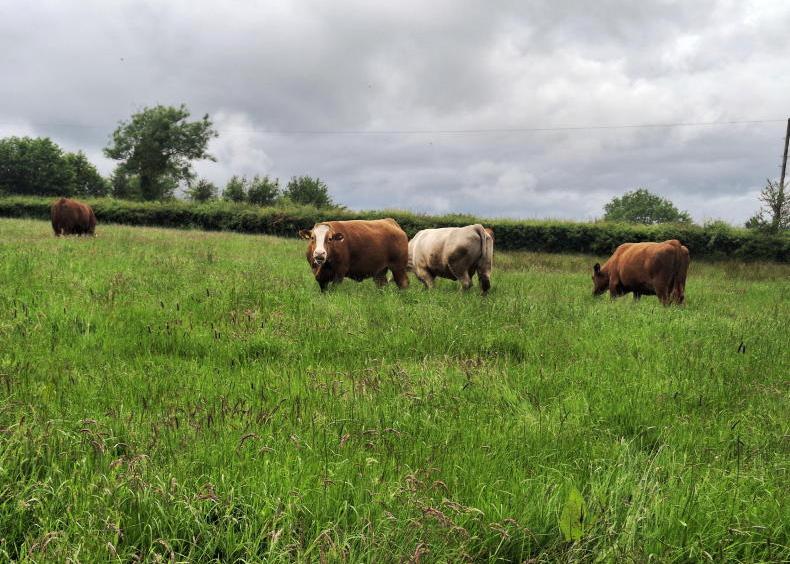
As usual I have lost control of my grass at this time of year. Every year during the month of May I fight a battle with the grass and every year the grass wins.
I try my best to stop grass from running to seed head – once that happens then you lose quality and the regrowth is slowed. This year I was on the ball early and cutting paddocks even before they got too far ahead.
The trouble is that by the first week in June I had a lot of paddocks that needed to be cut for bales.
It rained here for the first two weeks of the month, so it was impossible to get any grass baled up.
There are some who would advise that when paddocks are ready that you need to cut them no matter what the weather.
That is extremely easy to say if you are sitting in front of a computer in an office and some grass app is saying that your grass covers are too high.
But we farmers have to live in the real world and deal with things on the ground.
I have found (to my own detriment) that wet bales are a complete disaster.
They are impossible to stack and they are a torture to get the plastic off and feed out.
And on top of that there is very little feed value in them. There is nothing to gain by baling up paddocks in wet conditions – you need at least two dry days in a row.
The other problem is that, as grass in the paddocks gets heaver, it is harder to get it dry enough for baling.
Thankfully we were able to make use of the recent weather window and get some paddocks baled on Saturday and Monday.
However, I have been careful not to take out too much grass as bales.
These paddocks should have been cut two to three weeks ago, so they will be slow to recover – you could very easily move from having a surplus to not having enough grass in the fields. It has been a “no win” situation.
Grazing
The other main issue is that conditions have been poor for clean-outs in grazed swards, partly due to the weather and also because of the amount of headed material.
Cattle and sheep are having to be moved before they have the grass all eaten from the paddocks.
Again, someone is sitting in an office on a computer wondering why I am not cleaning out paddocks to the required level.
On farm I am breaking all the rules and best practice advice. The farm covers have been way above what is recommended and cattle and sheep are going into swards that should be cut.
My thinking is that they can eat as much as possible without doing any damage then I can run the topper over the ground (if conditions allow).
If the weather improves in the coming weeks, then I will start cutting paddocks regularly again. In an ideal world, paddocks are cut every week and then they will be coming back into the rotation at various stages.
Measuring
I have been measuring grass for a long time and I think that it is an extremely useful thing to do, but it is very frustrating when the advice and recommendations don’t match up with practical reality – farming can’t be done from an office, computer, or app on the phone.
My son recently told me that farming can’t always be done by the book and I thought it was a wise statement.
Grassland management in particular, is a balancing act and very dependent on weather and ground conditions.



SHARING OPTIONS