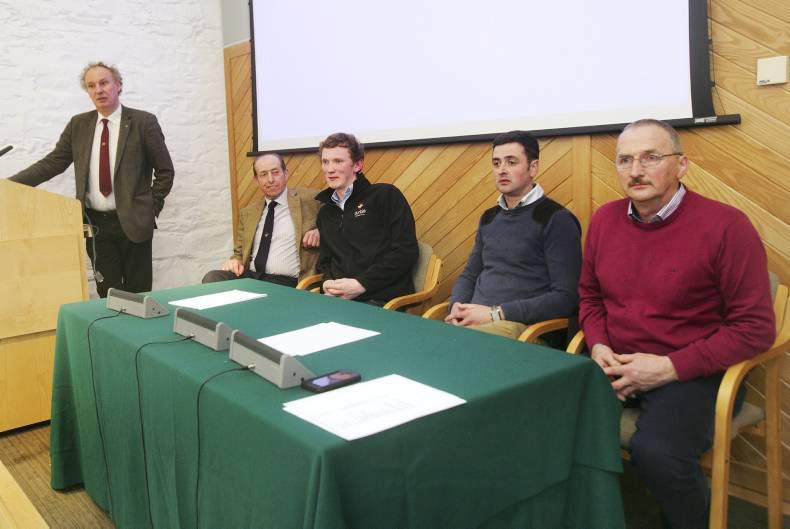
A strong case for much greater uptake of research recommendations on sheep farms was made at this week’s meeting of the National Sheep Association NI Region on the theme “The Future of the Sheep Industry”.
Speakers Isaac Crilly and Ian Buchanan stressed the need for technical efficiency and gave examples of how they had changed management of their flocks over the years, while working as farmer co-researchers with the Agri-Food and Biosciences Institute (AFBI) and AgriSearch.
Buchanan, who runs 900 Blackface and Blackface cross ewes on the hills near Dungiven and is current chairman of the British Wool Marketing Board, said there had been good research done over the past 20 years and more needs to be done to highlight this and get other farmers to implement the advice.
Buchanan expressed confidence that there will always be sheep farming as it’s one of the best options for using marginal land.
“But it needs to be made as handy as possible to keep young farmers involved,” he said, suggesting that farmers should use their Basic Payment to invest in making things easier to manage.
Commenting that looking after 200 to 300 sheep is not a full-time job, Buchanan said that people need to decide if they want to farm full-time or part-time or have a hobby farm. He said that there is a place for all of these, but pointed out that hobbies cost money.
His recommendations for the future in sheep were: “Utilise research, purchase good genetics for grass-based production, grow and use grass efficiently and make quality silage to lower winter feeding costs”.
Crilly, who farms near Castlederg in north Tyrone, said that the reduction in government support when the Single Farm Payment was introduced in 2005 had spurred him to look at what he could do to improve the performance of his own business.
Ten years ago he had a large percentage of E grade lambs and 40% of ewes requiring assistance at lambing. A lot of work and the top grades did not pay the bills.
The introduction of the Belclare breed and then New Zealand Suffolk has brought the flock to the point last year where 97% of ewes lambed unaided, 80% of carcases achieved U grades and 20% graded R. Sires are all selected on performance figures – no more trips to the ram sales.
Latest benchmarking figures indicate that Crilly produced 592kg of carcase weight per hectare and output was worth £2,183/ha, with costs of £1,286/ha. He is selling lambs at average 19kg carcase weight. With impressive performance figures flowing, it was sobering to hear that Crilly last year would have needed an average lamb price of 368p/kg to leave him with the average industrial wage for his work with a flock of 500 ewes (excluding the Single Farm Payment).
He has been a co-researcher farmer working with AFBI for the past 15 years and said it had put him on an immense learning curve.
He also praised the farm adviser who introduced him to feeding soya hulls.
For the past six years, he has fed no silage and says he would possibly quit sheep before he’d go back to silage. Feeding in the house is a pleasure, he says, with just soya hulls plus minerals plus wheat straw until six weeks before lambing, when he introduces soya bean meal.
Crilly’s advice to anyone looking to the future in sheep farming is:
Avoid the mindset of feeling victimised.Keep an open mind – don’t be afraid to do something different.Don’t allow breed societies to dictate – demand figures such as EBVs (Estimated Breeding Values).Don’t waste money on machinery.George Williamson from Dunbia told the gathering that 45% of lambs are not meeting the specification for the supermarkets. He contrasted the inconsistency of lamb with the consistency of poultry and pig meat, which are competing for consumers’ spending.
Williamson said fat is worth 15p/kg and it doesn’t pay the producer or the processor to have lambs over-fat and overweight. He urged flockowners to look at what they can do that is within their control.
“Look at your costs and how you can reduce these,” he commented.
A strong case for much greater uptake of research recommendations on sheep farms was made at this week’s meeting of the National Sheep Association NI Region on the theme “The Future of the Sheep Industry”.
Speakers Isaac Crilly and Ian Buchanan stressed the need for technical efficiency and gave examples of how they had changed management of their flocks over the years, while working as farmer co-researchers with the Agri-Food and Biosciences Institute (AFBI) and AgriSearch.
Buchanan, who runs 900 Blackface and Blackface cross ewes on the hills near Dungiven and is current chairman of the British Wool Marketing Board, said there had been good research done over the past 20 years and more needs to be done to highlight this and get other farmers to implement the advice.
Buchanan expressed confidence that there will always be sheep farming as it’s one of the best options for using marginal land.
“But it needs to be made as handy as possible to keep young farmers involved,” he said, suggesting that farmers should use their Basic Payment to invest in making things easier to manage.
Commenting that looking after 200 to 300 sheep is not a full-time job, Buchanan said that people need to decide if they want to farm full-time or part-time or have a hobby farm. He said that there is a place for all of these, but pointed out that hobbies cost money.
His recommendations for the future in sheep were: “Utilise research, purchase good genetics for grass-based production, grow and use grass efficiently and make quality silage to lower winter feeding costs”.
Crilly, who farms near Castlederg in north Tyrone, said that the reduction in government support when the Single Farm Payment was introduced in 2005 had spurred him to look at what he could do to improve the performance of his own business.
Ten years ago he had a large percentage of E grade lambs and 40% of ewes requiring assistance at lambing. A lot of work and the top grades did not pay the bills.
The introduction of the Belclare breed and then New Zealand Suffolk has brought the flock to the point last year where 97% of ewes lambed unaided, 80% of carcases achieved U grades and 20% graded R. Sires are all selected on performance figures – no more trips to the ram sales.
Latest benchmarking figures indicate that Crilly produced 592kg of carcase weight per hectare and output was worth £2,183/ha, with costs of £1,286/ha. He is selling lambs at average 19kg carcase weight. With impressive performance figures flowing, it was sobering to hear that Crilly last year would have needed an average lamb price of 368p/kg to leave him with the average industrial wage for his work with a flock of 500 ewes (excluding the Single Farm Payment).
He has been a co-researcher farmer working with AFBI for the past 15 years and said it had put him on an immense learning curve.
He also praised the farm adviser who introduced him to feeding soya hulls.
For the past six years, he has fed no silage and says he would possibly quit sheep before he’d go back to silage. Feeding in the house is a pleasure, he says, with just soya hulls plus minerals plus wheat straw until six weeks before lambing, when he introduces soya bean meal.
Crilly’s advice to anyone looking to the future in sheep farming is:
Avoid the mindset of feeling victimised.Keep an open mind – don’t be afraid to do something different.Don’t allow breed societies to dictate – demand figures such as EBVs (Estimated Breeding Values).Don’t waste money on machinery.George Williamson from Dunbia told the gathering that 45% of lambs are not meeting the specification for the supermarkets. He contrasted the inconsistency of lamb with the consistency of poultry and pig meat, which are competing for consumers’ spending.
Williamson said fat is worth 15p/kg and it doesn’t pay the producer or the processor to have lambs over-fat and overweight. He urged flockowners to look at what they can do that is within their control.
“Look at your costs and how you can reduce these,” he commented.









SHARING OPTIONS