The average price for good agricultural land in Ireland in 2025 was €14,126, a jump of 7% compared to 2024 as published in the Society of Chartered Surveyors Ireland (SCSI) and Teagasc Agricultural Land Market Review & Outlook 2026.
The report also projects that the national average farmland sales prices and rental prices forecast to rise by 4% in 2026.
Overall, the most expensive land in 2025 was in Wexford, where the average price per acre of good quality land was €19,226.
The county with the least expensive land was in Leitrim, where the average price per acre of poor quality land was €3,772.
The average price for poor quality land across the country last year was €6,963, a rise of 5% compared to 2024.
Prices are lower on average in the Connacht and Ulster regions, however the region had the strongest annual growth rates, with the largest jumps seen in counties Roscommon, Donegal and Monaghan.
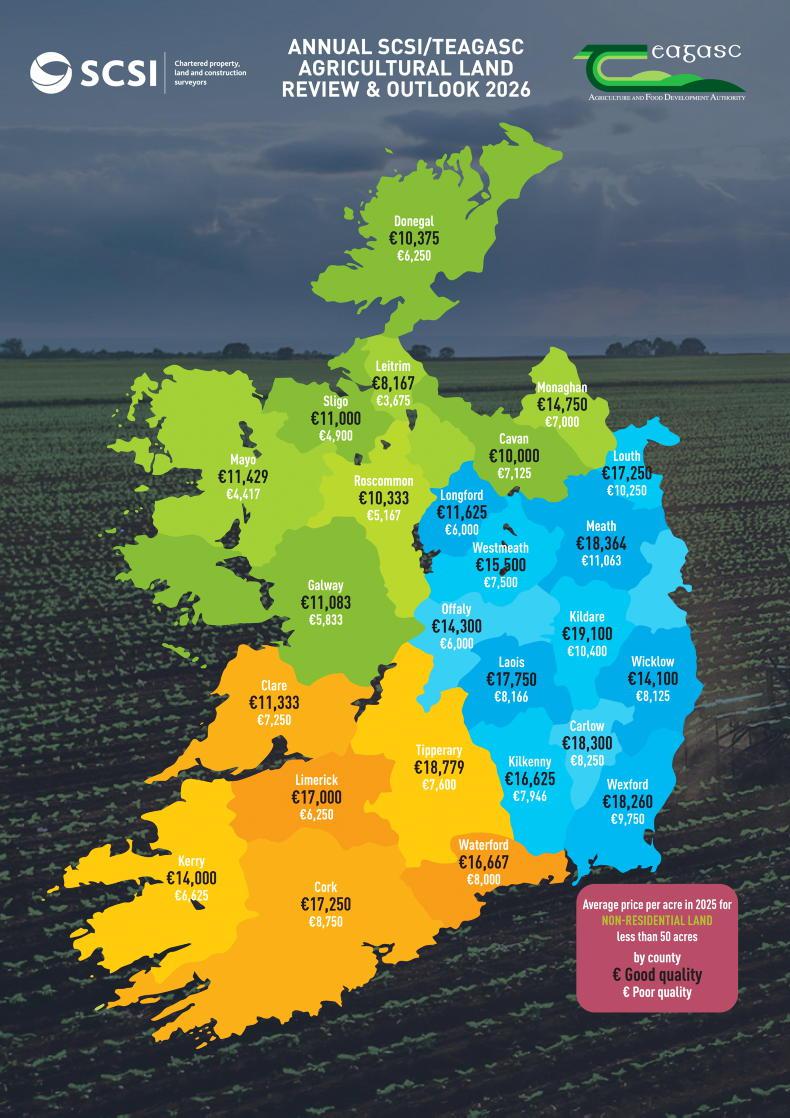
Average price per acre in 2025 for non-residential land less than 50 acres by county with the average price for good quality land in large text and poor quality in small text. \ SCSI/Teagasc
Rental land
Average land rental prices increased by 18% in the Connacht and Ulster regions in 2025, while Munster saw increases of 17% and Leinster increased by 2%.
The demand for long-term leasing remained strong in 2026 with 23% of agents reporting an increase in demand and 59% reporting stable demand.
In 2026, rental prices are projected to increase by 3% on average in Leinster and Munster, and by 5% in Connacht and Ulster.
Risk for dairy farmers
The report features a special focus on dairy farming – finding that dairy farmers are operating in an increasingly complex risk environment, due to market volatility, policy uncertainty and personal factors.
Demand for land within this bracket has remained strong, especially in renting, however these farmers may become more cautious going forward due to increased risk perceptions in the current climate, such as higher input costs, lack of labour or uncertainty in succession.
Uncertainty and outlook for 2026
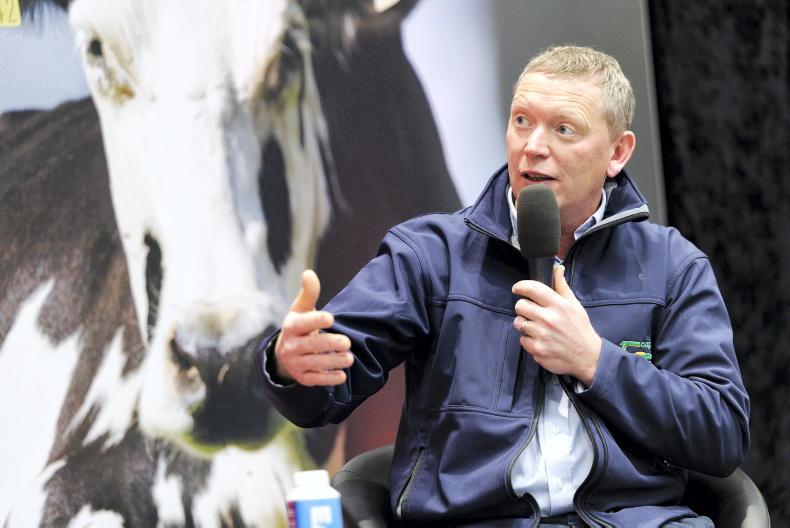
While agricultural performance in 2025 was strong, particularly for dairy and cattle sectors, 2026 is set to be significantly more challenging, Teagasc economist Dr Jason Loughrey has said.
“The outlook for Irish agriculture in 2026 is significantly more challenging, with unfavourable weather conditions, rising input costs, softer output prices and increased uncertainty expected to place pressure on farm profitability.
“Disruptions to energy markets arising from the US-Israeli war with Iran have contributed to increases in fuel, fertiliser, machinery hire and other input costs – with knock-on implications for farm profitability.”
“Dairy margins are expected to decline substantially in 2026, as lower milk prices and higher fertiliser, fuel and feed costs reduce profitability relative to 2025.
“Overall, Irish dairy margins net margins could be in excess of 50% lower compared to last year, as a result of lower prices and higher costs.
“Beef sector incomes are expected to moderate, although prices are forecast to remain above long term averages.
“Sheep producers face increasing cost pressures, with higher feed and fertiliser costs weighing on margins despite some recovery in lamb prices.
“While the outcome and duration of the war remain uncertain, it is likely that elevated fertiliser and energy prices will persist through 2026 and into 2027.
“These developments also highlight the extent to which Irish agriculture remains exposed to global supply chains and external economic shocks,” he said.
The strong prices for agricultural land are being driven by strong demand coupled with low supply, Dr Frank Harrington chair of the SCSI’s rural agency and lead of real estate and valuations at TU Dublin commented.
“In a competitive market dairy farmers continue to be identified by agents as the most active buyer group in the agricultural land market, followed by dry stock farmers and tillage farmers.
“While favourable conditions in the dairy and beef sectors supported increased sales activity during 2025, the report also highlights emerging constraints that are increasingly influencing decision making across the sector.
“Price volatility, rising input costs, regulatory requirements and wider geopolitical uncertainty are now central considerations for many farmers as they plan for the future,” he said.
The average price for good agricultural land in Ireland in 2025 was €14,126, a jump of 7% compared to 2024 as published in the Society of Chartered Surveyors Ireland (SCSI) and Teagasc Agricultural Land Market Review & Outlook 2026.
The report also projects that the national average farmland sales prices and rental prices forecast to rise by 4% in 2026.
Overall, the most expensive land in 2025 was in Wexford, where the average price per acre of good quality land was €19,226.
The county with the least expensive land was in Leitrim, where the average price per acre of poor quality land was €3,772.
The average price for poor quality land across the country last year was €6,963, a rise of 5% compared to 2024.
Prices are lower on average in the Connacht and Ulster regions, however the region had the strongest annual growth rates, with the largest jumps seen in counties Roscommon, Donegal and Monaghan.
Average price per acre in 2025 for non-residential land less than 50 acres by county with the average price for good quality land in large text and poor quality in small text. \ SCSI/Teagasc
Rental land
Average land rental prices increased by 18% in the Connacht and Ulster regions in 2025, while Munster saw increases of 17% and Leinster increased by 2%.
The demand for long-term leasing remained strong in 2026 with 23% of agents reporting an increase in demand and 59% reporting stable demand.
In 2026, rental prices are projected to increase by 3% on average in Leinster and Munster, and by 5% in Connacht and Ulster.
Risk for dairy farmers
The report features a special focus on dairy farming – finding that dairy farmers are operating in an increasingly complex risk environment, due to market volatility, policy uncertainty and personal factors.
Demand for land within this bracket has remained strong, especially in renting, however these farmers may become more cautious going forward due to increased risk perceptions in the current climate, such as higher input costs, lack of labour or uncertainty in succession.
Uncertainty and outlook for 2026
While agricultural performance in 2025 was strong, particularly for dairy and cattle sectors, 2026 is set to be significantly more challenging, Teagasc economist Dr Jason Loughrey has said.
“The outlook for Irish agriculture in 2026 is significantly more challenging, with unfavourable weather conditions, rising input costs, softer output prices and increased uncertainty expected to place pressure on farm profitability.
“Disruptions to energy markets arising from the US-Israeli war with Iran have contributed to increases in fuel, fertiliser, machinery hire and other input costs – with knock-on implications for farm profitability.”
“Dairy margins are expected to decline substantially in 2026, as lower milk prices and higher fertiliser, fuel and feed costs reduce profitability relative to 2025.
“Overall, Irish dairy margins net margins could be in excess of 50% lower compared to last year, as a result of lower prices and higher costs.
“Beef sector incomes are expected to moderate, although prices are forecast to remain above long term averages.
“Sheep producers face increasing cost pressures, with higher feed and fertiliser costs weighing on margins despite some recovery in lamb prices.
“While the outcome and duration of the war remain uncertain, it is likely that elevated fertiliser and energy prices will persist through 2026 and into 2027.
“These developments also highlight the extent to which Irish agriculture remains exposed to global supply chains and external economic shocks,” he said.
The strong prices for agricultural land are being driven by strong demand coupled with low supply, Dr Frank Harrington chair of the SCSI’s rural agency and lead of real estate and valuations at TU Dublin commented.
“In a competitive market dairy farmers continue to be identified by agents as the most active buyer group in the agricultural land market, followed by dry stock farmers and tillage farmers.
“While favourable conditions in the dairy and beef sectors supported increased sales activity during 2025, the report also highlights emerging constraints that are increasingly influencing decision making across the sector.
“Price volatility, rising input costs, regulatory requirements and wider geopolitical uncertainty are now central considerations for many farmers as they plan for the future,” he said.





SHARING OPTIONS